Three Consecutive Quarters at 1.4% Last Year... Double the Rate from Three Years Ago
Hyundai Card Maintains 0% Range While BC Card Soars Eightfold
Reducing Credit Loan Receivables and Reinforcing Staff... All-Out Effort to Safeguard Soundness
As borrowers struggle to repay credit card bills amid high interest rates, the delinquency rate of domestic credit card companies has doubled over the past three years. The average rate among eight major credit card companies is approaching the risky level of 2%, with BC Card exceeding 2% in the third quarter. While credit card companies are focusing on risk management by reducing loan receivables such as credit loans or increasing personnel in credit quality management departments, it is expected to be difficult to lower the delinquency rate below 1%.

On the 6th, a full survey of the delinquency rates over 13 quarters from the third quarter of 2021 to the third quarter of last year was conducted on eight major credit card companies (Woori, KB Kookmin, Lotte, BC, Samsung, Shinhan, Hana, Hyundai Card) through the Financial Supervisory Service’s Financial Statistics Information System. The average delinquency rate in the third quarter of last year was 1.41%, about twice the 0.83% recorded three years ago (Q3 2021). In particular, the average delinquency rate for the first to third quarters of last year remained in the 1.4% range for three consecutive quarters. From the third quarter of 2021 to the fourth quarter of 2022, the rate stayed between 0.7% and 0.9%, but it surpassed 1% in 2023 and is now approaching 2%. Here, the delinquency rate refers to the proportion of receivables overdue by more than one month among all receivables held by credit card companies.
According to the credit industry, a delinquency rate exceeding 2% for receivables overdue by more than one month is generally considered a dangerous level for the soundness of credit card companies. Since credit card companies do not have their own deposit functions, they raise funds by issuing bonds in the financial market. The lower the asset holdings and creditworthiness of borrowers, the higher the likelihood of increased delinquent receivables and the greater the risk that the credit card company will bear the associated costs.
Industry insiders attribute the surge in delinquency rates to interest rate hikes and the weakening repayment ability of borrowers due to economic recession. Unless credit card companies aggressively target high-quality customers with credit scores above 900 in a short period, it is difficult to manage borrowers who fall behind on payments. Generally, about six months after the Bank of Korea’s Monetary Policy Committee raises policy interest rates, the delinquency rates of credit card companies begin to be affected. In fact, the delinquency rate of the eight companies started to surge after surpassing 1% in the first quarter of 2023, which was six months after the Bank of Korea raised rates four consecutive times by the end of the third quarter of 2022 (end of September). The average interest rate on household loans in the banking sector exceeded 4.7%, and general credit loan rates soared to 6.24%. Since then, credit card companies have focused more on maintaining soundness indicators such as delinquency rates rather than strategies to increase sales and profitability, such as introducing Apple Pay.
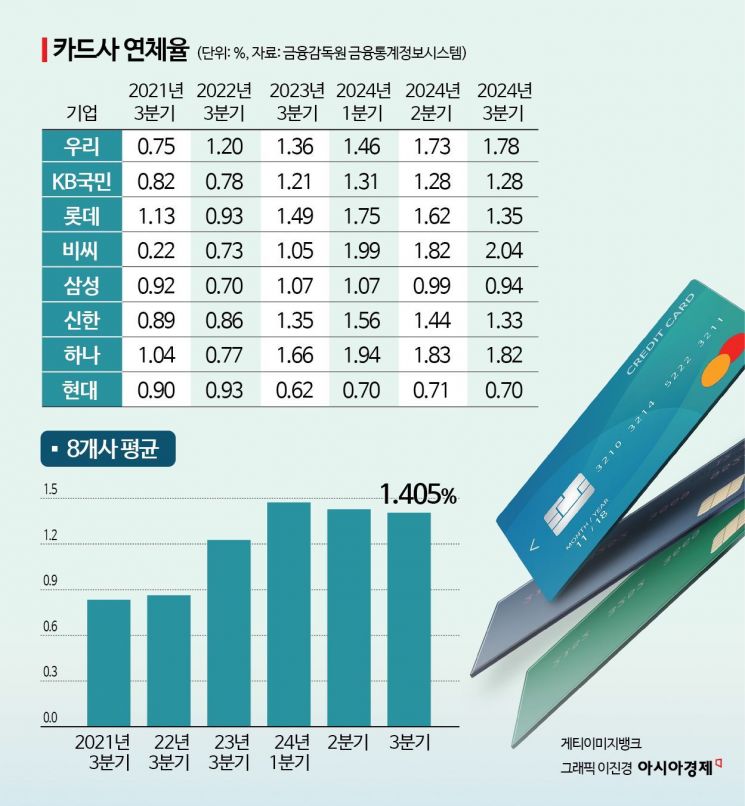
Notably, there was a significant polarization in delinquency rates among companies over the 13 quarters. Although the business environment deteriorated across the board, some credit card companies maintained delinquency rates in the 0% range, while others saw an eightfold increase over three years.
Hyundai Card maintained a delinquency rate in the 0% range for three years, with a gap of only 0.33 percentage points between the lowest and highest points (0.62% to 0.95%). Hyundai Card is known to be dedicating company-wide efforts to reducing credit loan receivables. Since the early 2000s, it has steadily strengthened its risk management organization and is reported to have the highest management level in the industry. It is also said that after Hyundai Card formed a joint venture (JV) with General Electric (GE) Capital in 2005 and acquired know-how in managing borrower receivable delinquency rates, it has maintained industry-leading credit quality management capabilities.
A Hyundai Card official said, "Our company has long maintained one of the lowest delinquency rates in the industry and has been thorough in risk management. In particular, we continue to manage key soundness indicators by expanding related organizations and reinforcing personnel."
On the other hand, BC Card’s delinquency rate rose more than eightfold from 0.22% in the third quarter of 2021 to 2.04% in the third quarter of last year. BC Card officially launched its card business in 2021 with the release of the 'K-Bank Simple Card.' Due to its relatively short business history, it experienced greater fluctuations in delinquency rates caused by high interest rates and economic recession compared to other credit card companies. It also struggled with delinquency rate management due to relatively poor performance in attracting high-quality customers. A BC Card official said, "We are conducting stricter screening for new loans such as credit loans. However, there was a temporary increase in delinquency rates during the loan receivables rebalancing process, and we will continue ongoing improvement activities to manage delinquency rates."
© The Asia Business Daily(www.asiae.co.kr). All rights reserved.


















