Obstacle to OpenAI's For-Profit Transition
Musk Filed First Lawsuit in February Last Year
Some Claims May Go to Trial
Billionaire vs billionaire battle.
This is the reaction of the U.S. legal community to the lawsuit between Elon Musk, CEO of Tesla, and OpenAI, a leader in the generative artificial intelligence (AI) industry. As the lawsuit filed by Musk to block OpenAI's transition to a for-profit corporation shows signs of moving to trial, the possibility of a prolonged dispute between the heads of major U.S. big tech companies has increased. There are also speculations that OpenAI's transition to a for-profit corporation could become uncertain as the 'anti-OpenAI' coalition opposing the move is gaining strength.
On the 4th (local time), according to Bloomberg and Reuters, U.S. District Judge Yvonne Gonzalez Rogers of the Oakland Federal Court in California expressed skepticism toward Musk's request for a preliminary injunction to halt OpenAI's for-profit transition, filed last December. She told Musk's lawyers, "It is rare to issue a preliminary injunction in a dispute that could take months."
Judge Rogers called Musk's claim of facing 'irreparable harm' excessive in a 'billionaire versus billionaire' lawsuit and said, "I am not inclined to freeze OpenAI's plans for an extended period in a rapidly growing industry."
She also hinted at the possibility that Musk's lawsuit could escalate into a full trial. Although she has not yet issued an official order, she stated, "Some issues in this case will go to trial, and Musk will have to testify before a jury to explain his position."
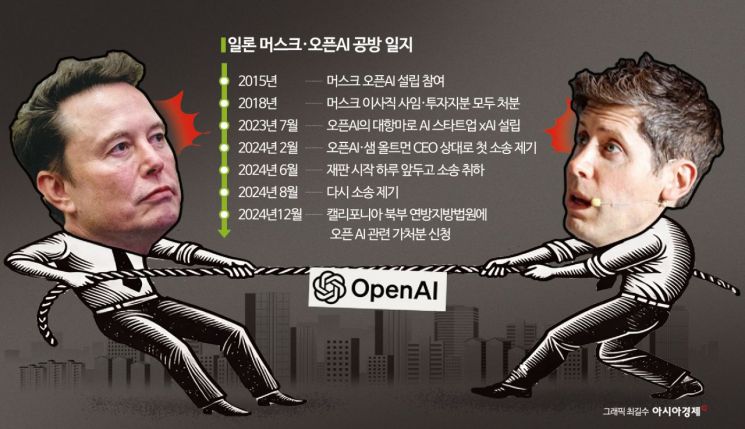
Musk's connection with OpenAI dates back to 2015. He co-founded OpenAI with CEO Sam Altman and others in 2015 but resigned from the board in 2018, divesting all his shares and leaving the company. In 2023, he founded xAI, an AI startup positioned as a rival to OpenAI.
The tension between the two parties intensified starting February last year. Musk filed his first lawsuit against OpenAI and CEO Altman, criticizing that "OpenAI's founding purpose was AI development for humanity, but now it focuses on profit generation." However, he withdrew the original lawsuit without explanation a day before the trial was set to begin in June. He then resumed the lawsuit in August.
In November last year, Musk submitted an amended complaint to the Northern District of California federal court, adding Microsoft (MS) as a defendant alongside OpenAI and CEO Altman. He alleged that OpenAI and MS violated antitrust laws through collusion. He claimed that in the $6.6 billion funding round led by OpenAI and MS, they imposed conditions preventing investors from investing in competitors, including Musk's xAI, constituting collusive behavior.
Musk's offensive against OpenAI continued until the end of last year. Less than a month after submitting the amended complaint, on December 3rd, Musk filed a preliminary injunction request with the Northern District of California court to halt OpenAI's transition to a for-profit corporation.
OpenAI countered Musk's claims as baseless 'harassment.' In response to the controversy over the for-profit transition, OpenAI has been working hard to quell opposition by releasing numerous emails and messages proving that it has supported a traditional corporate structure rather than a startup model from the beginning.
OpenAI maintains the position that "massive funding is necessary for AI development, and transitioning to a for-profit corporation is essential." To secure a leading position in the AI market against big tech companies armed with huge capital, more development funding is urgently needed. However, OpenAI argues that its current corporate structure limits its ability to attract investment.
Contrary to OpenAI's aspirations for a for-profit corporation, the view within the U.S. is not favorable. Meta founder and CEO Mark Zuckerberg sent a letter to Rob Bonta, California Attorney General, urging him to block OpenAI's for-profit transition. Jeffrey Hinton, a University of Toronto professor known as the 'godfather of AI,' also expressed opposition to OpenAI's for-profit transition. Hinton described CEO Altman as "much more concerned with profit than safety. It's unfortunate." The issue of OpenAI's for-profit transition has thus expanded into a debate over AI ethics.
Considering this atmosphere, there are also speculations that OpenAI's for-profit transition may become uncertain. It is rare for a nonprofit organization to convert into a for-profit corporation. Rose Chan Lui, director of the Law Center at the University of California, Los Angeles, said, "Historically, cases of transitioning from nonprofit to for-profit have been limited to medical institutions such as hospitals."
© The Asia Business Daily(www.asiae.co.kr). All rights reserved.

















