Expansion of Domestic and External Uncertainties and Exchange Rate Instability Lead to Rate Freeze
Consensus on Persistent Economic Sluggishness and Low Growth Risks... Higher Possibility of a Cut in February
When deciding to keep the base interest rate at 3.00% last month, the members of the Bank of Korea's Monetary Policy Committee (MPC) focused most on the "expansion of domestic and external uncertainties" and "instability in the won-dollar exchange rate." While the members agreed that not only foreign exchange risks but also downside risks to economic growth had increased, they also emphasized the need to "pause and catch their breath" by confirming the effects of the two interest rate cuts made in October and November last year, considering policy variables in major countries such as the United States and the development of the domestic political situation.
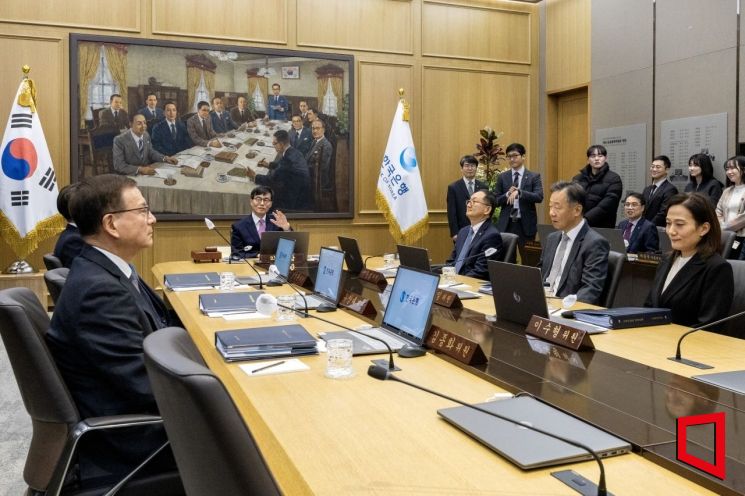 Bank of Korea Governor Lee Chang-yong is presiding over the Monetary Policy Committee at the Bank of Korea in Jung-gu, Seoul on the morning of the 16th. 2025.01.16.
According to the minutes of this year's first MPC monetary policy meeting (held on January 16), released by the Bank of Korea on the 4th, five out of six members, excluding Governor Lee Chang-yong, supported maintaining the rate and emphasized the need to verify the domestic and external uncertainties.
External factors requiring confirmation included the tariff policies of the new Trump administration in the U.S. and the interest rate differential between Korea and the U.S. One member said, "At this point, with a globally strong dollar combined with domestic political instability, further interest rate cuts could increase volatility in the foreign exchange market," adding, "Given the overlapping uncertainties domestically and internationally, it is advisable to keep the interest rate at the current level for now, review the effects of the last two rate cuts, and then consider additional cuts after observing the policy direction of the new U.S. administration, the Federal Reserve's rate decisions, and the domestic and international political and economic situations."
Another member also pointed out that "uncertainties related to major countries' policies and domestic politics have significantly increased." He noted, "In the international financial market, as the U.S. Fed hinted at adjusting the pace of rate cuts, risk appetite weakened and the U.S. dollar showed a sharp appreciation, and the volatility of major price variables in the domestic financial and foreign exchange markets has also expanded," adding, "we must continue to pay attention to the negative impact of the recently sharply rising won-dollar exchange rate on financial stability."
Domestically, it was seen as necessary to confirm the developments of the martial law incident at the end of last year and the subsequent impeachment political situation. Another member said, "Based on the two previous impeachment experiences, political uncertainty was resolved within 3 to 6 months, and the economic impact was limited," but added, "This time, the economic sentiment has dropped more sharply than before, and the domestic and external environment, including the rising exchange rate, is severe, so the economic impact is likely to be greater than in the past." Inflation is expected to remain generally at the target level, but attention should be paid to the increased upside risk due to the rising exchange rate.
Another member emphasized that the domestic and external economic conditions are "a situation where uncertainty is adding to uncertainty." He said, "Global uncertainty is a common risk factor worldwide, although the degree varies by country, but the domestic economy has experienced increased volatility in price variables such as the exchange rate due to political conflicts, raising concerns about external credibility and capital outflows," adding, "The expected scope of the U.S. Fed's rate cuts, which greatly influence the base interest rate decision, has narrowed, and there is a wide divergence in forecasts by major domestic and international institutions regarding the future path of U.S. policy rates, making it difficult to hastily decide the direction of the base interest rate."
Another member who also supported maintaining the rate said, "It is still difficult to accurately assess the impact of the domestic political situation on the real economy, and there is very high uncertainty regarding the timing and whether supplementary budgets will be prepared, making it hard to gauge policy effects."At the monetary policy meeting that day, member Shin Sung-hwan submitted a minority opinion calling for a 0.25 percentage point cut. Member Shin emphasized the increased downside risks to domestic demand and economic growth. He said, "I believe the growth rate in the fourth quarter of last year is likely to have been lower than initially forecast due to weak private consumption and construction activity," adding, "This year’s growth rate is also likely to underperform initial forecasts unless exports, centered on semiconductors, show unexpected strength or expansionary fiscal policies are implemented." Meanwhile, he expected inflation to continue a stable trend consistent with forecast paths for both consumer and core inflation rates, as the upward pressure from the recent rapid rise in the exchange rate and the downward pressure from weak domestic demand offset each other.
However, the members unanimously agreed that considering the sluggish growth and economic conditions, it is time to lower interest rates. Regarding the interest rate outlook three months ahead (forward guidance), all six members except Governor Lee expressed the opinion that the possibility of a rate cut should be kept open.
© The Asia Business Daily(www.asiae.co.kr). All rights reserved.

















