Bitcoin Swings by Nearly $9,000 in Two Days
Inflation Concerns Rise Amid Trump’s Tariff War
Bill Gates: "Cryptocurrencies Are Useless"
Cryptocurrency prices, including Bitcoin, have been showing high volatility, fluctuating in response to U.S. President Donald Trump's 'tariff show.'
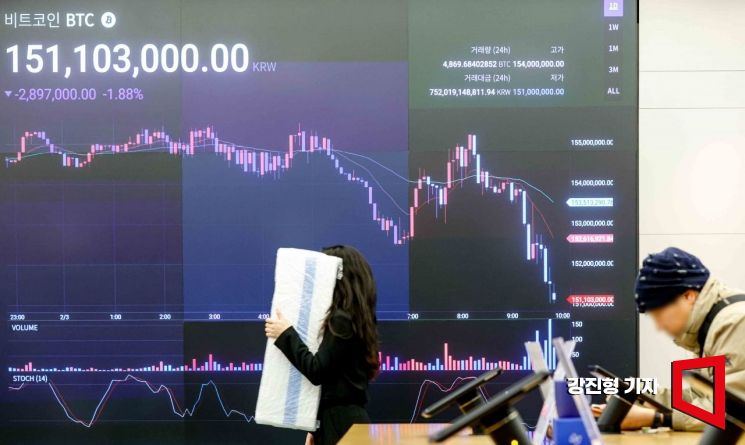 On the 3rd, as concerns over global trade disputes spread due to the US-initiated trade war, the price of Bitcoin, the leading cryptocurrency, plummeted below $100,000. A customer visiting the Upbit Customer Center in Gangnam-gu, Seoul, is waiting to receive consultation. Photo by Kang Jin-hyung
According to cryptocurrency market tracking site CoinMarketCap as of 10:30 a.m. on the 7th, Bitcoin recorded $96,809, down 0.21% from the previous day. The price, which was about $100,000 on the 2nd, plunged to $91,243 on the 3rd, then rebounded on the 4th to regain the $100,000 level. However, it fell below $100,000 again on the 5th. The gap between Bitcoin's high ($102,120) and low ($92,791) over the two days of the 3rd and 4th was $9,329.
The timing of tariff enforcement changes caused cryptocurrency prices to fluctuate. When President Trump announced on the 1st (local time) via executive order that additional tariffs of 25% would be imposed on Canada and Mexico and 10% on China, cryptocurrency prices began to plummet. He explained, "There will be pain, but it is worth paying," showing determination to proceed. However, a day before the scheduled tariff enforcement date (the 4th), President Trump suddenly decided to postpone the 25% tariffs on Canada and Mexico by one month, causing the falling cryptocurrency prices to surge. The price increase did not last long. When President Trump showed no change in stance regarding the tariffs on China, prices resumed their downward trend.
Although President Trump is creating a pro-cryptocurrency market by pledging to adopt Bitcoin as a strategic reserve asset in his presidential campaign and issuing the meme coin 'Official Trump,' the tariff war initiated by the U.S. is affecting cryptocurrency volatility due to inflation. When tariffs are imposed on consumer goods produced overseas, U.S. prices rise, and the timing of interest rate cuts is inevitably delayed to control inflation.
About 30% of imported clothing in the U.S. is made in China, so additional tariffs will increase prices. Additionally, approximately 50% of vegetables and 40% of fruits imported into the U.S. come from Mexico. Cryptocurrency-focused media CoinDesk emphasized, "The tariff war causes economic turmoil and promotes inflation," adding that "(tariff risks) could make it difficult for the Federal Reserve (Fed) to lower interest rates."
Negative outlooks on cryptocurrencies continue to emerge. Microsoft (MS) founder Bill Gates said in an interview with foreign media ahead of the release of his autobiography 'Source Code: My Beginnings' on the 2nd, "Cryptocurrencies are completely useless," and "People with high IQs are deceiving themselves." Gates' remarks were interpreted as a sharp critique aimed at Tesla CEO Elon Musk, who has shown a positive response to cryptocurrencies.
Nobel laureate in economics Eugene Fama, a professor at the University of Chicago, also holds a negative view on cryptocurrencies. In a podcast appearance, Professor Fama said, "Cryptocurrencies violate all the rules as a medium of exchange," and "Cryptocurrencies have no stable real value and are highly volatile." When podcast host economist Luigi Zingales asked about the "probability that Bitcoin's value will be zero within 10 years," Professor Fama replied, "It is close to 1 (100%)."
© The Asia Business Daily(www.asiae.co.kr). All rights reserved.

















