Foreign Tourists' Spending Reaches 9.3 Trillion Won, Up 33.8% from Previous Year
Domestic Tourism Expenditure by Koreans Declines

Last year, the amount spent by foreign tourists visiting Korea increased by more than 30% compared to the previous year. However, despite the rise in the number of foreign tourists entering the country and their expenditures, the number of domestic tourists traveling abroad is more than 1.5 times that of inbound foreign tourists, suggesting that the tourism balance deficit is likely to widen further.
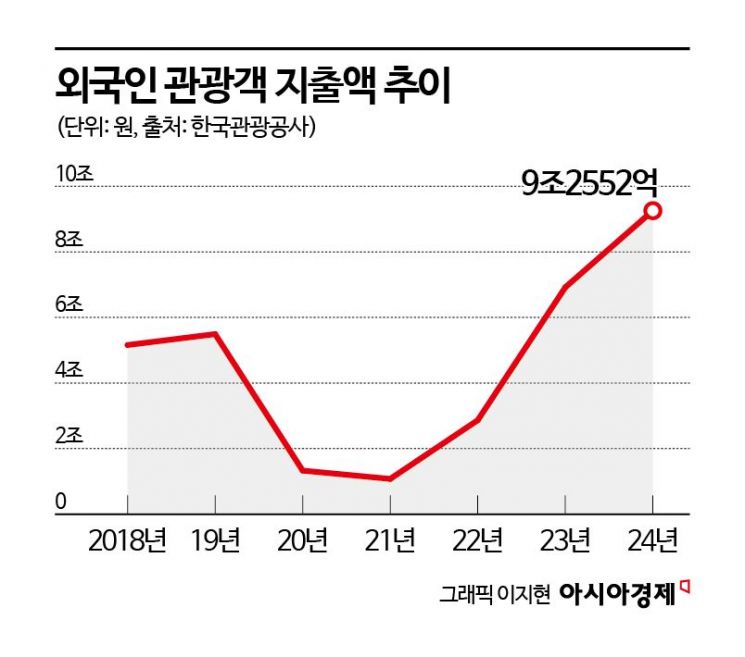
According to the Korea Tourism Organization on the 5th, the total expenditure of foreign tourists visiting Korea last year was 9.2552 trillion won. This amount increased by 33.8% (2.3374 trillion won) from the previous year (6.9178 trillion won), marking the highest annual consumption ever recorded. Foreign tourist consumption, which was around 5.4904 trillion won in 2019 when the highest number of tourists visited Korea, plummeted to 1.3277 trillion won the following year as the COVID-19 pandemic spread globally. In 2021, it even threatened to fall below the 1 trillion won mark, recording 1.0742 trillion won. After the endemic phase (periodic outbreaks of infectious diseases), it recovered to the 2 trillion won level, surpassed 6 trillion won in 2023, and approached 10 trillion won last year.
By region, Seoul accounted for 5.3878 trillion won, representing 65.9% of the total expenditure. Incheon, home to Incheon International Airport, ranked second with 778.7 billion won, or 9.5% of the total, followed by Busan (682.5 billion won) at 8.4%, Gyeonggi Province (626 billion won) at 7.7%, and Jeju Island (309.3 billion won) at 3.8%. The concentration of spending was notable, with the top five regions accounting for 95.3% of total expenditures, and Seoul alone making up two-thirds of the total.
By industry, shopping accounted for the largest share at 37.8%. Among this, spending at large shopping malls amounted to 2.4788 trillion won, representing 70.8% of shopping expenditures. Significant spending was also recorded at duty-free shops (737.4 billion won) and leisure goods shopping (179.4 billion won). Outside of shopping, accommodation costs such as hotels accounted for 33.9%, food and beverage for 19.2%, leisure services for 6.1%, and medical services for 1.8%.
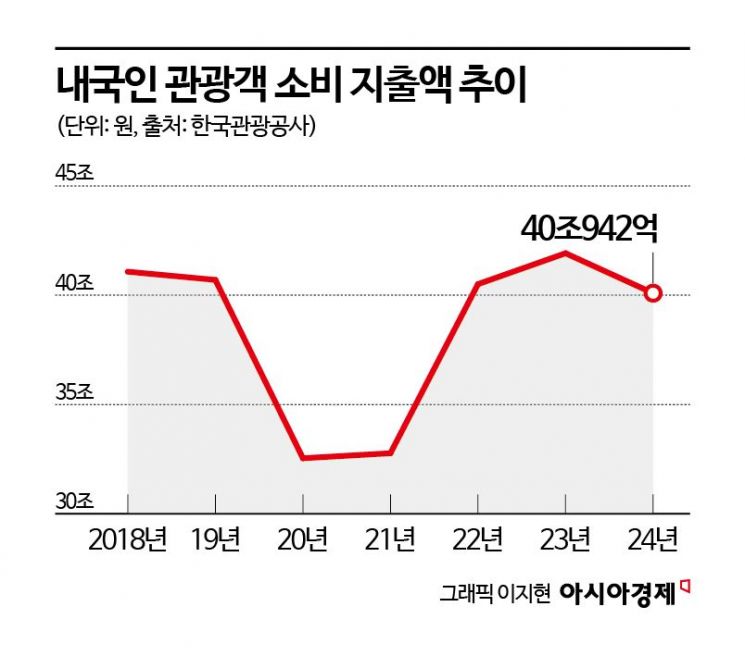
However, contrary to the record high spending by foreign tourists, domestic tourism consumption by Koreans within the country actually decreased. Last year, the amount spent by domestic tourists on tourism consumption was 40.0941 trillion won, down 4.3% (1.8263 trillion won) from the previous year (41.9204 trillion won). This figure is lower than both 2022 (40.5076 trillion won) and even the pre-pandemic year of 2019 (40.7100 trillion won).
Meanwhile, the cumulative number of inbound tourists last year was recorded at 16.37 million, a 48.4% increase from the previous year, recovering to 94% of the 2019 level before COVID-19. The number of foreign tourists visiting Korea dropped sharply from 17.5 million in 2019 to 2.52 million in 2020 due to the pandemic, and further decreased to 970,000 in 2021. It then increased to 3.2 million in 2022 and rose to 11.03 million in 2023, surpassing 10 million again. By country, last year’s inbound tourists were led by China with 4.6 million visitors, followed by Japan (3.22 million), Taiwan (1.47 million), and the United States (1.32 million).
© The Asia Business Daily(www.asiae.co.kr). All rights reserved.
![Clutching a Stolen Dior Bag, Saying "I Hate Being Poor but Real"... The Grotesque Con of a "Human Knockoff" [Slate]](https://cwcontent.asiae.co.kr/asiaresize/183/2026021902243444107_1771435474.jpg)


















