Difficulties in Gaining Local Support for Offshore Wind Power
29 Regulations and 10 Permitting Agencies
Competitors Complete Projects in 30 Months,
But Korea Takes an Average of 68 Months
Offshore Wind Power Special Act Stalled in the National Assembly
The next-generation core energy source, 'offshore wind power,' has been blocked by regulations. Rapid growth of offshore wind power is essential to achieve carbon neutrality, but there are dozens of laws to comply with and agencies to obtain permits from. Although a special law to consolidate regulations has been proposed, it has not passed the National Assembly.
According to the wind power industry on the 4th, the Electricity Commission decided on December 24 last year to withhold consideration of two requests for approval of offshore wind power projects. The projects in question are IS Dongseo's 'Tongyeong Yokjido Offshore Wind Power' and Lee Sun-shin Offshore Wind Power's 'Yeosu Lee Sun-shin 1 Offshore Wind Power.' Each has an installed capacity of 340MW and 345MW respectively, with total project costs approaching 1.5409 trillion KRW and 1.725 trillion KRW. The Electricity Commission's position is that further consent from local residents is required to proceed with the projects.
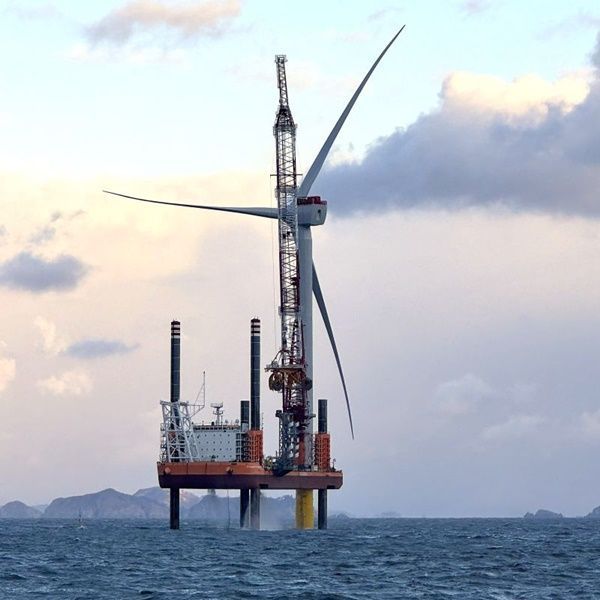
The problem is that the process of persuading local residents takes excessively long. Due to the nature of offshore wind power, construction disrupts fishing activities. Currently, 80% of planned offshore wind power construction sites overlap with areas of active fishing, leading to strong opposition from fishermen. Negotiations with residents must be handled by private companies, not by the national or local governments. A representative from an offshore wind power company said, "The project itself is very difficult to get approved, but the most challenging part is local acceptance," adding, "This stage alone consumes a lot of time."
Other regulations are also hindering progress. To operate an offshore wind power project, one must comply with a total of 29 regulations and obtain approvals from 10 agencies. The Ministry of National Defense often issues adjustment opinions if the offshore wind turbines exceed 500 feet (approximately 152.4 meters) in height, citing concerns that the turbine blades may interfere with military radar networks. The Ministry of Oceans and Fisheries requires route consultations to ensure the safety of coastal passenger vessels. Additionally, discussions with the Ministry of Environment are necessary regarding the impact on birds and marine and fishery resources.
30 months for competitors to build offshore wind power, 68 months in Korea
As a result, it takes an average of 68 months in Korea to analyze the feasibility of offshore wind power and complete construction. The industry reports that in advanced European countries, the average development period is 42 months, and in Denmark, it takes about 30 months. The Global Wind Energy Council also mentioned Korea in its 'Global Wind Report 2024' released last April, stating, "South Korea's renewable energy regulatory and permitting procedures are very complex and lack clear standards, causing confusion among operators," and pointed out that "serious delays are occurring."
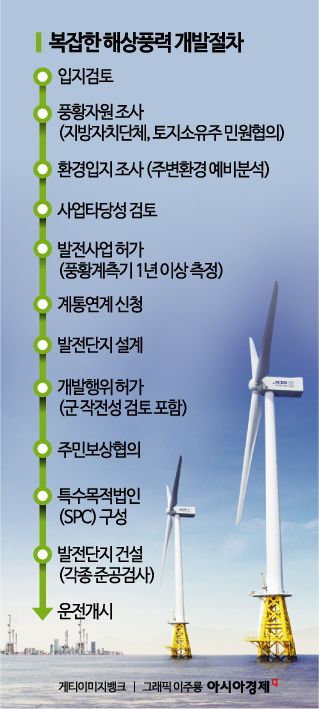
Lengthy permit periods have also caused projects to fail. A representative from the Korea Wind Energy Association said, "Although bids have passed, costs have risen so much in the meantime that construction becomes difficult, or in many cases, even when construction is nearly complete, grid connection is not provided, causing failure," lamenting, "The uncertainty is very high, so financing is even more difficult."
The government's offshore wind power targets have also turned red. According to the 10th Basic Plan for Electricity Supply and Demand announced in 2023, 12,000MW of energy from offshore wind power must be supplied by 2030. However, including the generators expected to operate in the first half of this year, domestic commercial offshore wind power complexes amount to only 320.5MW. Although offshore wind power must be rapidly expanded over five years, considering the construction time, achieving this goal is difficult.
Korea is already falling behind in the global market. The global offshore wind power market is expected to grow from 10.8 gigawatts (GW) in 2023 to 37.1GW in 2028. The share of offshore installations in wind power is also expected to increase from 9% to 20%. However, Korea's new offshore wind power capacity during this period is only about 3.1GW, in stark contrast to China, which is establishing an offshore wind power base of 72GW. The European Union (EU), led by the United Kingdom, is promoting a 42GW offshore wind power project, and Taiwan is also expecting 6.9GW of new offshore wind power.
To resolve these difficulties, the Offshore Wind Power Special Act has been proposed but remains pending in the National Assembly. The Offshore Wind Power Special Act aims for the government to pre-designate development zones and establish an integrated review body to drastically shorten the permitting process. On the morning of the same day, the government and ruling and opposition parties held a working-level meeting of the national policy consultation body and were reported to discuss the Offshore Wind Power Special Act along with the three energy-related laws.
© The Asia Business Daily(www.asiae.co.kr). All rights reserved.
![Clutching a Stolen Dior Bag, Saying "I Hate Being Poor but Real"... The Grotesque Con of a "Human Knockoff" [Slate]](https://cwcontent.asiae.co.kr/asiaresize/183/2026021902243444107_1771435474.jpg)

















