KOSPI rebounds in a single day... Gains over 1%
Fell 2.5% and broke below 2500 due to tariff shock the previous day
Relief reflected after news of tariff exemption
Correction seen as a buying opportunity for leading stocks like power equipment and shipbuilding
The KOSPI, which had fallen below the 2500 mark due to the tariff shock triggered by Trump, successfully rebounded within a day following news of a tariff exemption. Although the tariff issue will act as a factor of uncertainty in the stock market for the time being, it is expected to gradually ease and the market is anticipated to show signs of recovery.
As of 9:20 a.m. on the 4th, the KOSPI was at 2490.24, up 36.29 points (1.48%) from the previous day. The KOSDAQ rose 15.78 points (2.24%) to 719.58.
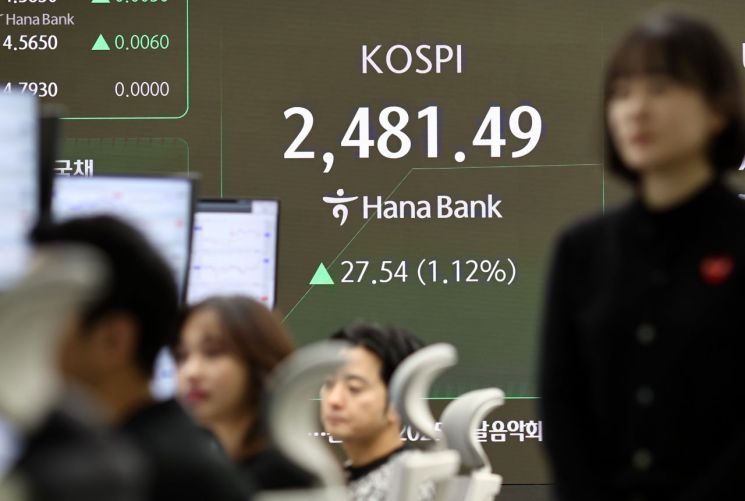
The KOSPI, which had fallen below 2500 due to the tariff shock the previous day, rebounded as relief spread following the news that tariffs on Mexico and Canada would be suspended for one month. Ji-won Kim, a researcher at KB Securities, said, "After the U.S. market closed, news came that tariffs on Canada were also postponed for 30 days following Mexico, confirming that President Donald Trump is using tariffs as a negotiation tool, which acted as a relief factor. However, there is still high uncertainty and exchange rate pressure, so a cautious approach is necessary," she analyzed.
There is a forecast that the tariff issue will gradually ease. Jun-ho Byun, a researcher at IBK Investment & Securities, said, "Trump's tariff issue partially materialized quickly at the beginning, increasing short-term uncertainty until it is confirmed whether it will spread further to major countries and to products such as semiconductors. However, considering the justification for universal tariffs, the possibility of negotiations, and the U.S. economic and inflation situation, the likelihood of tariff increases spreading to major global countries seems low, and the realized tariff increases are also likely to be postponed or withdrawn. Ultimately, it is judged as a short-term issue," he said.
There is also an opinion that the additional decline in stock prices due to the tariff issue will not be significant. Researcher Byun said, "In the case of the domestic stock market, the index has already fallen near the empirical valuation bottom, so the additional decline caused by the tariff issue is not expected to be large. As of the previous day, the KOSPI's 12-month forward price-to-book ratio (PBR) was 0.83 times, and unless universal tariffs expand to major global countries, it is judged that the possibility of significantly falling below the 2400 level around 0.8 times is low," he said.
The stock market, reflecting concerns, is expected to gradually recover. Byung-yeon Kim, a researcher at NH Investment & Securities, said, "Regarding the KOSPI, we maintain a buy recommendation for the first quarter in anticipation of a trajectory of adjustment due to Trump's aggressive policies and inflation concerns in Q1, a rise due to tax cuts and deregulation in Q2-Q3, and a readjustment with a profit-taking nature in Q4. If only the tariff scenario is considered, rather than a global trade war caused by retaliation and counter-retaliation, it seems the issue will gradually fade away through conditional tariff exemptions based on purchase conditions of U.S. products by the countries subject to tariffs. Due to the nature of stocks, the index will reflect the concerning situation to some extent in advance, then test the bottom and show a recovery trend depending on the progress," he said.
However, Trump-related risks may frequently act as factors increasing volatility in the stock market this month, so caution appears necessary. Ji-young Han, a researcher at Kiwoom Securities, said, "Trump's inconsistent actions not only regarding tariffs and tax cuts but also the Federal Reserve (Fed) suggest that financial market participants will be frequently exposed to uncertainty in February as well. Ultimately, noise surrounding Trump's tariffs, Fed policies, consumer price index (CPI), employment, and the DeepSeek incident will create stock price volatility in February," she predicted.
There is an opinion that the stock price adjustment due to tariffs will be a buying opportunity for leading stocks such as power equipment and shipbuilding. Researcher Han said, "The stock price adjustment caused by tariff noise will act as a buying opportunity at low prices for leading themes such as power equipment, shipbuilding, and nuclear power, which were the leading sectors in January," she forecasted.
© The Asia Business Daily(www.asiae.co.kr). All rights reserved.
!["The Woman Who Threw Herself into the Water Clutching a Stolen Dior Bag"...A Grotesque Success Story That Shakes the Korean Psyche [Slate]](https://cwcontent.asiae.co.kr/asiaresize/183/2026021902243444107_1771435474.jpg)
















