Lee Presides Over Semiconductor Special Act Debate
Shifts Right Despite Supporter Backlash
Concerns Within Party Over Progressive Policy Reversal
Major Labor Unions Urge Lee to Halt Discussions
Lee Jae-myung, leader of the Democratic Party of Korea, said on the 3rd regarding the Semiconductor Special Act, "When I asked why it is not possible to make an exception to 'allow concentrated work' if high-income experts in the R&D field of a specific industry agree, I had nothing to say."
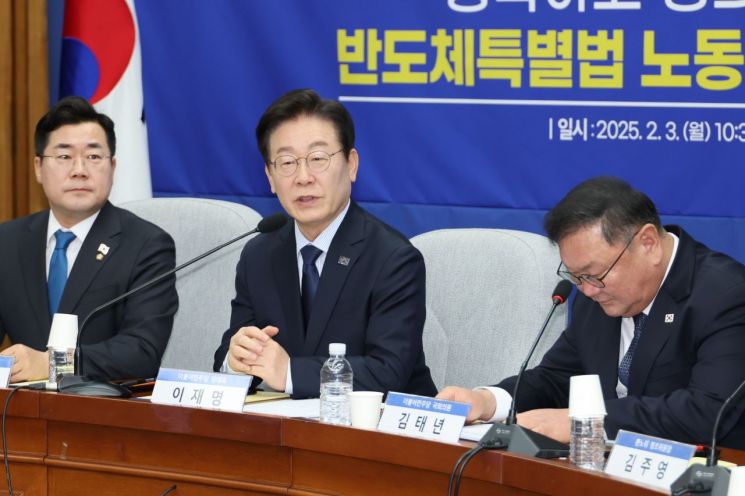
On the same day at the National Assembly, during a policy debate titled "How to Exclude the Semiconductor Special Act from the Application of the Labor Time Act?", Lee said, "There is likely no disagreement on the need for national support for the development of the semiconductor industry." Regarding the exemption of the 52-hour workweek in the semiconductor industry, he said, "We have not yet reached a conclusion," but questioned, "Is it right to prohibit by law high-income experts from working intensively during a specific period?"
The Semiconductor Special Act has not passed the National Assembly due to sharp conflicts between the industry and labor sectors over the exemption of the 52-hour weekly limit for R&D positions. The ruling party argues that considering the industry's position, an overtime exemption for the semiconductor industry is necessary, citing the need for labor time flexibility to secure technological competitiveness. On the other hand, the Democratic Party has opposed it based on the labor sector's stance that "exceptional regulations limited to specific industries can undermine the Labor Standards Act."
Regarding this, Lee personally chaired the debate, saying, "I want to hear the positions of both labor and management on the working hours issue." He directly asked about the Semiconductor Special Act, "Is it about increasing total working hours? Or is it about allowing concentrated work during a certain period without increasing total working hours?" and sought clarification on common misunderstandings.
He added, "Increasing total working hours would mean overhauling the labor law itself, so that is not the subject of the special act discussion," and stated, "The proposal is to allow flexibility to work intensively during certain periods and rest accordingly, which I consider reasonably rational."
"Difficult to Measure Performance by Time" vs "Securing Skilled Workforce First"…Opinions Divided Across Sectors
Opinions among industry, academia, and labor representatives attending the meeting were divided. Ahn Ki-hyun, Executive Director of the Semiconductor Industry Association, explained, "The semiconductor industry is technology-centered, with researchers at its core, and it is difficult to achieve results if research and development are measured by time." He emphasized the need for an exemption from the 52-hour workweek.
Kim Jae-beom, in charge of R&D at SK Hynix, also said, "We need to supply the memory demanded by customers and respond quickly if problems are found during evaluation. To do this, it is necessary to prepare to use researchers' time effectively."
The labor sector immediately opposed this. Son Woo-mok, Chairman of the Samsung Electronics National Labor Union, pointed out, "It is problematic to blame workers' working hours for corporate competitiveness." He argued, "It looks like an attempt to exploit labor. The issue is securing skilled personnel, not long working hours." The People's Solidarity for Participatory Democracy criticized, "It is self-contradictory for the Democratic Party and Lee, who have criticized Yoon Seok-youl's attempts to extend working hours, to now discuss easing working hour regulations," and raised their voices condemning Lee for showing policy moves no different from Yoon, following the abolition of the financial investment income tax and now easing working hour regulations.
The Korean Confederation of Trade Unions and the Federation of Korean Trade Unions also held an emergency press conference at the National Assembly that morning, stating, "We strongly oppose the outdated and retrogressive discussion on introducing exemptions to working hours." The two major unions demanded the repeal of the bill, saying it effectively nullifies the Labor Standards Act, which legally sets minimum labor conditions.
Differences Within the Democratic Party… "Should Discuss in the Labor Standards Act, Not Special Act"
Concerns about Lee's rightward shift were also sensed within the party. A Democratic Party lawmaker from the Environment and Labor Committee told Asia Economy in a phone interview regarding the exemption of the 52-hour weekly limit for semiconductor R&D, "According to Ministry of Labor data, even in Korea's long working hours environment, Hynix has never applied for special extended work, and its performance was good. They do not see problems in management due to working hours."
There is also a view that it is inappropriate for the party leadership to handle the exemption from the 52-hour workweek in the Semiconductor Special Act. A Democratic Party lawmaker from the Industry and Energy Committee warned, "Even if discussed, it should be under the Labor Standards Act. If working conditions start to be handled in special acts, every law might insert special provisions in special acts, which could nullify the Labor Standards Act."
Lee's direct initiation of the special act discussion despite backlash from traditional supporters is closely related to his recent rightward shift emphasizing 'post-ideology' and 'pragmatism.' He has been steadily aligning his steps to secure votes from the moderate and floating electorate ahead of the early presidential election this year. In fact, through policy debates this year, Lee has reversed the party's previous positions and decided to abolish the financial investment income tax and postpone virtual asset taxation. Some in the political circle predict that Lee may make progressive decisions on existing policy directions following this debate.
© The Asia Business Daily(www.asiae.co.kr). All rights reserved.

















