KIMM to Consolidate Small-Scale Government Projects into Block Funding for Larger Impact
KRICT to Operate Dedicated Policy and Administrative Support Organization for Collaboration Between Research Institutes and Companies
Minister Yoo Sangim Urges, "Propose Measures to Break Down Internal and External Barriers"
The Korea Institute of Machinery and Materials (KIMM) is planning to consolidate its existing small-scale government projects, which range from 100 million to 900 million KRW annually, into a block funding budget to scale up efforts aimed at securing ultra-competitive technologies in the semiconductor and display industries. The Korea Research Institute of Chemical Technology (KRICT) has decided to operate a dedicated policy and administrative support organization to facilitate organic cooperation with six government-funded research institutes, including the Korea Institute of Science and Technology (KIST), as well as LG Energy Solution, SK On, and Samsung SDI.
On the 3rd, Yoo Sang-im, Minister of Science and ICT, visited KIMM and KRICT, government-funded research institutes, to hold a 'Major Policy Issues Meeting,' where she listened to these institutes' strategies and research field opinions aimed at developing them into national hubs for securing core technologies.
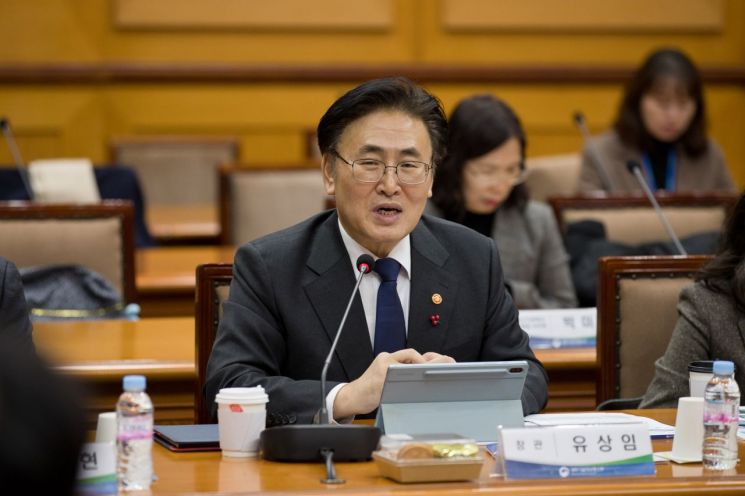 Minister Yoo Sang-im of the Ministry of Science and ICT visited the Korea Institute of Machinery and Materials in Yuseong-gu, Daejeon Metropolitan City, on the afternoon of the 3rd and held a "Key Policy Issues Meeting." Photo by the Ministry of Science and ICT
The Ministry of Science and ICT announced last June, after withholding designation of public institutions, a development direction for government-funded research institutes as 'national mission-oriented hubs for industry-academia-research collaboration' that are differentiated from universities and companies.
Since her appointment, Minister Yoo has been focusing on implementing development plans for government-funded research institutes and promoting practical measures to develop these institutes as strategic technology hubs for South Korea amid global technological hegemony competition.
In particular, projects such as 'adjusting business plans to resolve rigidity in institutional budget management' and 'expanding global TOP strategic research groups for collaborative research' are being promoted to support government-funded research institutes in leading strategic technologies as national research and development institutions and generating large-scale achievements.
KIMM announced plans to lead 'industrial site automation' through AI robots to strengthen manufacturing competitiveness. To this end, it introduced a technology development direction that autonomously responds to unpredictable field situations, a post-payment R&D project where companies propose key success factors for technology development and pay royalties after success to facilitate application and diffusion in industrial sites, and the K-Partners program, which strengthens technology industrialization by exchanging and cooperating with companies using advanced technologies possessed by KIMM.
In the nano-manufacturing processes and equipment development for the semiconductor and display industries, KIMM also presented a plan to scale up existing small government projects, ranging from 100 million to 900 million KRW annually, into block funding to secure ultra-competitive technologies.
KRICT expressed its ambition to become a central hub encompassing all leading players in South Korea's secondary battery industry across industry, academia, and research. Having been selected last year as the lead institution for the global TOP strategic research group in the secondary battery field, KRICT plans to operate a dedicated policy and administrative support organization to facilitate organic cooperation with six government-funded research institutes, including KIST, as well as LG Energy Solution, SK On, and Samsung SDI.
Additionally, KRICT aims to secure carbon-neutral competitiveness in the domestic chemical industry through innovative carbon capture and utilization (CCU) technologies based on carbon-free energy, and to establish a national response system by organically linking various government-commissioned projects through the advancement of future infectious disease response platforms, enabling rapid collection of domestic and international infectious disease data.
Minister Yoo emphasized, "Real change can only occur when various implementation measures are proposed from the field," and urged, "As national research and development institutions, please explore and propose to the government diverse implementation measures that can break down internal and external barriers such as budget and organizational flexibility."
© The Asia Business Daily(www.asiae.co.kr). All rights reserved.

















