Controversy Over Giant Taegeukgi Flagpole at Gwanghwamun Square
Sculptures Built with Stones from 22 Participating Countries
National Flags of Allied Countries to Be Displayed Aboveground and Underground
Comprehensive Renovation of Sejongno Park... Completion by 2027
The Seoul Metropolitan Government is creating a "Garden of Gratitude" at Gwanghwamun Square to symbolize the countries that participated in the Korean War. Light pillar sculptures will be made from stone sent by 22 participating countries, and an underground media wall will be installed to enable real-time communication with these countries, with approximately 60 billion KRW invested. After last year’s controversy when Mayor Oh Se-hoon announced the construction of a giant Taegeukgi flagpole, the plan was changed through public opinion collection to become a symbolic space expressing gratitude to allied countries.
On the morning of the 3rd, Mayor Oh revealed the plan for the development of Gwanghwamun Square at Seoul City Hall. Ten Korean War veterans were present to present gifts and express their gratitude to the mayor. Mayor Oh said, "Seventy-five years ago, 22 countries fought together for the Republic of Korea and made noble sacrifices. Because of their dedication, we are here today. Now it is our turn," adding, "We must remember their spirit while expressing our gratitude."
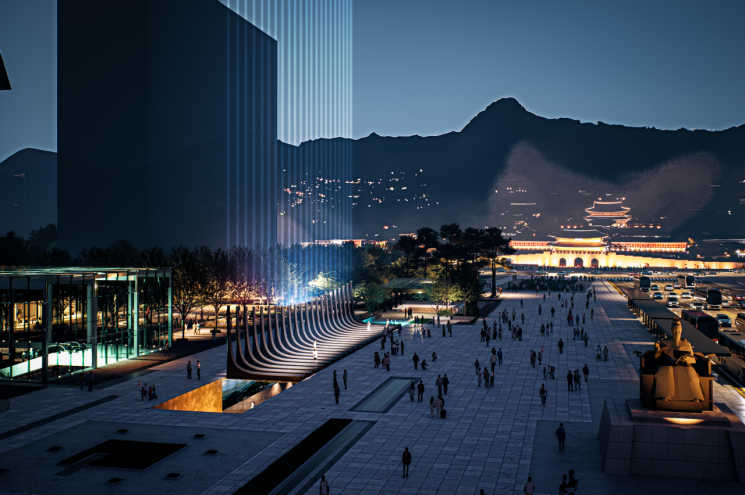 Above-ground part of the 'Garden of Gratitude' to be created at Gwanghwamun Square by the Seoul Metropolitan Government. Provided by Seoul Metropolitan Government
The aboveground and underground areas where the Garden of Gratitude will be established include Sejongno Park and the northern side of Sejong Center at Gwanghwamun Square. Mayor Oh emphasized that Gwanghwamun Square is a suitable location based on its historical symbolism. He said, "Gwanghwamun Square symbolizes the identity of the Republic of Korea and, as a tourist attraction located in the city center, it is the most appropriate place to show gratitude to the participating countries," adding, "Gwanghwamun Square is a space that can symbolically represent the values we cherish."
This location was also the site of controversy last year when Mayor Oh announced plans to install a 100-meter-high giant Taegeukgi flag at Gwanghwamun Square. Subsequently, Seoul City conducted a separate public opinion collection and shifted the theme to "Korean War UN Veterans," proceeding with an international design competition. Mayor Oh explained on the day, "The main figures of the Garden of Gratitude are the soldiers and victims from the 22 countries that participated. To achieve this, rather than emphasizing the Taegeukgi, I thought sculptures emphasizing the sacrifices and gratitude of the 22 countries would more accurately convey the meaning."
The "Garden of Gratitude" unveiled by Seoul City on this day consists of an aboveground section featuring 22 black granite stone pillars symbolizing the participating countries connected by glass bridges, and an underground section housing a space for real-time communication with the countries. A total budget of 62.8 billion KRW will be invested in the creation of the Garden of Gratitude and the maintenance of Sejongno Park. Approximately 10.8 billion KRW will be spent on the symbolic sculptures, and about 52 billion KRW on underground maintenance of Sejongno Park and related works.
Aboveground, 22 sculptures called "Light of Gratitude 22," ranging from 5.7 to 7 meters in height, will be installed to visualize gratitude toward the Korean War participating countries. In particular, stones quarried from the 22 participating countries will be brought in to create the sculptures, and on their sides, poems, literary works, and inscriptions in the native languages of the countries will be engraved to honor the sacrifices of the veterans. The 22 sculptures symbolize gratitude to the countries that participated in the Korean War, and the physical properties of the black stone represent the strong bonds with these countries. The sculptures will be arranged narrowly in a north-south direction to harmonize with the overall landscape of the square. According to Seoul City, "Light of Gratitude 22" can produce various lighting effects, allowing the use of light to express gratitude on allied countries’ commemorative days.
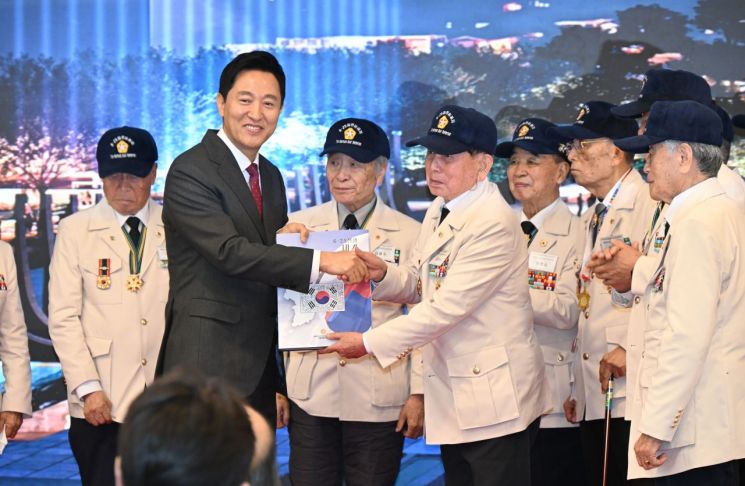 On the 3rd, Seoul Mayor Oh Se-hoon received a book (The Korean War, I Defended the Country) from a war veteran at the award ceremony for the winning design of the Sejongno Park and Symbolic Sculpture held on the first floor of the city hall. Photo by Seoul City
Regarding the procurement of stone from the 22 countries, Mayor Oh said, "When I first heard the idea, I was worried whether we could bring the stones in time for construction starting in September this year," adding, "If stones that are difficult to shape arrive, it may be technically possible to use some of them, and for countries that find it difficult to donate, we can purchase the stones ourselves."
Underground, a symbolic space enabling real-time communication with allied countries will be established. Along with a media wall where visitors can see videos and images of the 22 countries, the space will be equipped to display the Taegeukgi and the flags of allied countries. Visitors will be able to walk on a glass bridge between the aboveground sculptures to enter Sejongno Park. The glass bridge will have built-in smart glass that functions as a large media screen when viewed from below. Mayor Oh also announced plans to build a system using media technology to enable real-time communication with the 22 participating countries. If real-time communication is difficult due to time differences, recorded videos considering the time zones will be shown. The intention is to make the space not just a memorial but a living place of exchange.
Seoul City will also undertake comprehensive maintenance of Sejongno Park in conjunction with the creation of the Garden of Gratitude. On this day, an award ceremony was held for the "Sejongno Park and Symbolic Sculpture Design Competition," which includes "Light of Gratitude 22." The winning design is titled "Witmaru, Aretmadang, Memorial Space: 22." Seoul City plans to sign a design contract with the winner within this month, aiming to complete the symbolic space and sculptures within the year and finish Sejongno Park by May 2027.
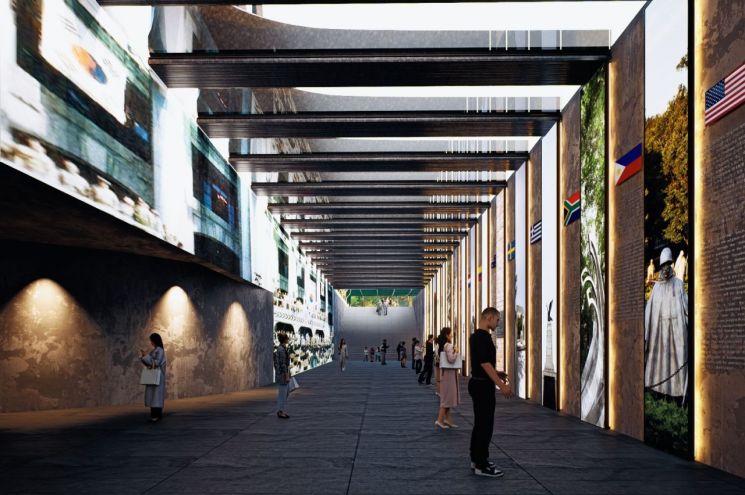 Underground section of the 'Garden of Gratitude' to be created at Gwanghwamun Square. Photo by Seoul City
Sejongno Park will have a total floor area of 8,768 square meters, with one aboveground floor and two underground floors, housing rest and dining facilities as well as multipurpose spaces. This is to overcome the limitations of the outdoor square, which, despite being located in the heart of the city, was difficult to use during extreme heat or cold. Through this, Seoul City plans to develop Sejongno Park into a new landmark of Seoul, harmonizing three pavilions, water features, and forest parks, aiming to attract 30 million visitors annually.
Meanwhile, on the 4th, Mayor Oh will invite the diplomatic corps of the 22 countries that participated in the Korean War to hold a briefing session related to the Garden of Gratitude project. Mayor Oh plans to express gratitude for the sacrifices, humanity, and international solidarity shown by the participating countries and personally introduce the meaning of the symbolic space and sculptures to the ambassadors.
© The Asia Business Daily(www.asiae.co.kr). All rights reserved.



















