Canadian, Mexican, and Chinese Currencies Weaken Against the Dollar
U.S. Inflation Rebound and Economic Downturn Expected
EU Tariffs Imminent... "Global Trade at Risk"
U.S. President Donald Trump has imposed tariffs on Canada, Mexico, and China, causing significant market tension. Concerns are growing that the tariffs could hinder economic growth, trigger a rebound in inflation, and escalate into a full-scale trade war due to the expansion of tariffs.
The Trump administration announced through an executive order that starting from the 4th (local time), an additional 25% tariff will be imposed on imports from Mexico and Canada, and a 10% tariff on imports from China. These countries immediately protested. Canada announced plans for retaliatory tariffs on U.S. imports, while Mexico indicated on the 3rd that it would reveal detailed tariff response measures. China also stated it plans to take countermeasures.
Regarding this, President Trump said on his social media platform Truth Social on the 2nd, "There may or may not be pain (due to the tariffs)," but added, "However, we will make America great again, and all of this will be worth the cost."
On the morning of the same day, the USD/CAD exchange rate briefly reached 1.4755 Canadian dollars, marking the highest level since 2003. The USD/Mexican peso exchange rate moved around 21.2116, breaking the 21-peso level for the first time since July 2022. The values of the Canadian dollar and Mexican peso sharply declined. The yuan exchange rate showed its weakest level against the dollar since September 2023.
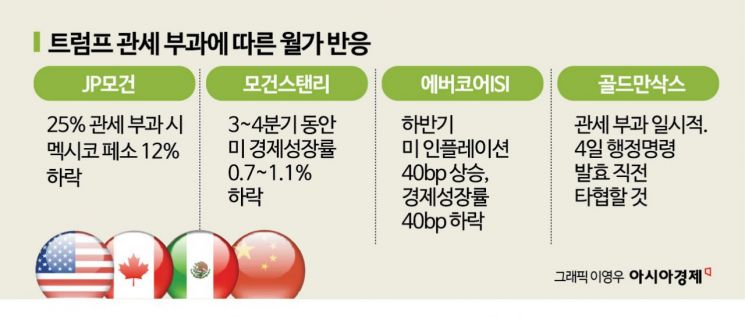
Although the White House has not yet disclosed all the details related to the tariffs, if a trade war fully breaks out with these three countries, it could damage the profits of U.S. companies and cause prices to rise again. This would delay U.S. interest rate cuts and weaken the Canadian dollar and Chinese yuan. JP Morgan estimated in a report released on the 31st of last month that if the U.S. imposes a 25% tariff on Mexico, the Mexican peso could fall by about 12%.
Yahoo Finance reported that reactions to the tariff imposition have begun to emerge on Wall Street, with economists and strategists seemingly starting to recognize the "pain" associated with the tariffs mentioned by President Trump.
Mark Malek, Chief Investment Officer at Siebert Financial, said, "The market will react to the tariffs," adding, "So far, the market has been on President Trump's side, but the situation could change. The market might challenge President Trump for the first time."
Morgan Stanley's Public Policy Research team forecasted that U.S. inflation could rise by 0.3% to 0.6% above the baseline over the next 3 to 4 months. They also projected that U.S. growth could decline by 0.7% to 1.1% below the baseline over the next 3 to 4 quarters.
Evercore ISI stated, "Foreign countries are likely to reduce U.S. exports, leading to decreased investment and employment, which could significantly impact U.S. economic growth," and predicted, "Inflation will rise by 40 basis points (1bp = 0.01 percentage point) and economic growth will fall by 40 basis points in the second half of this year."
On the same day, Klaas Knot, a European Central Bank (ECB) policymaker and President of the Dutch Central Bank, said in an interview with the Dutch TV program Buitenhof that the imposition of tariffs could stimulate U.S. inflation and lead to interest rate hikes.
However, Goldman Sachs forecasted that considering economic damage and factors such as curbing fentanyl inflows, the tariffs might be temporary. They also noted the possibility of a compromise between President Trump and these countries just before the executive order takes effect on the 4th.
The market is closely watching the possibility of tariffs expanding to other countries such as those in Europe. President Trump said regarding tariffs on the European Union (EU), "I won't say there is a timetable, but they will be imposed soon." Economist Marcell Aleksandrovich Soltmas of Economics said, "It is only a matter of time before the EU becomes a target," adding, "Meanwhile, Canada's imposition of tariffs on U.S. goods signals what is to come and highlights the risks to global trade."
© The Asia Business Daily(www.asiae.co.kr). All rights reserved.

















