Controversy Over Giant Taegeukgi Flagpole in Gwanghwamun Square
Sculptures Built Using Stone Materials from 22 Participating Countries
National Flags of Allied Countries Displayed Above and Below Ground
Comprehensive Maintenance of Sejongno Park... Completion Targeted for 2027
The Seoul Metropolitan Government is creating a 'Garden of Gratitude' in Gwanghwamun Square to symbolize the countries that participated in the Korean War. The plan is to express gratitude by constructing a media wall and sculptures using stone materials sent from 22 participating countries. After last year’s controversy when Mayor Oh Se-hoon announced the construction of a giant Taegeukgi flagpole, the project was transformed into a symbolic space of gratitude for allied countries through a public opinion gathering process.
On the morning of the 3rd, Mayor Oh unveiled the plan for Gwanghwamun Square at Seoul City Hall, stating, "As the center of our country for 600 years and a place that embodies the identity of the Republic of Korea and its people, we will create a 'Garden of Gratitude' here to inspire visitors from around the world."
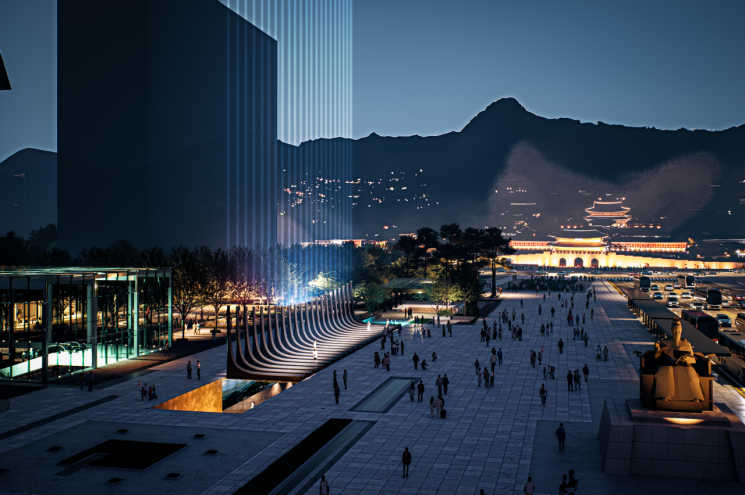 Above-ground part of the 'Garden of Gratitude' to be created at Gwanghwamun Square by the Seoul Metropolitan Government. Provided by Seoul City
This site was where Mayor Oh announced last year his plan to install a 100-meter-high giant Taegeukgi flag in Gwanghwamun Square, which sparked controversy. Subsequently, Seoul City conducted a separate public opinion gathering and shifted the theme to 'Korean War UN Veterans,' proceeding with an international design competition.
The 'Garden of Gratitude' revealed by Seoul City consists of an above-ground section featuring 22 black granite stone pillars symbolizing the participating countries connected by glass bridges, and an underground section housing a space for real-time communication with the allied countries.
Above ground, 22 sculptures called 'Light of Gratitude 22,' ranging from 5.7 to 7 meters in height, will be installed to visualize gratitude toward the Korean War participating countries. Notably, stones quarried from the 22 participating countries will be used to create the sculptures, with poems, literary works, and inscriptions in the native languages of those countries engraved on the sides to honor the sacrifices of the veterans. The 22 sculptures express gratitude to the countries involved in the Korean War, while the physical properties of the black stone symbolize a strong bond with these nations. The sculptures will be arranged narrowly along the north-south axis to harmonize with the overall landscape of the square. According to Seoul City, 'Light of Gratitude 22' can produce various lighting effects, allowing the use of light to express appreciation on allied countries’ commemorative days.
Underground, a symbolic space enabling real-time communication with allied countries will be established. This includes a media wall displaying videos and images of the 22 countries, as well as the capability to broadcast the Taegeukgi and allied countries’ flags. Visitors can walk across a glass bridge between the above-ground sculptures to enter Sejongno Park. The glass bridge is equipped with smart glass that functions as a large media screen when viewed from below. Mayor Oh also announced plans to build a system using media technology to enable real-time communication with the 22 participating countries. He emphasized that the space of gratitude will not be a mere memorial but a living venue for exchange.
Seoul City will also undertake comprehensive maintenance of Sejongno Park in conjunction with the creation of the 'Garden of Gratitude.' On the same day, an award ceremony was held for the 'Sejongno Park and Symbolic Sculpture Design Competition,' which includes the 'Light of Gratitude 22.' The winning design, titled 'Upper Terrace, Lower Yard, Memorial Space: 22,' will lead to a design contract with the winner within this month. The symbolic space and sculptures are planned to be completed within the year, with Sejongno Park targeted for completion by May 2027.
Sejongno Park will cover a total floor area of 8,768 square meters, spanning one floor above ground and two floors underground, featuring rest areas, food and beverage facilities, and multipurpose spaces. This aims to overcome the limitations of the outdoor square, which has been difficult to use during extreme heat or cold despite its central urban location. Through this, Seoul plans to develop Sejongno Park into a new landmark of the city, combining three pavilions, water features, and forest parks, attracting 30 million visitors annually.
On the 4th, Mayor Oh will invite the diplomatic corps of the 22 countries that participated in the Korean War to hold a briefing on the 'Garden of Gratitude' project. He plans to personally express gratitude for the sacrifices, humanity, and international solidarity demonstrated by the participating countries and introduce the meaning of the symbolic space and sculptures to the ambassadors.
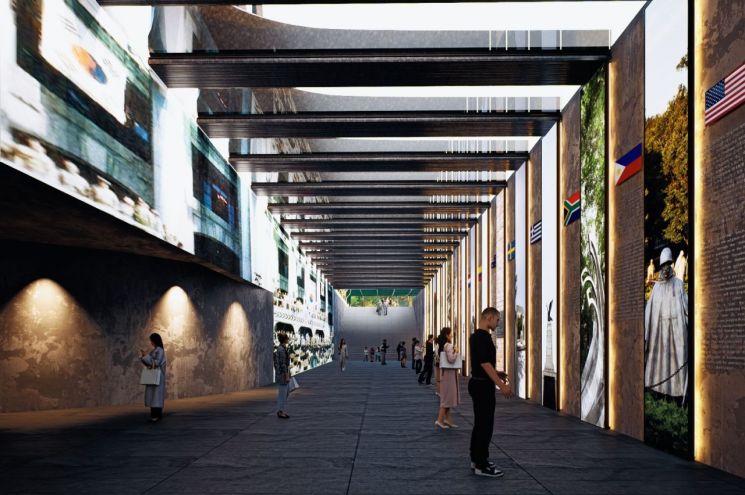 Underground section of the 'Garden of Gratitude' to be created at Gwanghwamun Square. Photo by Seoul City
© The Asia Business Daily(www.asiae.co.kr). All rights reserved.


















