Expected Wide Applications in Space Propulsion and Industrial Ion Beam Devices
Jointly Developed Hall Thruster with CosmoV to Be Mounted on CubeSat During Nuri’s Fourth Launch in November
The research team led by Professor Wonho Choi of the Department of Nuclear and Quantum Engineering at KAIST has developed an artificial intelligence technique capable of predicting the thrust performance of the "Hall electric thruster" (Hall thruster), an engine used in satellites and space probes, with high accuracy.
On February 3, KAIST announced that the research paper titled "Predicting Performance of Hall Effect Ion Source Using Machine Learning," with Jaehong Park, a PhD candidate in the Department of Nuclear and Quantum Engineering (Interdisciplinary Program in Space Exploration Engineering) at KAIST, as the first author, has been selected as the cover article for the internationally renowned journal "Advanced Intelligent Systems."
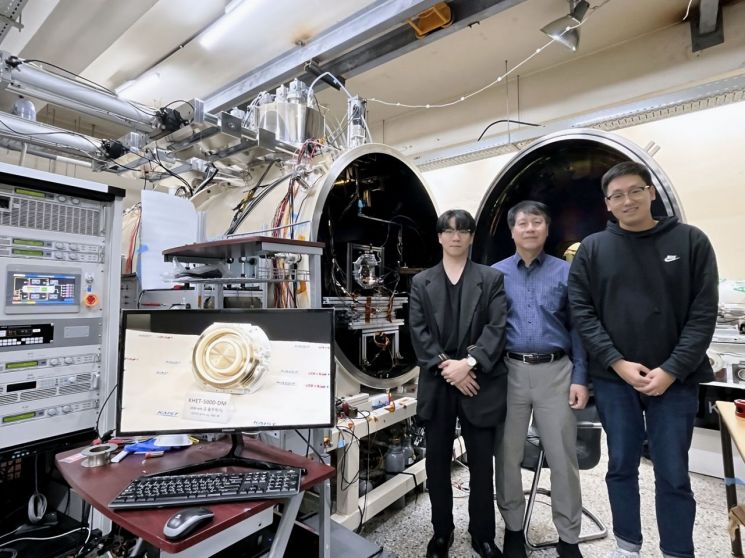 From the left, Youngho Kim, PhD candidate in Nuclear and Quantum Engineering, Wonho Choi, Professor in Nuclear Engineering, Jaehong Park, PhD candidate in Nuclear and Quantum Engineering. Provided by KAIST
The Hall thruster is a high-efficiency propulsion device that uses plasma and is utilized in various challenging space missions, such as SpaceX's Starlink satellite constellation and NASA's Psyche asteroid probe. It is considered one of the core technologies in space exploration.
The Hall thruster boasts high fuel efficiency, enabling significant acceleration of satellites or spacecraft with minimal propellant (fuel), and can generate substantial thrust relative to its power consumption. Leveraging these advantages, it is widely used in a variety of missions in the space environment where propellant conservation is crucial, including maintaining formation flight of satellite constellations, conducting orbital maneuvers to reduce space debris, and providing propulsion for deep space exploration such as comet or Mars missions.
With the advent of the New Space era and the expansion of the space industry, space missions are becoming more diverse, and demand for Hall thrusters tailored to these missions is increasing. Therefore, to rapidly develop high-efficiency Hall thrusters optimized for each unique mission, it is essential to have a method that can accurately predict thruster performance from the design stage.
However, existing methods have limitations in that they either fail to precisely handle the complex plasma phenomena occurring within the Hall thruster or are restricted to specific conditions, resulting in low accuracy in performance prediction.
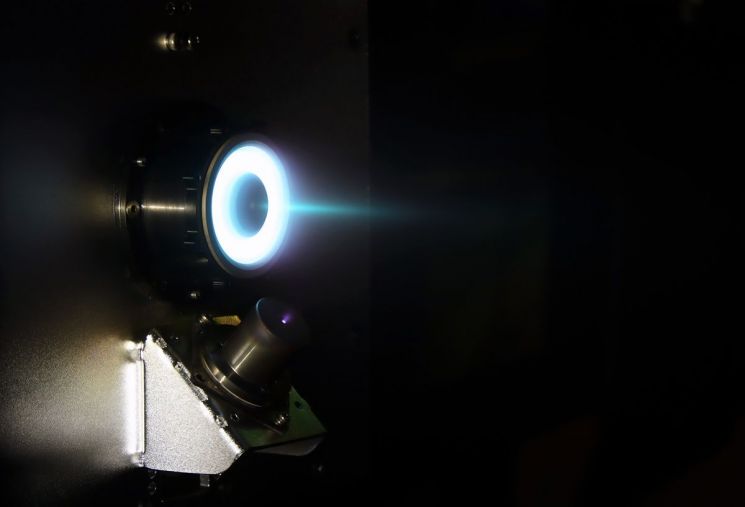
The research team has developed an AI-based high-accuracy thruster performance prediction method that dramatically reduces the time and cost required for the iterative processes of design, manufacturing, and testing of Hall thrusters.
Since 2003, Professor Wonho Choi's team has been leading research and development in electric propulsion in Korea. Utilizing their self-developed electric propulsion computational analysis tool, they generated 18,000 Hall thruster training datasets and applied an artificial neural network ensemble structure to predict thrust performance.
The computational analysis tool, developed to secure high-quality training data, models plasma physical phenomena and thrust performance. The accuracy of this tool was validated by comparing it with over 100 experimental datasets obtained from 10 Hall thrusters, which were developed for the first time in Korea by the research team, showing an average error of less than 10%.
Professor Wonho Choi stated, "This AI technique can be applied not only to Hall thrusters but also to the research and development of ion beam sources used in various industries such as semiconductors, surface treatment, and coating." He added, "Together with CosmoV Co., Ltd., the Hall thruster for CubeSat developed using this AI technique will be mounted on the CubeSat K-HERO during the fourth launch of Nuri, scheduled for November this year, where its performance will be verified in space."
© The Asia Business Daily(www.asiae.co.kr). All rights reserved.


















