1. 1.14 Million Pieces of Satellite Debris in Earth's Orbit
2. Research Teams from 11 Universities and Institutions Worldwide Publish Paper
3. "We Must Prevent Space from Becoming Filled with Debris"
Scientists have united in calling for solutions to the increasing satellite debris in Earth's orbit to prevent potential traffic accidents in the future. On the 2nd, Kyunghyang Shinmun reported, "Researchers from 11 universities and institutions worldwide, including the U.S. National Aeronautics and Space Administration (NASA), the University of Texas at Austin, and the University of Plymouth in the UK, published a paper in the international journal One Earth urging the United Nations to intervene to prevent Earth's orbit from becoming overcrowded with space debris."
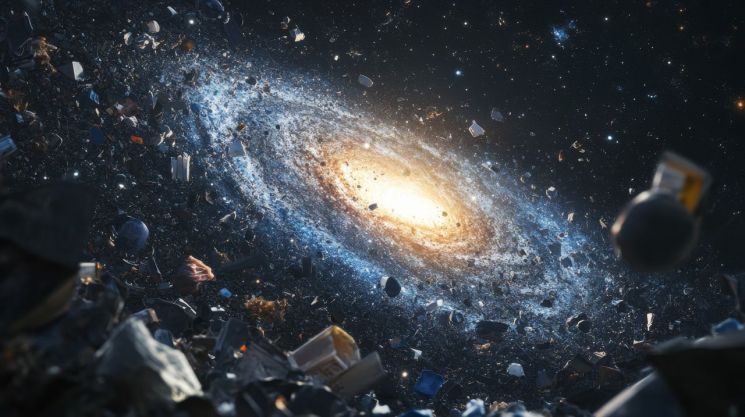
Space debris refers to defunct satellites, remnants of rockets whose functions have ended, and fragments created by collisions between satellites. According to the paper, there are approximately 40,000 pieces larger than 10 cm in diameter and about 1.1 million pieces between 1 and 10 cm. These debris travel at speeds eight times that of a bullet, and if they collide with satellites in Earth's orbit, they can cause severe damage or completely destroy them.
The increase in space debris is largely influenced by the 'Starlink' project of SpaceX, a U.S. private space company led by Elon Musk, CEO of Tesla. Starlink is a massive communication network that deploys numerous small satellites in Earth's orbit to serve as base stations, enabling internet access from anywhere on the ground. Currently, about 7,000 Starlink satellites orbit Earth, accounting for 60% of the total satellites (approximately 12,000). According to SpaceX, up to 42,000 Starlink satellites are planned to be launched.
Although Starlink satellites have collision avoidance functions when other space objects approach, concerns have been raised about whether space traffic accidents can be completely prevented due to the sheer number of satellites. Frequent collisions between satellites in Earth's orbit could damage satellite-based services such as ground observation and communication.
In response, the researchers urged the United Nations to address the issue. The paper emphasized, "The UN should add space debris management to the Sustainable Development Goals (SDGs), which would help prevent crises that may arise on our planet."
In 2015, the United Nations adopted the Sustainable Development Goals (SDGs) to end global poverty, protect the Earth, and ensure peace and prosperity for all by 2030. These include 17 core goals that humans must practice to live sustainably on Earth, such as 'poverty eradication' and 'zero hunger.' The researchers proposed managing debris in Earth's orbit by adapting Goal 14, 'Life Below Water,' which focuses on protecting marine ecosystems.
© The Asia Business Daily(www.asiae.co.kr). All rights reserved.

















