A research team at KAIST has developed a Hall effect thruster (hereinafter Hall thruster) for CubeSats using artificial intelligence techniques, which will be installed on the K-HERO CubeSat of the Nuri rocket (4th launch) scheduled for launch this November to verify its performance in space.
The Hall thruster is a high-efficiency propulsion device used in advanced space missions such as SpaceX's Starlink constellation satellites and NASA's Psyche asteroid probe, and is one of the core space technologies.
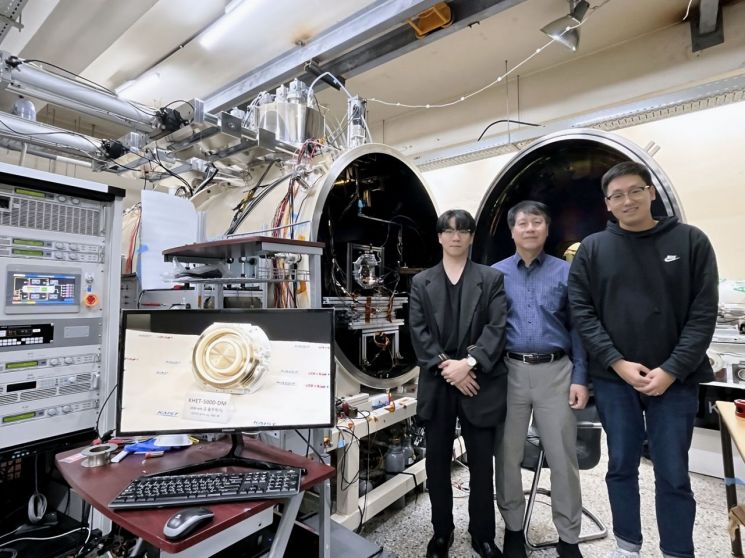 (From left) Youngho Kim, Ph.D. candidate, Department of Nuclear and Quantum Engineering; Wonho Choi, Professor, Department of Nuclear Engineering; Jaehong Park, Ph.D. candidate, Department of Nuclear and Quantum Engineering. Provided by KAIST
On the 3rd, KAIST announced that Professor Choi Won-ho's research team from the Department of Nuclear and Quantum Engineering has developed an artificial intelligence technique that can predict the thrust performance of Hall thrusters, which are engines for satellites or space probes, with high accuracy.
The Hall thruster can accelerate satellites or spacecraft with a small amount of propellant (fuel) and generate large thrust relative to power consumption.
Due to these advantages, Hall thrusters are widely used in space environments for missions such as maintaining formation flight of satellite constellations, orbital maneuvering to reduce space debris, and providing propulsion for deep space exploration like comet or Mars exploration.
Above all, with the recent expansion of the space industry and diversification of space missions, the demand for Hall thrusters optimized for each mission is increasing. However, to rapidly develop high-efficiency Hall thrusters optimized for each unique mission, it is essential to have techniques that accurately predict thruster performance from the design stage.
However, existing methods have limitations in precisely handling the complex plasma phenomena occurring inside Hall thrusters or are limited to specific conditions, resulting in low accuracy in performance prediction.
Accordingly, the research team developed an AI-based highly accurate thruster performance prediction technique that drastically reduces the time and cost involved in the repetitive processes of designing, manufacturing, and testing Hall thrusters.
Previously, the research team began research on electric propulsion development in Korea for the first time in 2003 and has led related R&D. In this process, the team applied an artificial neural network ensemble structure to predict thrust performance based on 18,000 Hall thruster training data generated by their self-developed electric propulsion computational analysis tool.
The computational analysis tool was developed to secure high-quality training data and models plasma physical phenomena and thrust performance. The accuracy of the computational analysis tool was verified to have an average error within 10% (high accuracy) when compared with over 100 experimental data from 10 Hall thrusters developed for the first time in Korea by the research team.
Also, the trained artificial neural network ensemble model operates as a digital twin that can predict thruster performance within seconds with high accuracy according to the design variables of the Hall thruster.
In particular, it can analyze in detail changes in performance indicators such as thrust and discharge current according to design variables like fuel flow rate and magnetic field, which were difficult to analyze with previously known scaling laws.
The research team demonstrated that the artificial neural network model developed this time showed an average error within 5% for the 700W and 1kW Hall thrusters developed in-house, and within 9% for the 5kW high-power Hall thruster developed by the U.S. Air Force Research Laboratory, proving the potential for AI prediction techniques to be widely applied to Hall thrusters of various power levels in the future.
Professor Choi Won-ho said, “The AI-based performance prediction technique developed by our research team has high accuracy and is already being used in analyzing thrust performance of Hall thrusters, which are engines for satellites and spacecraft, and in the development process of high-efficiency, low-power Hall thrusters. This AI technique can also be applied to research and development of ion beam sources used in various industries such as semiconductors, surface treatment, and coating.”
He added, “The CubeSat Hall thruster developed using AI techniques will be installed on the 3U (30x10x10cm) CubeSat K-HERO on the 4th Nuri rocket launch scheduled for this November to conduct performance verification in the actual space environment.”
Meanwhile, this research was conducted with support from the National Research Foundation of Korea’s Space Pioneer Project (Development of 200mN-class high-thrust electric propulsion system).
© The Asia Business Daily(www.asiae.co.kr). All rights reserved.

















