Discovered at the End of Last Month: Asteroid '2024 YR4'
Up to 100 Meters in Diameter... Currently Tracking Its Path
A new asteroid with a 1.2% chance of colliding with Earth in December 2032 has been discovered, prompting related organizations to prepare countermeasures.
On the 31st of last month (local time), foreign media including the US CNN reported that NASA and the European Space Agency (ESA) recently discovered an asteroid named '2024 YR4.' The probability of this asteroid colliding with Earth on December 22, 2032, is 1.2%. On the other hand, the chance of it safely passing by Earth is about 99%, making the collision probability very low. The academic community expects that future observations will help determine the likelihood of a collision.
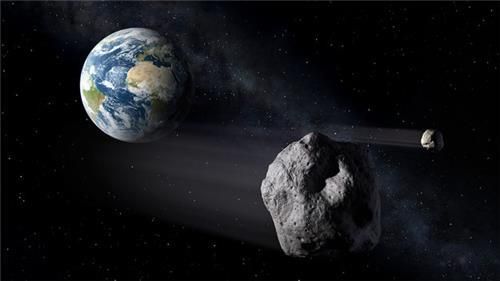
2024 YR4 was discovered on December 27 last year through the Asteroid Terrestrial-impact Last Alert System (ATLAS) telescope in Chile. Tracking results show that this asteroid is currently about 45 million kilometers away from Earth and is moving farther away over time. It will be observable until early April, and since it continues to orbit the Sun, it is expected not to return near Earth until 2028.
The diameter of this asteroid is estimated to be between 40 and 100 meters. ESA explained that an asteroid of this size collides with Earth once every few thousand years and can cause serious damage to the affected area. There are no known cases of other large asteroids with a collision probability exceeding 1% with Earth at present.
International asteroid response organizations such as the International Asteroid Warning Network (IAWN) and the Space Mission Planning Advisory Group (SMPAG) have begun discussions on this matter. Led by NASA, IAWN plans to organize groups involved in tracking and characterizing asteroid details and develop strategies to assess collision outcomes if necessary.
SMPAG will hold a meeting next week in Vienna, Austria. At this meeting, if the asteroid remains a continuing threat, recommendations on ways to reduce potential impacts will be provided, and possible measures will be explored. Specific mitigation methods include altering the asteroid’s trajectory or evacuating areas on the ground that could be affected.
Davide Farnocchia, a navigation engineer at NASA Jet Propulsion Laboratory’s Center for Near-Earth Object Studies (CNEOS), said, "If 2024 YR4 remains a threat at the end of the observation period, mitigation measures could be considered, but it is premature at this time." He added, "The current priority is to continue observing the asteroid and reduce the uncertainty of its position in 2032."
© The Asia Business Daily(www.asiae.co.kr). All rights reserved.

















