Jongno Academy Announces Analysis Results on the 2nd
"Clear Preference for Top-Tier Universities Recently"
It has been analyzed that the number of repeat test-takers (N-su students) taking the 2026 College Scholastic Ability Test (CSAT) will be around 200,000. This is the highest figure in 25 years since the 2001 academic year.
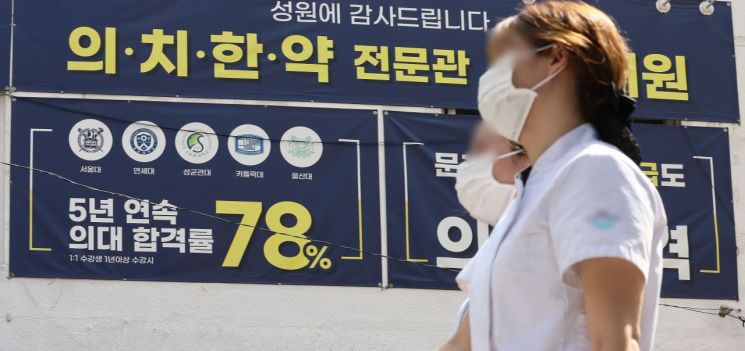 An analysis has predicted that the number of repeat test-takers for the 2026 College Scholastic Ability Test will be around 200,000. Yonhap News
On the 2nd, Jongno Academy announced that based on the number of CSAT registrants, the number of N-su students for the 2026 CSAT is expected to be between 190,000 and 200,000. Considering the recent ratio of N-su students compared to high school seniors, the yearly trend of N-su students, and the number of high school seniors, it predicted that the number could reach up to 202,762. This represents an 11.5% increase compared to the 181,893 N-su students (including those with equivalency diplomas) in the 2025 academic year.
If the number of N-su students surpasses 200,000, it will be the largest scale since 260,959 in the 2001 academic year. The number of N-su students exceeded 200,000 eight times from the 1994 to 2001 academic years, with the highest being 313,828 in the 1996 academic year. From 2002 to 2025, the number remained in the 100,000 range, with 198,025 in 2004 being the highest during this period.
The number of high school seniors graduating this February, who are the direct target of repeat test-takers for the 2026 academic year, is 453,812. Among them, 340,777 took the 2025 CSAT. This is a 4.3% increase compared to the number of high school seniors who took the CSAT the previous year.
Based on the regular admission quotas and the number of applicants for 202 five-year universities in the 2025 academic year, the estimated number of students who failed to enter any university is 11,763, a 3.0% increase from the previous year.
In particular, the number of regular admission failures in the so-called medical fields, including 98 medical, dental, Korean medicine, and pharmacy schools nationwide, increased by 18.9% compared to the previous year. The increases were 2,028 (29.4%) for medical schools, 234 (20.3%) for dental schools, 254 (11.6%) for Korean medicine schools, and 596 (9.6%) for pharmacy schools, respectively.
Furthermore, it was added, "Due to recent employment difficulties, there is a clear preference for top-tier universities, and even after entering university, there is a strong tendency to re-challenge top universities through taking a gap year or repeating a year. The government's adjustments, such as how much they reduce the number of medical school admissions for the 2026 academic year, are also expected to significantly influence the scale of N-su students in the 2006 academic year."
© The Asia Business Daily(www.asiae.co.kr). All rights reserved.

















