The pilot of the passenger plane that crashed after colliding with a military helicopter near Washington DC is presumed not to have received assistance from the Traffic Alert and Collision Avoidance System (TCAS). This is because the accident occurred at a low altitude where the TCAS warning does not sound.
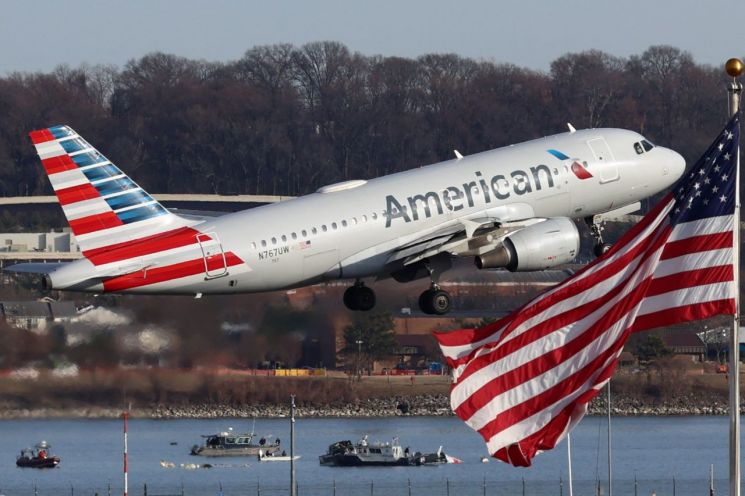 A plane is taking off from Ronald Reagan Airport near Washington DC, USA. Photo by Yonhap News Agency·Reuters
According to the Washington Post (WP) on the 31st (local time), TCAS is a device installed on aircraft that automatically detects nearby aircraft through transmitters and receivers and sends warnings to pilots to prevent collisions.
Currently, the TCAS detection range for most aircraft is a radius of 12 miles (approximately 19.3 km), which is 2 to 4 times the 3 to 5 miles considered a safe distance. If there is a possibility of collision with another aircraft within 30 to 60 seconds, it emits a warning sound saying "Traffic, traffic," and if there is a possibility of collision within 15 to 30 seconds, it recommends vertical maneuvering.
Starting with the mandatory installation of TCAS on large U.S. airline aircraft in 1993, it is now operational on most commercial civil aircraft worldwide. In the U.S., it is reported that no collision accidents have occurred between aircraft equipped with this device.
Military helicopters like the U.S. Army's 'Black Hawk' (Sikorsky H-60), which was involved in the recent accident, are not equipped with TCAS. However, they do have transmitters and receivers that communicate signals with the TCAS of civil aircraft. This raises questions about whether the pilots of the PSA Airlines passenger plane, a subsidiary of American Airlines, could have received warnings through TCAS.
However, since this accident occurred at an 'exception altitude' for TCAS, it appears that no warning sound was issued. Generally, when an aircraft's altitude drops below 500 feet (approximately 152 m), TCAS does not send warnings. Although the exact location of the accident is not yet confirmed, considering that the altitude allowed for military helicopters is typically around 200 feet (approximately 60 m), it is highly likely that the TCAS warning did not sound.
Wesley Olson of the MIT Lincoln Laboratory said, "Even the sounding of a warning or the lighting of a red alert when pilots need to control the aircraft can cause them to lose concentration," adding, "It is very unlikely that a warning sound was issued in this accident."
© The Asia Business Daily(www.asiae.co.kr). All rights reserved.
![Clutching a Stolen Dior Bag, Saying "I Hate Being Poor but Real"... The Grotesque Con of a "Human Knockoff" [Slate]](https://cwcontent.asiae.co.kr/asiaresize/183/2026021902243444107_1771435474.jpg)
















