Lagarde: "Bitcoin Will Not Be Adopted as Reserve Asset by ECB Member States"
ECB Cuts Key Interest Rates Amid Economic Slowdown Concerns
Emphasizes Safety and Liquidity of Reserve Assets; Warns Against Money Laundering Risks
Trump's Virtual Asset Remarks and Eurozone's Negative Growth Highlighted
Christine Lagarde, President of the European Central Bank (ECB), stated on the 30th (local time) that she is confident "Bitcoin will not be introduced as reserve assets by any central bank belonging to the ECB General Council," Bloomberg reported.
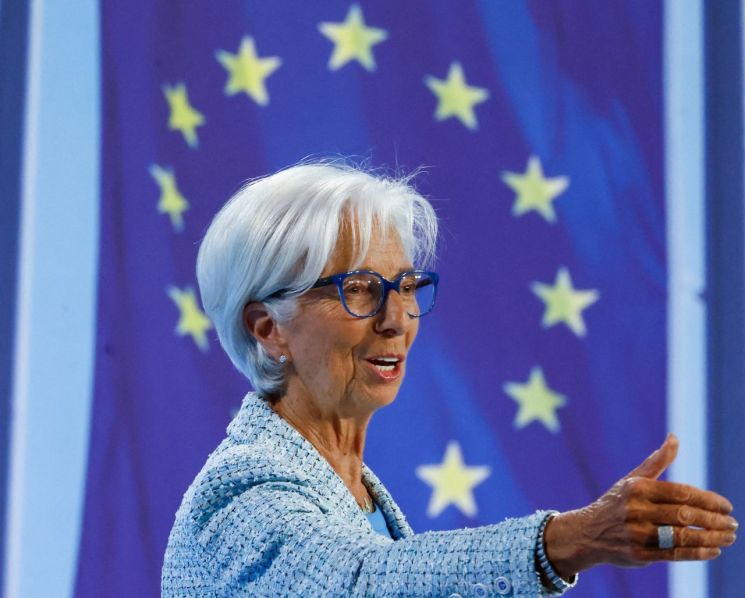
At a press conference held in Frankfurt, Germany, Lagarde said, "Reserve assets must be liquid and safe, and should not be subject to suspicions of money laundering or other criminal activities," conveying her negative stance on the introduction of Bitcoin as reserve assets to the European Union (EU) member states, adding that this view is held by the Governing Council and probably also by the General Council.
The ECB General Council includes all EU member states, unlike the Governing Council, which only consists of central bank governors from the Eurozone (20 countries using the euro). Regarding recent remarks by Ale? Michl, Governor of the Czech National Bank, who mentioned considering purchasing Bitcoin as about 5% of reserve assets for diversification, Lagarde said, "I had a good conversation with him," and that Governor Michl also agreed that reserve assets must be safe.
Earlier, during last year's presidential election campaign, U.S. President Donald Trump said, "I will make the United States the capital of virtual assets" and "I will stockpile Bitcoin as a strategic asset."
On the same day, the ECB lowered the deposit rate by 0.25 percentage points from 3.00% to 2.75%, and the main refinancing rate by 0.25 percentage points from 3.15% to 2.90% through its monetary policy meeting. This decision came amid growing concerns about economic slowdown as the Eurozone's GDP growth rate for the fourth quarter of last year was recorded at 0.0% compared to the previous quarter. Notably, Germany and France, considered the Eurozone's 'Big 2,' recorded negative growth rates of -0.2% and -0.1%, respectively.
Lagarde said, "The pace, sequence, and scale of (interest rate cuts) will be determined based on data and analysis collected in the future," adding, "We know the direction of the journey regarding monetary policy." She also expressed concern about President Trump's tariff policies, saying they "will have a global negative impact."
Since September last year, the ECB has maintained a path of interest rate cuts by lowering key policy rates by a total of 125 basis points (1 bp = 0.01 percentage points) over four occasions. Market forecasts suggest that the ECB will lower rates again in March and cut an additional total of 70 basis points this year.
© The Asia Business Daily(www.asiae.co.kr). All rights reserved.

















