Aimed at Reversing Biden Policies
Opposition and Nonprofits Push Back
Impact on Korean Investors Uncertain
The Trump administration in the United States attempted on the 28th (local time) to temporarily suspend the execution of federal government-managed grants and loans in order to filter out projects from the previous administration that did not align with its policy direction, but this was halted due to court intervention.
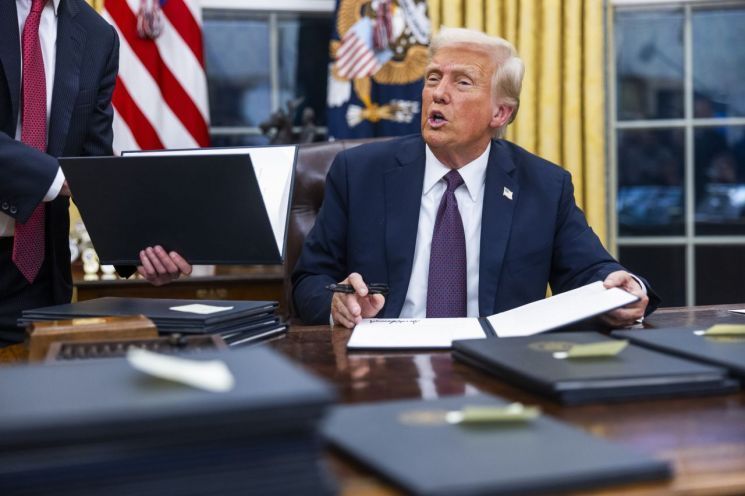 US President Donald Trump is signing an executive order at the White House on the 22nd. Photo by Yonhap News
Matthew Bass, Acting Director of the White House Office of Management and Budget (OMB), announced in a memo sent to various government agencies on the 27th that federal-level grant and loan expenditures would be temporarily suspended starting at 5 p.m. Eastern Time on the 28th.
Acting Director Bass also instructed each agency to comprehensively analyze whether each federal grant and loan program aligns with the Trump administration’s policy direction and to submit a report by the 10th of next month.
The memo implied that grants not consistent with President Trump’s executive orders?such as banning DEI (Diversity, Equity, and Inclusion) initiatives at the federal level and restricting expenditures related to clean energy?could be abolished.
In the memo, Bass stated that federal government spending for the 2024 fiscal year approached $10 trillion, of which federal financial support including grants and loans exceeded $3 trillion (approximately 4,300 trillion Korean won).
White House spokesperson Caroline Levitt explained during a briefing on the 28th that this measure is "clearly limited to programs, projects, and activities related to the president’s executive orders, such as ending DEI and the Green New Deal (the Biden administration’s eco-friendly industrial policy), and stopping support for NGOs that harm national interests." She emphasized that it is not a general suspension of support.
Despite this explanation from the U.S. administration, foreign media reported that significant confusion followed because it was difficult to precisely gauge which funds would be suspended. According to outlets such as The Washington Post (WP), under the unclear guidelines from the Trump administration, programs operated with government grants and loans across the U.S. experienced disruptions.
Although the White House stated that Medicaid (medical support for low-income individuals) funds were not subject to suspension, several states encountered difficulties accessing Medicaid funds.
Some school support and childcare-related services also failed to operate smoothly. The New York Times (NYT) reported that nonprofit organizations, charities, and public service programs dependent on government funding were in a state of panic as they tried to assess the impact of the administration’s measures.
Chuck Schumer, Senate Majority Leader of the opposition Democratic Party, criticized the administration’s actions as illegal and said, "If this continues, the American people will pay a terrible price."
Additionally, Hakeem Jeffries, House Democratic Leader, announced in a letter to fellow lawmakers that an emergency congressional meeting would be held on the 29th to discuss countermeasures.
Nonprofit organizations relying on government funds filed lawsuits against the administration, claiming that various projects could be halted and harmed by the measures. Lauren Alikhan, a judge at the U.S. District Court for the District of Columbia handling the case, stated, "I believe there is a risk of irreparable harm," and ordered a suspension of the Trump administration’s temporary halt on fund disbursement at least until 5 p.m. on the 3rd of next month. Judge Alikhan was appointed by former President Joe Biden.
This measure is noteworthy because it could affect Korean electric vehicle, battery, and semiconductor companies that have invested in the U.S. expecting various government supports such as tax credits and grants based on the Biden administration’s Inflation Reduction Act (IRA) and the CHIPS Act.
Political media outlet Politico obtained a 52-page list from the OMB detailing projects under review by department, which includes projects related to the interests of Korean companies. These include the "Semiconductor (CHIPS) Incentive Program," "Tax Credits for Clean Vehicles," "Advanced Manufacturing and Production Tax Credits," and "Federal Loan Guarantees for Innovative Energy."
However, Acting Director Bass’s memo states that the suspension of grant execution will be implemented "to the extent permitted under applicable law," so there is analysis that it remains to be seen whether grants to Korean companies that have already completed contracts related to loans or grants with the U.S. government will be suspended.
Furthermore, even if grants are temporarily suspended, there is hope that grants linked to Korean investments in U.S. facilities and job creation may be restored due to the influence of lawmakers from both ruling and opposition parties representing the districts where those investments are located.
© The Asia Business Daily(www.asiae.co.kr). All rights reserved.
![Clutching a Stolen Dior Bag, Saying "I Hate Being Poor but Real"... The Grotesque Con of a "Human Knockoff" [Slate]](https://cwcontent.asiae.co.kr/asiaresize/183/2026021902243444107_1771435474.jpg)
















