An Investment of 162.8 Billion KRW, Up 3.1 Billion from Last Year
Promoting Convergence Industries Linked to Processing, Experience, and Tourism
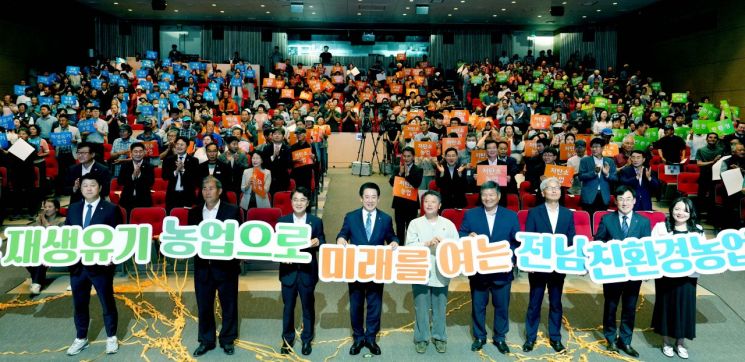 Jeonnam Province will invest 162.8 billion KRW this year to intensively foster low-carbon eco-friendly agriculture centered on organic farming, enhancing its competitiveness as the nation's largest production and supply base for eco-friendly agricultural products. Provided by Jeonnam Province
Jeollanam-do, as the leading region for organic agriculture in Korea, will invest 162.8 billion KRW (with 27.8 billion KRW from self-funding) to intensively foster low-carbon, eco-friendly agriculture centered on organic farming to enhance its competitiveness.
According to Jeollanam-do on the 29th, this year’s major policy directions for eco-friendly agriculture focus on diversifying certified items such as organic fruits and vegetables, expanding a sustainable production base centered on farming and low-carbon practices, stabilizing farm management, strengthening the safety of eco-friendly agricultural products, and expanding stable sales channels.
By sector, 113.7 billion KRW will be invested in 31 projects to establish a sustainable and stable production base, including 32 billion KRW for creating eco-friendly agricultural complexes, 19.8 billion KRW for soil conditioners, 19.7 billion KRW for organic farming materials, and 8.3 billion KRW for building eco-friendly agricultural infrastructure.
To stabilize the management of farms practicing eco-friendly agriculture and diversify certified items such as fruits and vegetables, 38.8 billion KRW will be provided for eight projects, including 17.5 billion KRW for the eco-friendly agriculture direct payment system, 6.7 billion KRW for continuous direct payments for organic and pesticide-free farming, 9.5 billion KRW for certification fee support, and 3 billion KRW for establishing specialized fruit and vegetable complexes.
Projects are also underway to secure stable sales channels for eco-friendly agricultural products and promote rural convergence industries linked to experiences and tourism.
Alongside strengthening farmer education on compliance with certification standards and obligations for eco-friendly agricultural products, 8.9 billion KRW will be invested in 34 projects, including 1.6 billion KRW for eco-friendly product packages, 1.8 billion KRW for fostering young contract-farming households, 18 billion KRW for the Haenam Organic Industry Complex Service Support Center (2024?2028), and 1 billion KRW for fostering organic ecological villages.
To secure stable sales channels through promotion of eco-friendly agricultural products, new projects to strengthen the competitiveness of eco-friendly agriculture will be implemented, such as 720 million KRW for eco-friendly packages for infants and young children, 400 million KRW for tailored marketing for certified farms, and 300 million KRW for marketing support for prototype development of organic ecological village brands.
Meanwhile, as of the end of December last year, the area certified for eco-friendly agricultural products in Jeollanam-do reached 34,265 ha, accounting for 50% of the national total and ranking first in the country. Of this, the area certified for organic farming was 22,422 ha, representing 60% of the national certified area.
© The Asia Business Daily(www.asiae.co.kr). All rights reserved.
![Clutching a Stolen Dior Bag, Saying "I Hate Being Poor but Real"... The Grotesque Con of a "Human Knockoff" [Slate]](https://cwcontent.asiae.co.kr/asiaresize/183/2026021902243444107_1771435474.jpg)
















