In 2009, University Funding Reflected Tuition Increase Rates
Over a Decade of Freeze: "Reached the Limit"
Adjusted for Inflation, Tuition Down 22% Compared to 2011
50 Universities Confirm Tuition Hikes This Year
National and Public Universities May Join the Increase Next Year
Following the government's tuition freeze policy since 2009, universities, particularly private ones, which had refrained from raising tuition fees for the past 16 years, are now increasing them one after another this year. With inflation soaring but tuition fees, a major source of school funding, remaining frozen, it has become increasingly difficult not only to secure talented students but also to repair deteriorating school facilities.
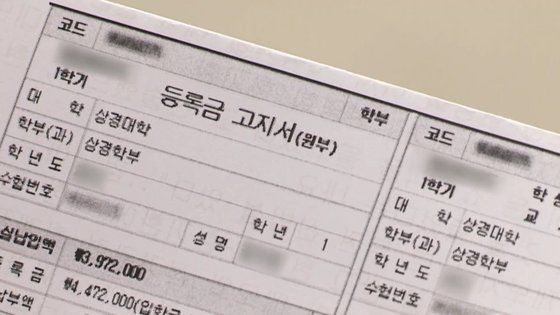
◆ Tuition Freeze Driven by 'Half-Price Tuition' Demand = The reason universities froze or reduced tuition fees for over a decade dates back to the Lee Myung-bak administration in 2008. During his presidential campaign, Lee proposed measures to share the economic crisis burden with ordinary citizens, with the flagship policy being 'half-price tuition.' However, as fulfilling the half-price tuition pledge became difficult, the government instead included 'tuition increase rate' as an evaluation criterion for work-study scholarship programs. Universities received different levels of funding based on their tuition increase rates. Since 2012, universities that raised tuition have faced restrictions on receiving 'Type II National Scholarships,' thereby encouraging tuition freezes. Since then, universities have reluctantly maintained or lowered tuition fees.
So, what were university tuition fees like during that period? According to the Ministry of Education, Science and Technology's submission to National Assembly Education, Science and Technology Committee member Lee Cheol-woo, the '2005?2009 Tuition Increase Status' for 40 national/public and 156 private four-year universities nationwide showed that national/public universities averaged 3.86 million KRW, while private universities averaged 7.08 million KRW. The five-year increase rates were 46.3% for national universities and 30.5% for private universities, which was two to three times higher than the consumer price inflation rate of 15.8% during the same period. In the aftermath of the 2008 economic crisis, with employment rates falling and student loan repayment burdens rising, tuition hikes far exceeding inflation inevitably became a heavy burden. Criticism also arose at that time that universities were obsessed with raising tuition while accumulating hundreds of billions of won in reserves.
◆ Is the 16-Year Tuition Freeze Policy Coming to an End? = Recently, especially among private universities, there have been numerous appeals that they have "reached their limit," signaling cracks in the long-standing tuition freeze policy. This is because, unlike the past when tuition increases far exceeded inflation during 16 years of freezes and reductions, the current situation is the exact opposite. According to the Korea Council for University Education, the average annual tuition per student at all universities last year was 6.829 million KRW, a 1.4% decrease compared to 2011. Adjusted for inflation, this represents a 22.4% drop. Tuition at national/public universities fell 23.3% from 4.807 million KRW in 2011 to 3.687 million KRW, and private universities dropped 21.9% from 8.552 million KRW to 6.68 million KRW. The Council attributes this to "continuous tuition reduction and freeze policies."
Meanwhile, expenses including salaries and administrative operating costs have steadily increased. According to the Council's survey of private universities, the ratio of expenses to actual operating revenue rose from 65.9% in 2011 to 72.9% in 2023, an increase of 7.0 percentage points. Operating profits have been declining. During the same period, operating profits plummeted from 855.9 billion KRW to 40.7 billion KRW. From 2017 to 2022, some universities even recorded deficits. The Council explained, "The continuous occurrence of operating deficits clearly reflects the poor financial condition of private universities." Yang Oh-bong, newly elected president of the Council and president of Jeonbuk National University, expressed difficulties in school operations due to the long-term tuition freeze during a press conference at the Council's general meeting on the 21st. He said, "After deducting personnel, operating, and facility costs, only 30 to 40 billion KRW remains. For an institution with over 30,000 students, this amount is insufficient to repair leaking roofs or broken restroom doors." Lee Seong-geun, president of Sungshin Women's University, also told Lee Ju-ho, Deputy Prime Minister and Minister of Education, who attended the meeting, "The fact that most universities can raise tuition means they have reached their limit."
◆ 70% of University Presidents Propose Tuition Increase This Year, Increase Rate '5.0?5.49%' = Universities, which have long complained of financial difficulties, have started raising tuition fees one after another this year. According to the Korea Association of Private University Presidents (KAPUP), as of the 26th, 50 universities have confirmed tuition increases for this year. After Sogang University, a major private university in Seoul, decided to raise undergraduate tuition by 4.85% for the first time in 13 years, Ewha Womans University (3.1%), Kookmin University (4.97%), Hankuk University of Foreign Studies (5%), and Yonsei University (4.98%) also decided to increase tuition. The number of universities joining the tuition hike after the Lunar New Year holiday may increase further.
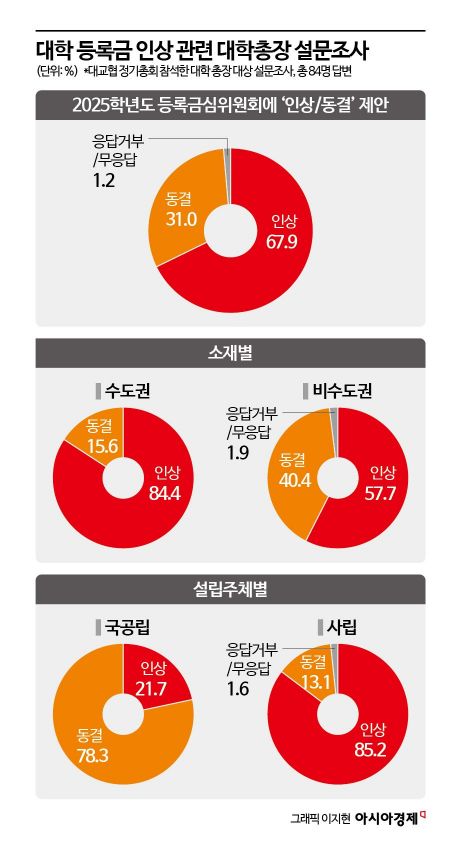
According to a survey conducted on the 22nd by the Ministry of Education press corps targeting 84 presidents of four-year universities, 67.9% (57 respondents) said they have proposed or plan to propose tuition increases for the 2025 academic year to the Tuition Deliberation Committee. The proportion of those who said they would freeze tuition was 31% (26 respondents). The most common proposed increase rate was '5.0?5.49%' at 50.9% (29 respondents).
From next year, national/public universities are also expected to join the tuition increase trend. When asked whether they are considering raising tuition for the 2026 academic year, 69.0% of all respondents (19.0% definitely will increase, 50.0% leaning toward increase) indicated plans to raise tuition. This rate was 67.2% (18.0%, 49.2%) for private universities and 73.9% (21.7%, 52.2%) for national/public universities.
© The Asia Business Daily(www.asiae.co.kr). All rights reserved.

![Clutching a Stolen Dior Bag, Saying "I Hate Being Poor but Real"... The Grotesque Con of a "Human Knockoff" [Slate]](https://cwcontent.asiae.co.kr/asiaresize/183/2026021902243444107_1771435474.jpg)
















