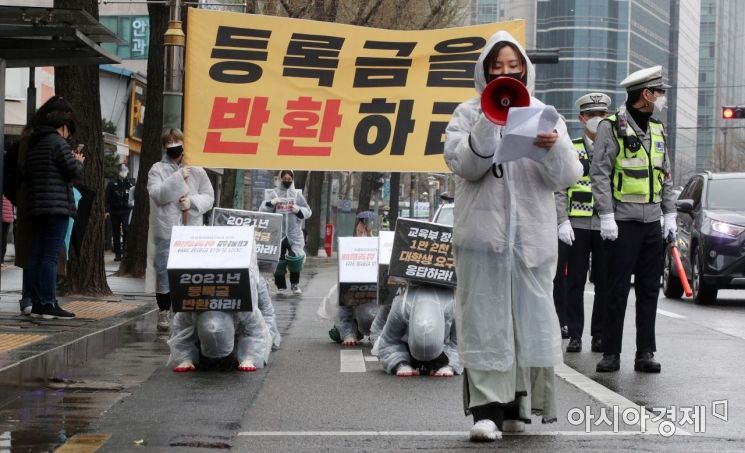
 University students belonging to the 2021 Tuition Refund Movement Headquarters are performing Samboilbae near Gyeongbokgung Station, urging the refund of university tuition fees due to the impact of COVID-19 non-face-to-face classes. Photo by Kim Hyun-min
Seoul National University of Science and Technology has joined the ranks of tuition fee increases, which had been primarily led by private universities.
On the 27th, Yonhap News reported, "The Tuition Fee Deliberation Committee of Seoul National University of Science and Technology held its third meeting on the 23rd and approved a proposal to raise undergraduate tuition fees by 5.49% compared to last year." Tuition fees for international students were also increased by the same rate. The graduate tuition fee increase rate was set at 5% during the first meeting on the 3rd. Previously, a survey conducted from the 17th to the 21st among 710 enrolled students showed that 423 (59.6%) preferred tuition fees to remain frozen. Since December 2022, after the Seoul Metropolitan Council cut the university's support fund by 10 billion KRW, Seoul National University of Science and Technology has been considering raising tuition fees. In 2012, under then-Mayor Park Won-soon’s leadership, the university introduced the 'half-price tuition' policy, reducing tuition fees by about half.
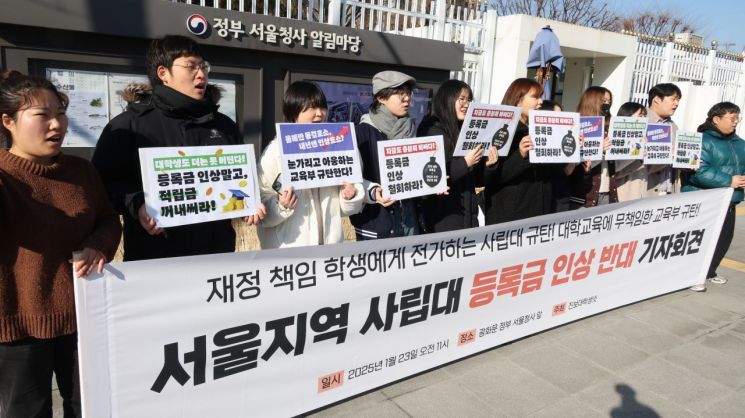 The Progressive Student Network held a press conference opposing tuition fee increases at private universities in the Seoul area in front of the Government Seoul Office Building on January 23. Photo by Yonhap News.
Besides Seoul National University of Science and Technology, major universities in Seoul that raised undergraduate tuition fees this year include Yonsei University (4.98%), Kyonggi University (5.2%), Kookmin University (4.97%), Sogang University (4.85%), Ewha Womans University (3.1%), Hankuk University of Foreign Studies (5%), Dongguk University (4.98%), and Dongduk Women’s University (4.2%). In the provinces, Daegu University (5%) and Hallym University (5.4%) also increased tuition fees.
The Korea Council of Private University Presidents (KCPUP) reported on the 23rd in their '2025 Academic Year Tuition Fee Increase Status' document that, based on media announcements and university websites, 27 universities?including 23 private and 4 national/public universities?have decided to raise tuition fees. By region, 16 universities in the metropolitan area and 11 in non-metropolitan areas decided to increase tuition fees. The increase rates range from 2.20% to 5.48% for private universities and 4.96% to 5.49% for national/public universities. KCPUP also stated that 13 universities are currently discussing tuition fee increases in their Tuition Fee Deliberation Committees.
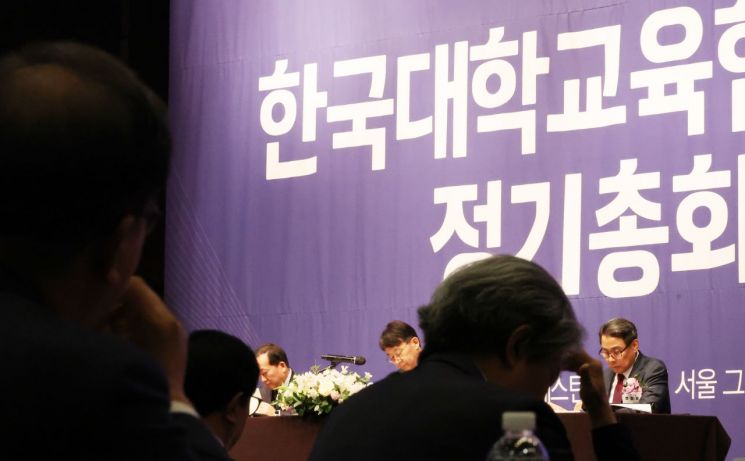 On the morning of January 22, university presidents and others attended the regular general meeting of the Korean Council for University Education held at the Westin Chosun Hotel in Seoul. Photo by Yonhap News
According to a survey conducted on the 26th by the Ministry of Education’s press corps targeting 84 presidents of four-year universities nationwide, 57 (67.9%) said they have proposed or plan to propose tuition fee increases to their Tuition Fee Deliberation Committees. Twenty-six (31.0%) said they would keep fees frozen, and one (1.2%) did not respond. By location, in the metropolitan area, 27 out of 32 presidents (84.4%) said they have proposed or plan to propose increases. In non-metropolitan areas, 30 (57.7%) favored increases, 21 (40.4%) favored freezing, and one (1.2%) did not respond.
By type, among private universities, 52 out of 61 presidents (85.2%) said they have proposed or plan to propose increases, while only 8 (13.1%) favored freezing. For national/public universities, freezing was favored by 18 (78.3%), significantly outnumbering the 5 (21.7%) who favored increases. The proposed increase rates submitted to the Tuition Fee Deliberation Committees were over 5.0% to 5.49% for 50.9%, more than half. Earlier, the Ministry of Education set the upper limit for tuition fee increases this year at 5.49%. Rates between 4.0% and 4.9% accounted for 36.8%, and those between 2.0% and 3.9% accounted for 12.3%.
© The Asia Business Daily(www.asiae.co.kr). All rights reserved.



















