Appointments of Public Enterprise Heads Tied to Political Climate
Impeachment Turmoil Brings Selection Process to a Halt
"Delays Likely Until New Government Is Formed"
The appointment process for successors to the heads of financial public enterprises has come to a 'zero hour' due to the aftermath of the emergency martial law and impeachment political turmoil. Some institutions whose terms have already expired are unable to proceed with personnel work such as president recruitment. This is because the procedure requires presidential appointment and cannot be free from government influence, leading to concerns that the vacancies may continue until the new government is formed.
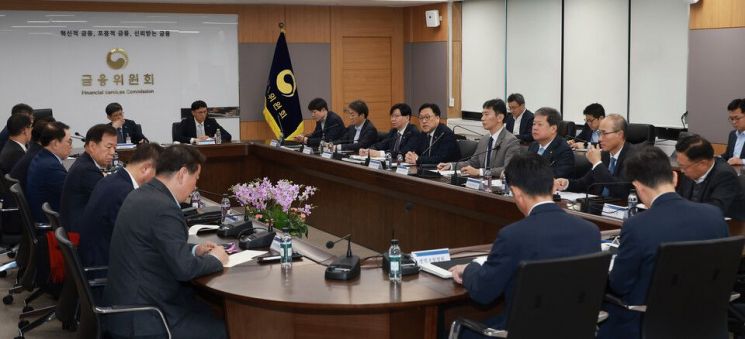 Kim Byung-hwan, Chairman of the Financial Services Commission (center), is speaking at a financial situation review meeting with financial public institutions held at the Government Seoul Office Building on December 4 last year. Photo by Financial Services Commission, Yonhap News Agency
According to the financial sector on the 3rd, there are seven financial public enterprises whose heads’ terms expire this year. Among them, three have already ended their terms. The heads of the Korea Inclusive Finance Agency (Seogeumwon) and the Credit Recovery Committee, both led by the same president, Lee Jae-yeon, had their terms expire on the 1st of this month. At Korea Asset Management Corporation (KAMCO), President Kwon Nam-joo completed the term on the 17th of last month. Four other institutions?Korea Development Bank (June), Korea Credit Guarantee Fund (August), Korea Financial Telecommunications & Clearings Institute (August), and Korea Deposit Insurance Corporation (November)?also have heads whose terms end this year.
Although Seogeumwon and KAMCO have already completed their terms, the successor appointment process has effectively stalled. KAMCO formed the executive recommendation committee, the first step to selecting a new president, in November last year, but the process has not progressed further due to the emergency martial law and impeachment political turmoil. Seogeumwon has yet to even form its recommendation committee.
The successor appointment procedures for these institutions take at least two to three months. According to the Act on the Management of Public Institutions (Gongunbeop), the process must go through stages including forming the recommendation committee → candidate recruitment → recommendation of candidates by the committee → appointment or proposal by the Financial Services Commission chairman → final appointment by the president. To avoid delays, the law stipulates that the recommendation committee must be formed at least two months before the term expires. However, with the presidential office’s duties suspended at the end of last year, which includes candidate verification and final approval, the process has effectively been put on hold.
There is a high possibility that the appointment process will be delayed for a considerable period. The financial sector expects that appointments for public enterprises will normalize after the next presidential election. The early presidential election is expected to take place between May and June, and in that case, the appointment processes for the other four institutions whose terms end this year may also be delayed due to the concurrent formation of the inaugural cabinet. A financial sector official said, "The heads of financial public enterprises are practically candidates from government officials such as the Financial Services Commission or Ministry of Strategy and Finance, and politicians. The appointment process will gain momentum only after the positions of first-level government officials are decided following the next presidential election."
Financial public enterprises allow the current heads to continue their duties until successors are appointed. This is also the case for KAMCO, Seogeumwon, and the Credit Recovery Committee. While the risk of operational gaps is low, the temporary management system continues. The longer the interim system lasts, the more the operational drive of public institutions, which play a key role in policy execution, may decline. It is also difficult to promote new projects or establish mid- to long-term plans. A financial sector official said, "Internal tension inevitably decreases," adding, "Delays in appointments caused by political situations or personnel changes in the relevant ministries are a chronic problem."
© The Asia Business Daily(www.asiae.co.kr). All rights reserved.
![Clutching a Stolen Dior Bag, Saying "I Hate Being Poor but Real"... The Grotesque Con of a "Human Knockoff" [Slate]](https://cwcontent.asiae.co.kr/asiaresize/183/2026021902243444107_1771435474.jpg)
















