Government Pilots Mobile Resident Registration Card Issuance
Available to All Citizens Aged 17 and Older
Mobile Foreigner Registration Card Also Fully Introduced
The government is currently piloting the issuance of mobile resident registration cards. Even without carrying a physical resident registration card, identity verification is possible by storing the card on a mobile phone. If you possess a resident registration card embedded with an IC (integrated circuit) chip, you can easily reissue it even if you change your mobile phone.
The mobile resident registration card is the fourth mobile ID added following the mobile driver's license, national veterans registration card, and overseas Korean identity verification card. Citizens aged 17 and older can use the resident registration card on their smartphones. This marks a transition to a digital format 56 years after it was first issued in paper form in 1968.
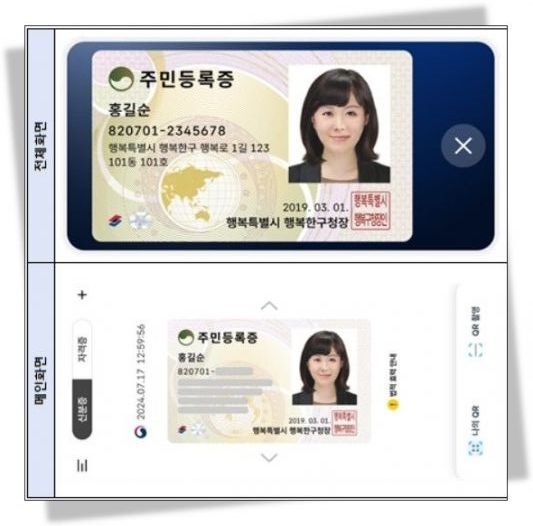
As of the 28th, the government is piloting the issuance of mobile resident registration cards in nine local governments: Sejong City, Hongcheon-gun in Gangwon, Goyang-si in Gyeonggi, Geochang-gun in Gyeongnam, Seo-gu in Daejeon, Gunwi-gun in Daegu, Ulju-gun in Ulsan, Yeosu-si in Jeonnam, and Yeongam-gun in Jeonnam. After verifying system stability, the plan is to expand issuance nationwide within the first quarter.
Residents whose registered address is in the pilot issuance area can visit a local community center to obtain an 'IC resident registration card' to recognize on their mobile phone or apply for a mobile resident registration card using the 'QR issuance' method. When applying for the IC resident registration card, a photo taken within the last six months must be submitted. The mobile resident registration card features high-level security by applying blockchain and encryption technologies to prevent personal information leakage and fraudulent use.
The government has also transitioned the foreigner registration card to mobile. The mobile foreigner registration card can be issued to all registered foreigners aged 14 and older who possess a smartphone in their own name and has the same legal effect as the physical foreigner registration card.
There are two methods for issuing the mobile foreigner registration card: the 'IC foreigner registration card method' and the 'QR code scanning method.' The IC foreigner registration card method involves recognizing the IC foreigner registration card in the mobile ID app to issue the mobile foreigner registration card. Applications can be made at immigration and foreigner offices. This method allows reissuance of the mobile foreigner registration card without visiting immigration or foreigner offices even if the phone is changed or the app is deleted.
It can be used everywhere just like the existing foreigner registration card, and the scope will be expanded to enable use in non-face-to-face services. It can be used at places requiring identity verification such as government offices, convenience stores, and hospitals, and plans are underway to collaborate with related agencies and commercial banks to enable use in major public services and major banks' mobile financial services soon.
Meanwhile, the government is also completely redesigning the current physical resident registration card introduced in 1999. For this purpose, a public-private joint 'Resident Registration Card Improvement Promotion Committee' has been formed. In September last year, a 'Resident Registration Card Design Improvement Forum' was held with participation from the public, design experts, and historians to review the need for design improvements of the resident registration card.
© The Asia Business Daily(www.asiae.co.kr). All rights reserved.
![Clutching a Stolen Dior Bag, Saying "I Hate Being Poor but Real"... The Grotesque Con of a "Human Knockoff" [Slate]](https://cwcontent.asiae.co.kr/asiaresize/183/2026021902243444107_1771435474.jpg)
















