LG acquires management rights of Bear Robotics
Combining commercial robots with B2B solutions
Securing competitiveness in industrial and home-use sectors
Samsung focuses on humanoid robot development
through Rainbow Robotics acquisition
Hyundai plans to integrate Boston Dynamics robots
into next-generation vehicles
Hanwha also enters autonomous robot development
LG Electronics' decision on the 24th to acquire management rights of Bear Robotics was driven by the company's focus on the fact that Bear Robotics is an AI-based commercial autonomous robot company. LG Electronics expects to strengthen the structural competitiveness of its robot business by combining Bear Robotics' technological capabilities with its own manufacturing expertise and supply chain management (SCM) know-how, and to exert significant influence in the B2B (business-to-business) sector. It is also reported that LG is considering a sales strategy that supplies corporate customers with all the products they need at once by combining commercial robots with LG Electronics' B2B solutions such as hotel TVs, signage, and IT devices. Furthermore, as the paradigm of the robot business shifts toward software (SW) centricity, LG Electronics foresees that it can secure technological competitiveness not only in industrial robots but also in business-use and home-use robots by utilizing the numerous robot SW platforms owned by Bear Robotics.
CEO Jo Joo-wan stated earlier this month at CES 2025, the world's largest electronics and IT exhibition held in Las Vegas, USA, that "robots are a clear future," and added, "We are preparing home-use robots such as mobile AI home hubs beyond the F&B and logistics delivery robots we are currently focusing on."
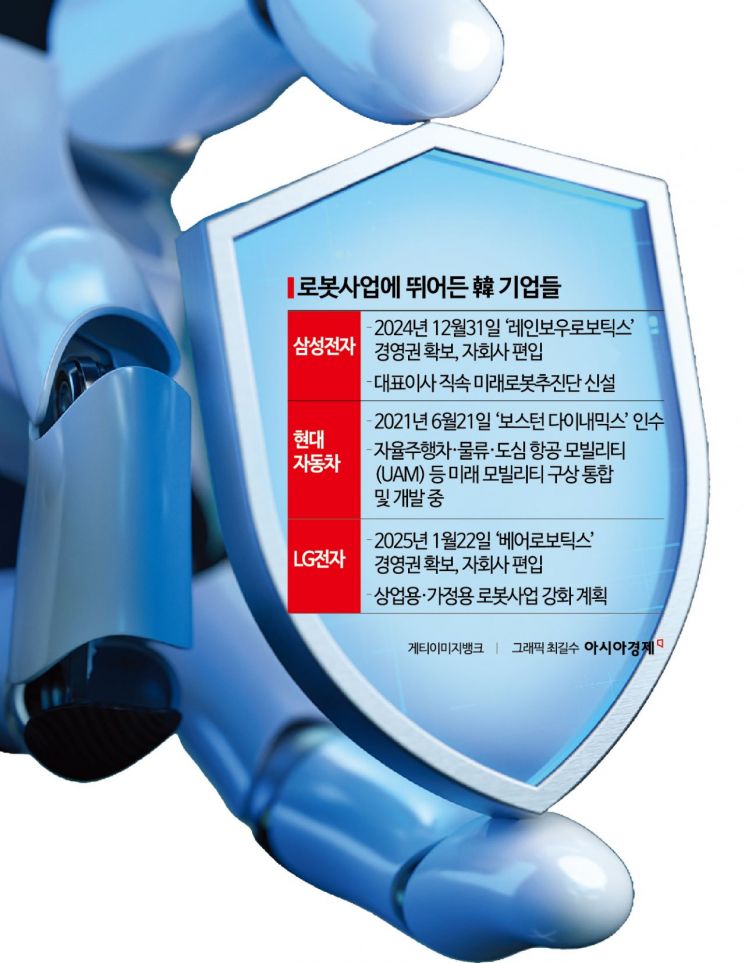
With LG Electronics deciding to acquire a robotics company, competition in the robotics field among major domestic companies such as Samsung Electronics and Hyundai Motor Company is expected to intensify. Hyundai Motor Company already acquired Boston Dynamics in 2021, and Samsung Electronics secured management rights of Rainbow Robotics at the end of last year. The fact that large corporations are securing management rights and majority shareholder status beyond mere equity investments in new technologies in robotics shows their intention to actively nurture the robotics field as a solid new growth engine business in the future.
In particular, Samsung Electronics and LG Electronics, which have competed in the home appliance market, are likely to face off in the 'home-use robot' sector. Samsung Electronics announced that it will first launch its AI companion robot 'Ballie' in South Korea and the United States around May to June. In addition, it is reviewing whether to promote a subscription business for Ballie, similar to those for home appliances. LG Electronics also plans to release a mobile AI home hub (project name: Q9) within this year.
Samsung Electronics is focusing on developing 'humanoid robots' that resemble humans. It is currently pursuing a corporate merger with the specialized company in this field, Rainbow Robotics. Regarding this, Samsung Electronics filed for review with the Korea Fair Trade Commission on the 13th and is awaiting the decision, which is expected as early as the end of this month. Based on Rainbow Robotics, Samsung Electronics established the 'Future Robot Promotion Team' under Vice Chairman Han Jong-hee. Professor Oh Jun-ho of KAIST, the founder of Rainbow Robotics, leads the team, and in-house robot research departments have joined in the form of a task force (TF). The team reportedly consists of about 50 members.
The activities of the promotion team are expected to become more concrete once the corporate merger with Rainbow Robotics is completed. Humanoid robots are anticipated to gain attention with the advent of the 'physical artificial intelligence (AI)' era. Vice Chairman Han Jong-hee said, "The humanoid plan seems to be accelerating," and added, "We will move forward together (in line with global trends)."
Hyundai Motor Company plans to integrate humanoid robots created through Boston Dynamics into next-generation automobiles. It also hopes to deploy robots in automobile manufacturing processes. Boston Dynamics is recognized for its technology with products such as the quadruped robot 'Spot,' which was deployed for the security of then-President-elect Donald Trump, and the newly released humanoid robot 'All New Atlas' last year. Additionally, Hanwha launched 'Hanwha Robotics' in 2023 and is developing collaborative robots and autonomous driving robots, aiming to target the food service and leisure industries. Recently, it has also been focusing on research and development (R&D) of lightweight collaborative robots. Hyundai Motor Company and Kia have established a robotics lab and unveiled the autonomous delivery robot 'Dali Delivery' and the industrial wearable robot 'XBL Shoulder' last year, aiming to enter markets in South Korea, Europe, and North America with these products.
© The Asia Business Daily(www.asiae.co.kr). All rights reserved.
![Clutching a Stolen Dior Bag, Saying "I Hate Being Poor but Real"... The Grotesque Con of a "Human Knockoff" [Slate]](https://cwcontent.asiae.co.kr/asiaresize/183/2026021902243444107_1771435474.jpg)
















