Outwardly, a Response to 'Voisumer' Demands
Lower R&D and Marketing Costs, Secure Sales: 'Three Birds with One Stone'
Relaunch Craze Could Lead to the 'Curse of the Present'
Nongshim Ramen (1975), Minos Banana Milk (1993), Pokachip Sweet Cheese Flavor (2014)….
Products that were released long ago, gained tremendous fame, but were eventually discontinued have returned to us. This is a kind of 'relaunch marketing.' As consumer sentiment froze due to economic recession caused by high exchange rates, high prices, and high interest rates, food companies chose to minimize research and development and marketing costs. Thanks to consumers opening their wallets for familiar products, stable sales effects can also be seen in the early stages of release. However, there are concerns that the relaunch craze could lead to neglect of new product development, causing food companies to fall into the 'curse of the present.'
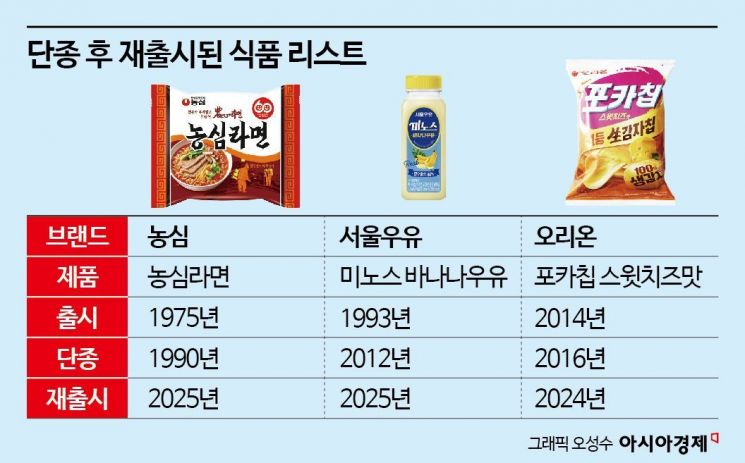
According to the distribution industry on the 27th, Nongshim relaunched 'Nongshim Ramen' on the 13th to celebrate its 60th anniversary. It was released 50 years ago in 1975 and was so popular that it led to the company name change from Lotte Industrial Co., Ltd. to Nongshim in 1978. It is also famous for the advertising copy 'Older brother first, younger brother first.'
The newly released Nongshim Ramen is based on the recipe from 1975 held by Nongshim R&D and has been upgraded recently to suit consumer tastes. Nongshim applied the characteristics of traditional gukbap (soup with rice) restaurants, which feature deep and clean broth, the umami of beef and rice starch combined, and a spicy taste added with various minced seasonings, to Nongshim Ramen.
Familiarity is not only in taste. The Nongshim Ramen packaging also inherits the design from its 1975 release. It gifts nostalgia to generations who remember the old Nongshim Ramen and adds retro freshness to younger generations. Nongshim is considering relaunching two more products in the first half of the year.
Earlier, Seoul Milk also relaunched 'Minos Banana Milk' on the 7th. This product was released in 1993, loved for a long time, and discontinued in 2012. The returning Minos Banana Milk boasts a rich taste with 86% domestic raw milk content and added banana juice. In particular, the overwhelmingly high milk content allows consumers to enjoy the fresh yet rich taste of milk. The packaging also reinterprets the 1990s design to stimulate consumer nostalgia.
Additionally, Orion relaunched 'Pokachip Sweet Cheese Flavor' in August last year. Pokachip Sweet Cheese Flavor, released in 2014, was discontinued in 2016 during a product lineup reorganization. Besides Pokachip Sweet Cheese Flavor, Orion also relaunched products like Sun (Taste of the Sun), Chicken Pop, and Wacle.
The recent relaunch craze in the food industry is superficially a response to the demands of 'voisumers.' Voisumer is a term combining 'voice' and 'consumer,' referring to consumers who express their voices to reflect their demands in products or corporate policies. As channels to express opinions such as online communities and SNS have increased, the influence of voisumers is growing day by day.
However, the demands of voisumers are not the entire background of the relaunch craze. It also includes food companies' strategies to minimize costs and maximize sales amid economic recession. First, relaunching existing products significantly reduces research and development costs. This is because development is based on upgrading quality and taste using existing recipes. Packaging is also made similar to the original, so design costs are low. Especially, the fact of relaunching itself serves as marketing, reducing promotional expenses.
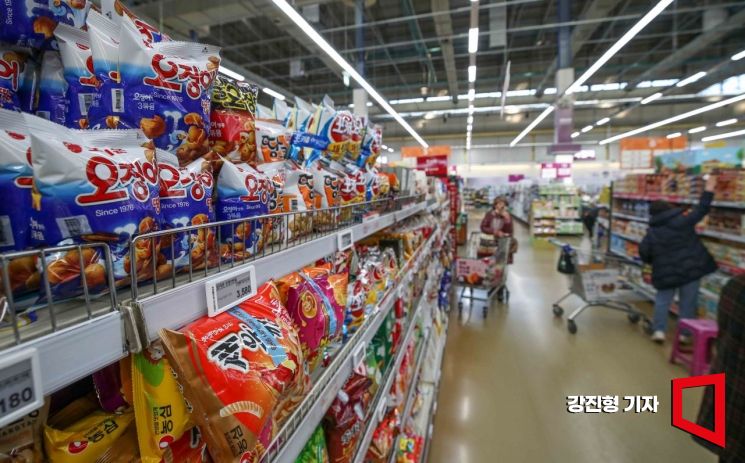
At the same time, it easily stimulates consumer nostalgia and opens wallets, guaranteeing sales above a certain level. From a corporate perspective, it is a 'three birds with one stone' situation where they respond to consumer demands, reduce costs, and guarantee sales. A food industry insider explained, "In a high-price, recession situation, consumers tend to seek familiar products with proven taste," adding, "From the manufacturer's point of view, relaunching continues because it can achieve great effects with little investment."
However, there are concerns that if food companies focus on relaunching discontinued products while neglecting new product development that grows the market, the entire market may lose vitality and fall into the 'curse of the present.' The curse of the present means a situation where companies, instead of striving to develop new products to turn a red ocean market into a blue ocean, focus only on reducing immediate costs and thus decline.
In fact, the food industry has had no clear hit products recently. Although products like Nongshim Shin Ramyeon Tomba gained popularity, they were new products utilizing existing products and did not have the ripple effect like Haitai Confectionery's 'Honey Butter Chip' in the past. On the other hand, there are also calls for food companies to increase R&D expenses, which are below 1% of sales, to avoid complacency and strive to develop new products that will revive the market. A food industry insider said, "The food industry has a lower operating profit margin compared to other industries, so it is inevitable to be stingy with research and development investment," but added, "To restore vitality in the domestic market and continue the K-food craze overseas, it is time to make more active investments in new products rather than taking the easy path."
© The Asia Business Daily(www.asiae.co.kr). All rights reserved.
![Clutching a Stolen Dior Bag, Saying "I Hate Being Poor but Real"... The Grotesque Con of a "Human Knockoff" [Slate]](https://cwcontent.asiae.co.kr/asiaresize/183/2026021902243444107_1771435474.jpg)

















