Two domestically produced multipurpose helicopters, 'Surion (KUHC-1)', have been additionally deployed to wildfire sites starting this year.
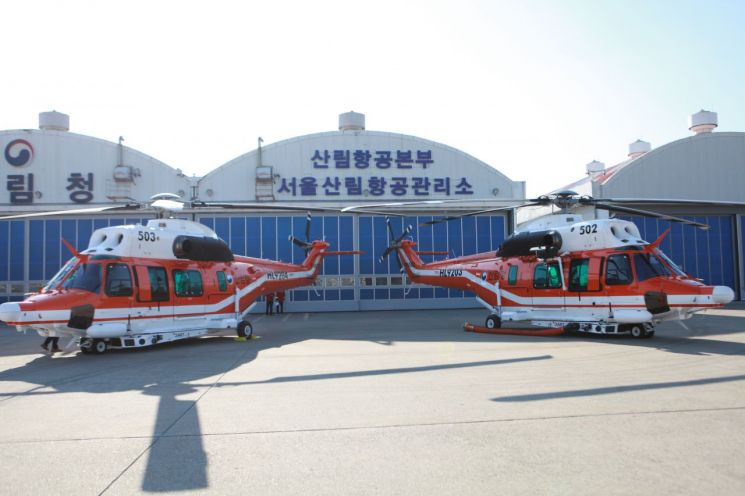 The Korea Forest Service has added two Surion helicopters to the Seoul Forest Aviation Management Office this year. The newly introduced Surion, a domestically produced multipurpose helicopter, is expected to contribute to strengthening aerial firefighting capabilities, especially for nighttime forest fires. Photo by Korea Forest Service
On the 23rd, the Korea Forest Service announced that a Surion inauguration ceremony was held the previous day at the Seoul Forest Aviation Management Office.
Earlier, the Korea Forest Service signed a supply contract worth 49.8 billion KRW with Korea Aerospace Industries (KAI) and additionally deployed two Surion helicopters to the Seoul Forest Aviation Management Office in December last year. Including the one introduced in 2018, the total number of Surion helicopters deployed to wildfire sites has reached three.
In particular, the newly introduced Surion this year is a multipurpose helicopter equipped with ▲smart integrated avionics ▲airborne collision avoidance system ▲rotor blade anti-icing device ▲latest night vision equipment and high-performance infrared cameras, making effective wildfire suppression possible even at night.
Above all, considering the suspension of parts supply for the Russian-made medium helicopter (KA-32), which has lowered helicopter operational rates, the additional introduction of Surion is expected to greatly aid wildfire disaster response.
Before the introduction of Surion, the Korea Forest Service conducted safety education on aerial command and firefighting for about 300 wildfire helicopter pilots from the Forest Aviation Headquarters, local governments, Ministry of National Defense, National Fire Agency, National Police Agency, and Korea National Park Service. The training covered ▲airborne collision prevention during simultaneous deployment of wildfire helicopters ▲accident prevention in adverse weather conditions such as mountainous areas and night flights ▲procedures for operating mobile water tanks for rapid wildfire suppression.
Additionally, measures to prevent bird strike risks during helicopter operations with related agencies, helicopter aviation fuel refueling procedures, and support for civilian aviation fuel refueling were discussed to ensure smooth helicopter operations.
Lee Yong-kwon, Disaster Control Officer of the Korea Forest Service, stated, “We will make every effort to further strengthen the cooperative wildfire helicopter system among civilian, government, and military sectors to enhance our capacity to respond to large-scale wildfires.”
© The Asia Business Daily(www.asiae.co.kr). All rights reserved.

















