National Assembly Advanced Strategic Industry and Energy Forum
1.3 Trillion Won in Benefits from AMPC Last Year
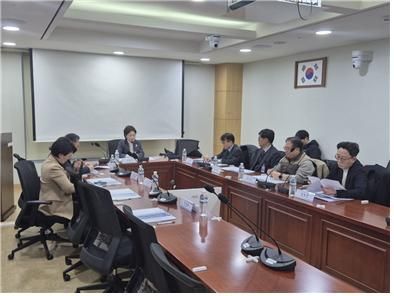 Eonju Lee, Supreme Council Member of the Democratic Party of Korea (center in photo), is holding the 2nd meeting of the 'National Assembly Advanced Strategic Industry and Energy Forum' on the 23rd. 2025.1.23 Provided by Eonju Lee's Office
During Donald Trump's second term in office, it was revealed that the three domestic battery companies plan to invest a total of 73 trillion won in the United States. Amid speculation about the possible repeal of the Inflation Reduction Act (IRA) since President Trump's inauguration, there are calls for the political and government sectors to actively inform the U.S. side of Korean companies' investment plans in the U.S. to ensure the retention of the Advanced Manufacturing Production Tax Credit (AMPC) clause under the IRA.
On the 23rd, Lee Eon-ju, Supreme Council Member of the Democratic Party of Korea, held the 2nd meeting of the 'National Assembly Advanced Strategic Industry and Energy Forum' at the National Assembly Members' Office Building to discuss trends in the electric vehicle and autonomous vehicle industries and measures to strengthen global competitiveness.
At the meeting, Kim Seung-tae, Policy Director of the Korea Battery Industry Association, who participated as a panelist, stated, "The three battery companies are planning to establish 14 factories in seven regions across the U.S. While they invested $4.5 billion (approximately 6.4 trillion won) during the Joe Biden administration, they plan to invest $50.9 billion (approximately 73.1 trillion won) during Trump's second term." The Battery Industry Association plans to actively promote this through outreach activities in the U.S. and requested strong support from the National Assembly.
The AMPC included in the IRA is a type of subsidy provided by the U.S. government to companies that produce and sell batteries domestically. Battery cells receive benefits of $35 per kilowatt-hour (kWh), and modules receive $10 per kWh. Kim said, "Last year, the three domestic battery companies received an estimated 1.3 trillion won in benefits from the AMPC," adding, "If the AMPC is abolished, the damage to companies will be significant."
In response, Representative Lee Eon-ju promised active support, stating, "We will spare no effort at the National Assembly level, including parliamentary diplomacy and domestic legislative support." Lee added, "The global electric vehicle battery market is essentially divided between China and us. If a trade chill under Trump occurs, our industry will inevitably suffer more damage compared to China, which has a relatively large domestic market and government-led support measures," emphasizing, "It is necessary to highlight that China's market monopoly is not beneficial to the U.S."
Kim Ju-hong, Executive Director of the Korea Automobile Mobility Industry Association, who presented at the event, explained that in preparation for the repeal or suspension of electric vehicle preferential policies under Trump's second term, the electric vehicle industry is preparing countermeasures such as securing manufacturing flexibility to meet increased demand for hybrids (HEVs) and reducing production costs in anticipation of IRA subsidy reductions, diversifying investments and exports to other regions such as ASEAN, and emphasizing Korea's economic contributions to the U.S. during external cooperation activities.
In the domestic electric vehicle industry, to ensure manufacturing flexibility, if the IRA is repealed, production of hybrid vehicles at U.S. electric vehicle-dedicated factories is being considered. Additionally, efforts are underway to diversify exports to ASEAN regions such as Indonesia and Vietnam.
Seo Jae-hyung, President of the Intelligent Automotive Parts Promotion Institute, stated that autonomous driving technology is a constant source of the mobility industry and a national economic driver. While domestic autonomous driving mobility commercialization parts are competitive in terms of performance, reliability, price, and mass production, Korea is at a disadvantage in artificial intelligence (AI), software, and connected technologies.
He explained that innovation centered on software is necessary for the transition to future vehicles, but Korea's export-oriented ecosystem, which makes it difficult to establish a self-sufficient domestic industry, hinders innovative transitions such as horizontal restructuring of supply chains.
Representative Lee Eon-ju announced, "To foster the autonomous driving mobility ecosystem, we will hold a public hearing to explore solutions through a mega sandbox for issues that cannot be resolved by the current regulatory sandbox." The event was attended by National Assembly members including Jeong Seong-ho and Kwon Hyang-yeop of the Democratic Party of Korea, who listened to industry trends and discussions.
© The Asia Business Daily(www.asiae.co.kr). All rights reserved.

















