Lottery Sales Increase Every Year
Estimated Lottery Sales to Reach 7.6879 Trillion Won This Year
Controversies Over Manipulation and Low Prize Money Spark Complaints
Yang Mo (29), an office worker living in Yangcheon-gu, Seoul, buys 5,000 won worth of lottery tickets every Monday at a lottery store near his home. Yang said, "I buy the lottery every week because I think I can't make big money just by working," adding, "It's the price of a cup of coffee, but imagining winning the lottery makes my week enjoyable."
 Generally, lottery tickets are considered a "recession-type product" that sells well during economic downturns. This is because the harder life gets, the more people dream of striking it rich overnight. Getty Images
Despite the sharp contraction in consumer sentiment due to high inflation and high interest rates, the lottery industry is enjoying a boom on its own. This is interpreted as a result of the increasingly difficult lives of ordinary people and growing uncertainty about the future, leading more people to hope for a windfall.
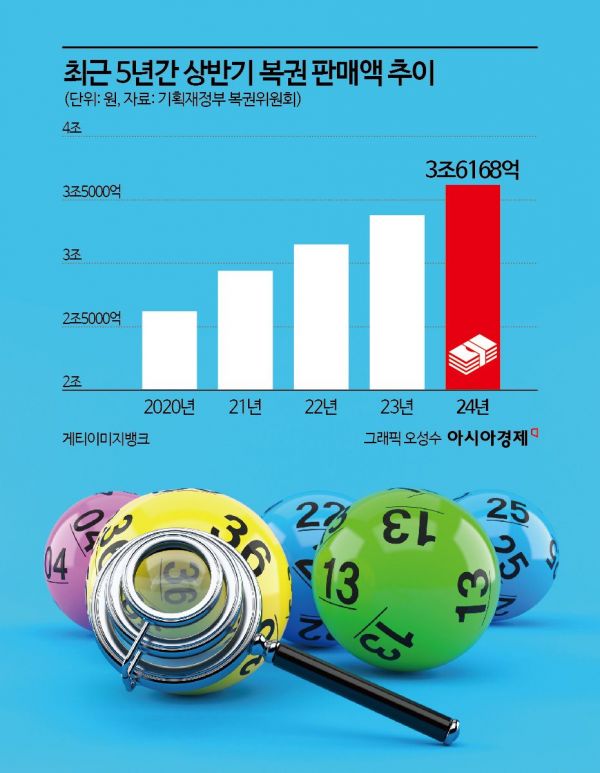
According to the Ministry of Economy and Finance's Lottery Commission (Lottery Commission), lottery sales in the first half of last year totaled 3.6168 trillion won, a 7.0% increase compared to the same period the previous year (3.379 trillion won). First-half lottery sales have increased every year, from 2.6205 trillion won in 2020 to 2.9391 trillion won in 2021, and then surpassing 3 trillion won at 3.1473 trillion won in 2022. With rising demand for lottery tickets, the estimated annual lottery sales for this year are projected at 7.6879 trillion won.
Generally, lotteries are 'recession-type products' that sell well when the economy is tough. This is because the harder life gets, the more people dream of a sudden fortune. However, lottery sales do not necessarily increase during every recession. For example, during the full impact of the 1998 foreign exchange crisis, lottery sales dropped sharply by 12.4% to 320.9 billion won compared to the previous year. During the global financial crisis in 2008, lottery sales increased by only 0.5% to 2.394 trillion won compared to the previous year.
Some argue that uncertainty about the future has led to the lottery craze. Since the rate of increase in prices and housing costs is faster than asset accumulation through labor such as working at a job, people give up on realistic expectations and instead aim for a chance at sudden wealth.
In fact, social mobility has become increasingly difficult over the years. According to the '2017-2022 Income Mobility Statistics' released by Statistics Korea in December last year, 34.9% of people changed their income class (income quintile) compared to the previous year as of 2022. This means that one in three people experienced a change in income class. However, only 17.6% of them moved up to a higher income quintile. The proportion of people moving to a higher income quintile compared to the previous year was 18.1% in 2018, 18.0% in 2019, and 18.2% in 2020, but dropped to 17.6% in both 2021 and 2022.
Although everyone buys lottery tickets hoping for a sudden fortune, manipulation controversies recur every year. In particular, the 1057th Lotto draw on March 4, 2023, became problematic when 664 people won second prize. Normally, the number of second prize winners is less than 100. When the controversy grew, the Lottery Commission stated, "Among the 664 winning tickets, 609 were manually selected with specific numbers," and that "this was a result of a random draw."
Complaints about the prize money have also continued. Due to the prize money being low relative to inflation, even winning first prize does not guarantee a life-changing fortune. For example, the first housing lottery ticket in 1969 cost 100 won, with a first prize of 3 million won. Considering that the average price of a house in Seoul at that time was about 2 million won, the prize money was enough to fulfill the dream of owning a home in one go. However, now, after taxes, the average first prize of about 2 billion won in Lotto is said to be insufficient to buy even an apartment in Gangnam.
In this regard, the Korea Institute of Public Finance, a government research institute, analyzed in its report 'Determination of Lottery (Lotto 6/45) Prices' that "Since COVID-19, asset prices such as stocks and real estate have risen very sharply," and "In a situation where most asset and goods prices are rising, the value of the Lotto first prize amount can be felt as relatively low."
© The Asia Business Daily(www.asiae.co.kr). All rights reserved.



















