Real GDP Growth Rate at 0.1% in Q4 Last Year
0.4 Percentage Points Lower Than Bank of Korea's Forecast
Martial Law Impact Hits Lodging and Restaurant Consumption
Main Downturn Factor: Sluggish Construction Investment
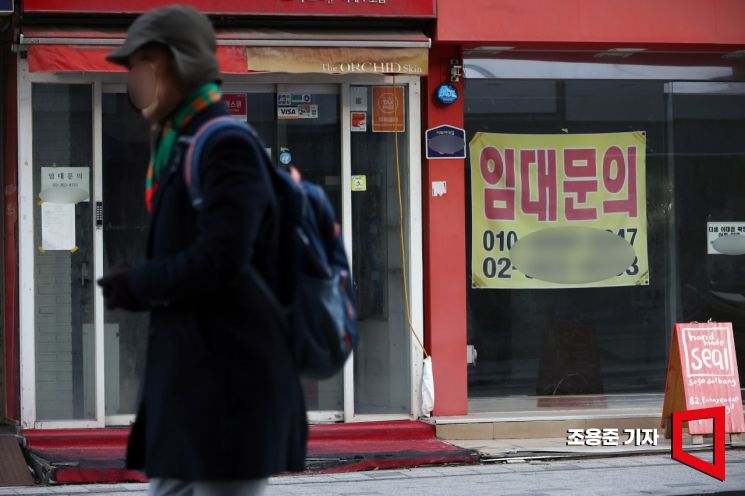 Amid domestic and international adverse factors such as economic recession and sluggish domestic demand, the number of store closures among small business owners is rapidly increasing. On the 26th, vacant stores lined up in a commercial area densely populated with shops in Sinchon, Seoul. Accordingly, the amount of closure compensation for small business owners exceeded 1.3 trillion won this year, marking an all-time high. Photo by Jo Yongjun
The government analyzed that the 0.1% growth in real Gross Domestic Product (GDP) in the fourth quarter of last year was due to political instability, similar to a martial law situation, which worsened private consumption. It explained that the contraction in construction investment due to sluggish orders was worse than expected. However, it judged that the economic contraction effect caused by tax revenue shortages was minimal.
On the 23rd, Lee Seung-han, Director of the Comprehensive Policy Division at the Ministry of Economy and Finance, met with reporters at the Sejong Government Complex and said about last year’s GDP, “Political instability is estimated to have had the greatest impact on private consumption,” adding, “If there had been no political instability, private consumption would have at least been maintained or improved as high inflation and high interest rates eased and income conditions improved.” He explained that consumer sentiment shrank following the emergency martial law declared by President Yoon Seok-yeol on December 3 last year, negatively affecting food, lodging, and retail sectors, which pulled down the GDP.
The Bank of Korea announced on the same day that the GDP growth rate for the fourth quarter of last year was 0.1%, and the annual growth rate was 2.0%. The fourth-quarter growth rate is 0.4 percentage points lower than the Bank of Korea’s forecast of 0.5% made in November last year.
The most decisive factor for the GDP decline was identified as the sluggishness in construction investment. Director Lee said, “We expected construction investment to be a negative factor due to sluggish orders, but the actual impact was greater,” adding, “Basically, the progress rate of construction work was poor.” He further explained, “It seems that a combination of factors such as construction financing conditions, sluggish local real estate markets, and rising construction costs worked together to produce unfavorable results.”
However, he cautiously predicted that the situation this year would be better than last year. Director Lee forecasted, “Since orders have been positive since last year, although gradual, the second half of the year is expected to be better than the first half.”
Regarding concerns that tax revenue shortages might have lowered the growth rate, he stated that the impact was “minimal.” He evaluated, “The government contributed 0.4 percentage points to growth,” and added, “From 2000 to 2023, the government’s average contribution rate was about 19%, so the impact of tax revenue shortages was not significant.”
© The Asia Business Daily(www.asiae.co.kr). All rights reserved.

















