Shipment Volume Hit 44.19 Million Tons Last Year, Lowest in 35 Years
"Double Whammy" from December 3 Martial Law and High Exchange Rates
Industry Missed Out on December Demand Surge
The cement industry, which is experiencing unprecedented management difficulties, has faced a 'double whammy' as it missed the December demand boost due to the 12·3 emergency martial law. Experts predict that the industry conditions will not improve for the time being as the structural recession continues amid sustained high exchange rates and high inflation.
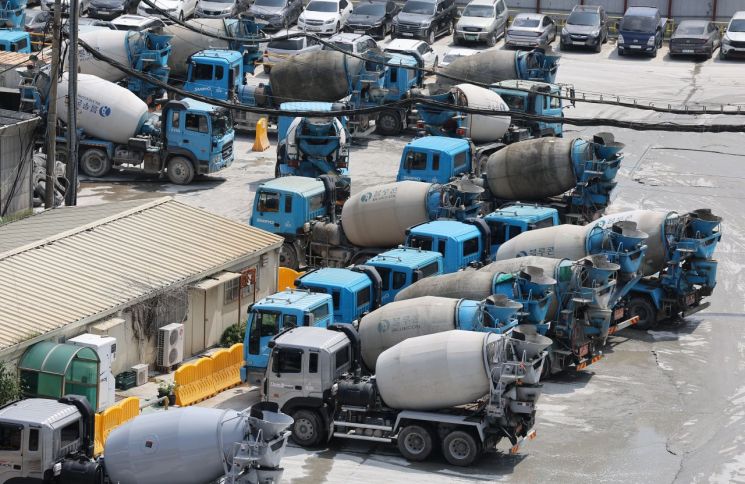
According to a survey conducted by the Korea Cement Association on 9 member companies on the 23rd, last year's cement shipment volume totaled 44.193 million tons, a 13.3% decrease compared to the previous year (50.963 million tons). This is the lowest figure in 35 years since the association began compiling statistics. Production volume was 41.931 million tons, down 18.0% from the previous year (51.116 million tons). Han Chansu, director of the Korea Cement Association, said, "Due to the difficult construction market, shipments sharply declined from the second half of last year, marking the worst record in 35 years," adding, "This year, shipments are expected to be around 40 million tons, and including exports, approximately 43 million tons, which means a regression to the level of the 1980s."
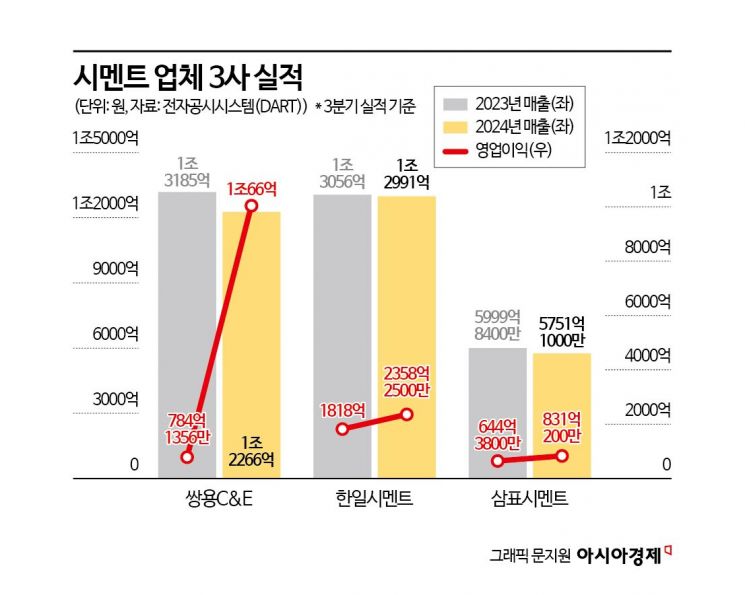
The cement industry fell into a sharp slump from the second half of last year as the construction market, its upstream industry, deteriorated. In the third quarter of last year, the sales of Ssangyong C&E, the industry leader, were 1.2266 trillion won, down 7.1% compared to the same period last year, while sales of Hanil Cement and Sampyo Cement decreased by 0.5% and 4.15%, respectively. As a desperate measure starting two years ago, the industry raised prices, which slightly increased operating profits, but overall, the defensive effect was minimal. Director Han said, "We managed to hold on to this extent by raising prices several times over two years," lamenting, "It will be difficult to raise prices further, and with numerous adverse factors such as the real estate recession and rising prices, there is no sign of improvement."
The impact of the 12·3 emergency martial law last month was particularly severe. Generally, the cement industry tends to increase shipments sharply in December, just before the low season of January and February, but due to the martial law, consumer sentiment was greatly dampened, and the soaring exchange rate increased the burden of importing thermal coal. An industry insider said, "In our industry, December is considered a special demand period because shipments are concentrated before the start of the winter season in January and February, but last year, due to the martial law, the figures were noticeably lower compared to previous years," adding, "The burden of thermal coal, which is 100% imported, increased, and electricity rates also rose, affecting the industry."
Experts forecast that the industry recession will continue for the time being amid domestic and international uncertainties. Song Chayoung, a professor in the Department of Architecture at Gwangju University, analyzed, "In the past, even if the real estate market was temporarily weak, the continuous influx of population quickly resolved the situation, but now, due to population decline, the situation is completely different," adding, "The recession is expected to continue for 3 to 5 years, and a domino effect is likely to occur, especially among relatively weak small and medium-sized enterprises."
© The Asia Business Daily(www.asiae.co.kr). All rights reserved.


















