Trump Administration Pledges High Tariffs on China
"America First Policy Will Have an Impact"
Concerns Raised Over Low Growth Potential of Chinese Factory
"Long-Term Strategy Should Be to Withdraw from China"
SK Hynix, which achieved record-high performance last year, is expected to smoothly complete the final payment for Intel's NAND flash business acquisition scheduled for March. Going forward, SK Hynix will take over Intel's NAND business-related IP (intellectual property rights) and the operational personnel of the Dalian factory in China. While resolving uncertainties and absorbing not only facilities but also technology and personnel is positive, considering the strengthened China-related economic measures under the second Trump administration and the worsening NAND market conditions, the outlook is not entirely optimistic.
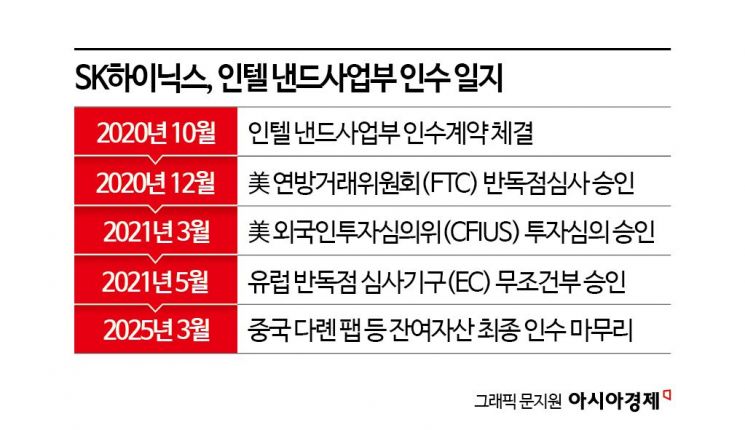
According to the semiconductor industry on the 23rd, SK Hynix completed the first payment of $7 billion in 2021 and will make the remaining payment of $2 billion in March to finalize the merger and acquisition (M&A) of Intel's NAND flash and SSD (solid-state drive) business. An SK Hynix official explained, "Once this deal closes, the operational authority of the Dalian factory will be fully transferred, resulting in overall unification."
SK Hynix has overcome the weakness in the NAND business at once through the Intel acquisition. Until then, the NAND flash business was SK Hynix's "sore spot." While Hynix consistently maintained the second-largest position in DRAM following Samsung Electronics, it remained the fifth-largest player in the NAND business. However, it now solidifies its position as the second-largest player in both DRAM and NAND, forming a clear duopoly in memory semiconductors alongside Samsung Electronics.
Recently, as the second Trump administration's crackdown on China began, negative forecasts emerged regarding SK Hynix's acquisition of the Chinese factory. Since former U.S. President Donald Trump has pledged high tariffs on China, concerns about increased business risks are inevitable. There are also predictions that the rapid growth of Chinese companies will gradually reduce dependence on Korean semiconductors.
"Due to the Trump administration's China crackdown... Operating cutting-edge processes will not be easy"
Yu Hoe-jun, president of the Semiconductor Engineering Society and professor in the Department of Electrical Engineering at KAIST, commented on SK Hynix's Intel acquisition, saying, "There will be an impact from the Trump administration's 'America First' policy. In the long term, it could serve as a good leverage once relations with China improve, but currently, it feels more like receiving 'junk'."
Experts particularly expressed a negative outlook on the growth potential of the NAND flash business at the Chinese factory. While the NAND flash market is generally expected to expand demand for the time being due to the AI boom and data center expansion, there are concerns that the Chinese business could become a hindrance.
Lee Chang-han, former vice chairman of the Korea Semiconductor Industry Association, evaluated, "Hynix may maintain overall volume in the short term, but doing business in China itself is extremely risky." He added, "It is difficult to form a high-end product lineup in China with the current memory business alone. Only supplementary investments to produce existing volumes are possible, while new investments in cutting-edge technology are difficult."
Kim Yong-seok, distinguished professor at Gachon University Semiconductor College who worked at Samsung Electronics for over 30 years, said, "Even if NAND flash produced by SK Hynix, Samsung Electronics, and others in China is consumed locally to some extent, exports to the U.S. cannot be completely ruled out. There will be their own judgments, but if Trump's harassment of China continues, importing equipment for process upgrades will also be difficult."
Professor Kim also analyzed the growth of Chinese semiconductor companies as a variable from a long-term perspective, in addition to the uncertainty triggered by the Trump administration. He said, "As Chinese companies gradually increase their memory production capacity (CAPA), they will try to reduce dependence on Korean semiconductor companies. Negotiations with Trump are important for now, but in the long term, I think we should gradually withdraw from China."
Weak NAND flash demand and oversupply expected this year
The outlook for the NAND market is not bright either. It is expected that major semiconductor companies worldwide will begin cutting NAND flash production this year. According to market research firm TrendForce, the NAND flash industry will face dual pressures of weak demand and oversupply this year. TrendForce stated, "In response, manufacturers such as Micron (U.S.), Samsung Electronics, SK Hynix (including Solidigm), Kioxia, and SanDisk are planning production cuts," adding, "These cuts are mainly implemented by lowering utilization rates and delaying process upgrades."
The reason NAND manufacturers are resorting to production cuts is the continued deterioration of market conditions. Due to increased internal and external uncertainties, shipments of key consumer electronics such as smartphones and laptops continue to be sluggish, and even the previously robust enterprise solid-state drive (SSD) market is slowing down due to reduced IT investment.
NAND prices are also continuously falling. Since the third quarter of last year, NAND prices have been declining, and pessimistic forecasts for demand in the first half of this year have emerged.
The aggressive stance of Chinese memory companies is also cited as a reason. TrendForce said, "Chinese suppliers are aggressively expanding production supported by domestic substitution policies, intensifying global market competition." According to TrendForce, Micron has already announced NAND production cuts, and Kioxia and its partner SanDisk are preparing similar measures. Additionally, Samsung Electronics is facing increased inventory pressure due to intensified competition in the Chinese market and continuous transitions to new technologies, and SK Hynix is also analyzed to need adjustments in its production strategy.
© The Asia Business Daily(www.asiae.co.kr). All rights reserved.
![Clutching a Stolen Dior Bag, Saying "I Hate Being Poor but Real"... The Grotesque Con of a "Human Knockoff" [Slate]](https://cwcontent.asiae.co.kr/asiaresize/183/2026021902243444107_1771435474.jpg)

















