Abolishing Unreasonable Regulations and Rapid Budget Execution
Comprehensive Support Plan for Livelihood Recovery Across Four Key Sectors
Seocho-gu, Seoul (Mayor Jeon Seong-su) is launching a full-scale implementation of the ‘Comprehensive Support Measures for Livelihood Recovery.’
The main goal of this comprehensive plan is to revive livelihoods across various sectors such as the economy, daily life, welfare, and healthcare, actively identify and improve unreasonable regulations, and execute projects promptly through rapid budget spending.
The plan aims to maximize project effectiveness by strengthening interdepartmental collaboration, increase momentum through frontline employees’ proactive regulatory reform efforts, and advance budget utilization. On the 20th, the district held a ‘Comprehensive Support Measures for Livelihood Recovery Report Meeting’ to prepare these initiatives.
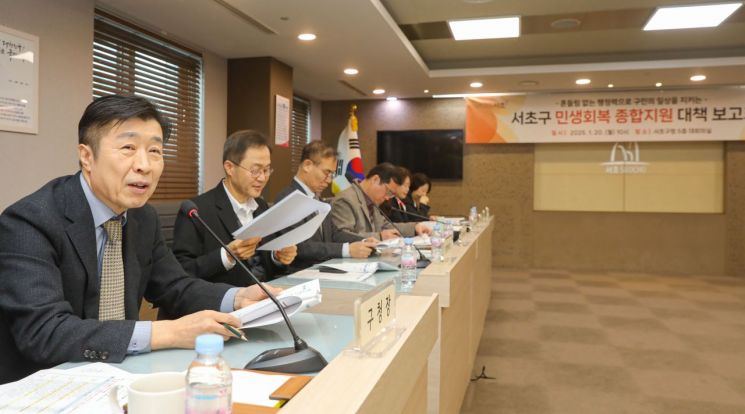 Jeon Seong-su, Mayor of Seocho District (left in the photo), emphasized practical support that residents can feel during the comprehensive support measures briefing for livelihood recovery held on the 20th. Provided by Seocho District.
To support livelihood recovery, Seocho-gu has prepared a total of 20 detailed support measures across four major areas: economy, residents’ daily life, welfare, and healthcare. In the economic sector, the district will invest a record-high 60 billion KRW to revitalize neighborhood commercial districts through the ‘Munjeonseongsi Project.’ It will also work on creating distinctive streets and establishing a differentiated global tourism brand for the ‘First Terminal and Sebit Tourism Special Zone Embracing the Han River,’ designated last year.
In the residents’ daily life sector, the district will expand programs such as interest support for rental deposit loans for newlyweds and youth, and a lifelong education voucher program worth approximately 350,000 KRW annually for residents aged 19 and older.
In the welfare sector, the district will support healthy eating habits by providing meal vouchers to family care youth and young adults, and assist self-reliance by expanding customized jobs for people with disabilities and low-income groups.
In the healthcare sector, the district plans to expand pertussis vaccinations, vitamin D tests for senior health checkups, dementia treatment management fees, and newly implement medical expense support for prenatal health management.
Alongside these efforts, the district will actively work to eliminate unreasonable regulations that cause inconvenience to residents’ daily lives and economic activities. Previously, the district signaled a green light for reconstruction projects by easing soil fluoride regulations and significantly improved convenience for residents by being the first nationwide to relax large supermarket business regulations. Additionally, practical regulatory improvements for small business owners were achieved by reducing the exclusion criteria for food promotion fund loans and easing the designation requirements for alley-type shopping districts.
Building on these achievements, the comprehensive plan newly identifies a total of 22 regulatory reform tasks in areas such as resolving resident inconveniences, easing economic regulations, strengthening welfare services, and increasing administrative efficiency. Moving forward, the district will operate a permanent Regulatory Reform Reporting Center to continuously identify and improve regulations that cause inconvenience to residents, and establish a new Regulatory Reform Committee composed of experts from various fields to promote tangible regulatory elimination that residents can feel.
To boost the domestic economy and consumer sentiment recovery, the district will lead efforts by promptly releasing the budget. In the first quarter, it will designate priority management projects and execute 179.5 billion KRW early, while intensively managing large-scale investment projects such as construction and services to increase the speed and scale of budget execution. The district also plans to systematically manage execution status by forming a ‘Rapid Execution Task Force’ and holding monthly progress report meetings, which is expected to drive real recovery of the livelihood economy.
Mayor Jeon Seong-su stated, “The most important aspect of district administration is ‘plus administration’ that helps residents’ daily lives,” adding, “We will focus all administrative power on faithfully implementing the ‘Comprehensive Support Measures for Livelihood Recovery’ that revives livelihoods, reduces regulations, and releases budgets, becoming a strong pillar that protects residents’ daily lives.”
© The Asia Business Daily(www.asiae.co.kr). All rights reserved.

















