Michael Beeman Offers Strategy for Responding to Trump's Second Term
Led Korea-U.S. FTA Negotiations During Trump's First Term
"Consider Ways to Help Reduce U.S. Trade Deficit"
A suggestion has emerged that South Korea should present an 'additional contribution' as a new negotiation card to respond to the second term of Trump, which has forecasted a major upheaval in the global trade order. Since the Trump administration views trade policy from a 'zero-sum' perspective, this is interpreted as a strategy for South Korea to emphasize that it does not harm the interests of the United States.
Michael Beeman, former Deputy U.S. Trade Representative (USTR), expressed this view on the afternoon of the 21st at the Grand Intercontinental Parnas Hotel in Gangnam-gu, Seoul, during the '2025 KITA World Trade Forum' hosted by the Korea International Trade Association (KITA). He stated that South Korea's 'additional contribution' to the U.S. is necessary to avoid the 'universal tariff' announced by President Donald Trump or to respond to the renegotiation of the Korea-U.S. Free Trade Agreement (FTA).
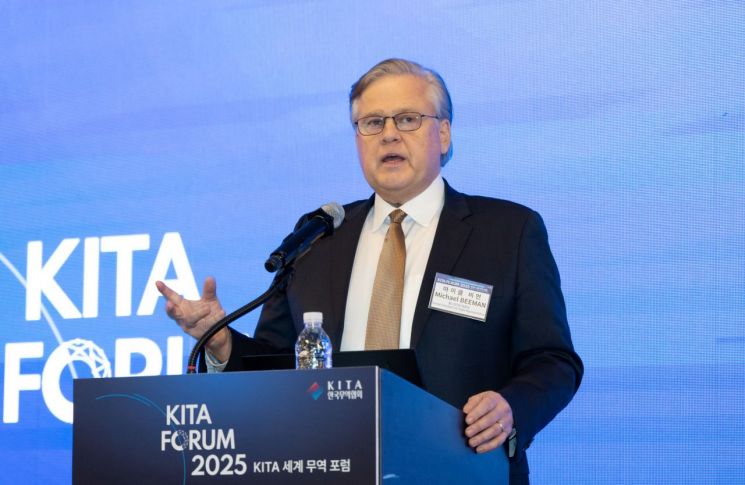 Michael Beeman, former Deputy U.S. Trade Representative (USTR), is giving a special lecture at the "2025 KITA World Trade Forum" hosted by the Korea International Trade Association (KITA) at the Grand InterContinental Parnas Hotel in Gangnam-gu, Seoul, on the afternoon of the 21st. Photo by Korea International Trade Association
In a discussion on the future of Korea-U.S. economic cooperation coinciding with the launch of Trump's second term, former Deputy Beeman said, "Although there has been no immediate 'big bang' statement about imposing universal tariffs, various transformative statements are expected in the future," adding, "If the Korea-U.S. FTA renegotiation takes place, the universal tariff issue will be set aside, but it should also be considered that the new negotiations themselves may not follow the traditional patterns of trade negotiations."
President Trump has pledged to impose universal tariffs of around 10-20% on products imported from virtually all trading partners. He advocates 'fair' trade instead of 'free' trade. The general assessment is that the purpose is to eliminate the U.S. trade deficit by using tariffs and subsidies as policy tools.
Regarding the Trump administration's strategy, former Deputy Beeman said, "From the U.S. perspective, which holds a zero-sum view, it is necessary to consider what kind of card would make them feel 'this is balanced enough,'" mentioning South Korea's shipbuilding industry, which has drawn a love call from President Trump. He also added, as a 'personal opinion,' that South Korea's new negotiation card should target areas that can reduce the U.S. deficit.
He said, "The U.S. is concerned about deficits with South Korea, the European Union (EU), Japan, Mexico, Canada, and others," and added, "It would be good for South Korea to appeal that it helps contain China or, even if not just China, assists in controlling other countries through customs cooperation and other aspects."
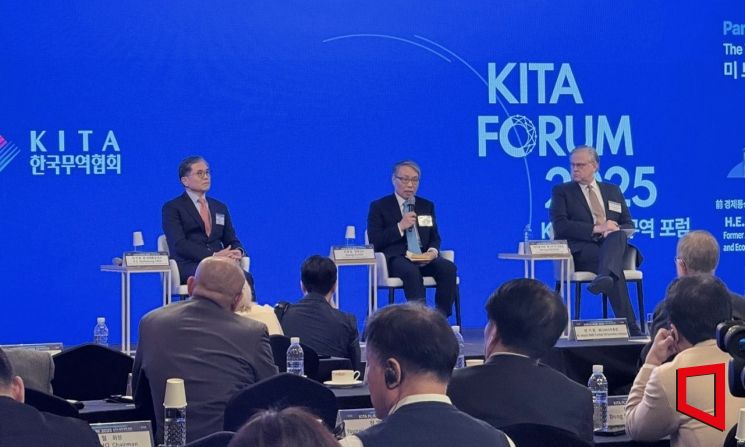 (From left) Choi Seok-young, former Ambassador for Economic and Trade Affairs at the Ministry of Foreign Affairs, Choi Byung-il, Professor Emeritus at Ewha Womans University, and Michael Berman, former Deputy U.S. Trade Representative (USTR), are discussing the future of Korea-U.S. economic cooperation at the "2025 KITA World Trade Forum" hosted by the Korea International Trade Association (KITA) on the afternoon of the 21st at the Grand InterContinental Parnas Hotel in Gangnam-gu, Seoul. Photo by Jang Hee-jun
When asked, "Theoretically, universal tariffs could also be imposed on FTA countries; how should South Korea respond?" former Deputy Beeman answered by reflecting the 'mindset' of officials from Trump's first term.
He said, "To be frank and more direct, those who worked in the Trump first-term administration would support the current policy direction as it aims to revitalize U.S. manufacturing and production facilities," adding, "It is a perspective that sees the need for measures to increase domestic production in the U.S."
He repeatedly emphasized South Korea's 'additional contribution.' Former Deputy Beeman said, "The U.S. wants to have more production facilities on its own soil, so it would be good to think about how South Korea can help with that and how South Korea can assist the trade policies promoted by Trump."
© The Asia Business Daily(www.asiae.co.kr). All rights reserved.


















