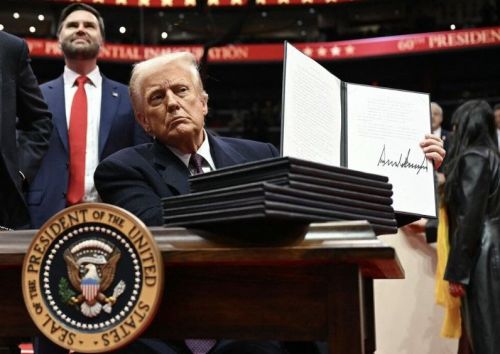
On the 20th (local time), U.S. President Donald Trump issued around 40 executive orders immediately upon taking office, as he had previously announced. A significant number of these orders pertain to energy-related matters, including withdrawal from the Paris Climate Agreement, declaration of a U.S. energy emergency, unleashing American energy, temporary suspension of offshore wind lease sales on the outer continental shelf, and review of wind power projects.
Among these, the provisions concerning the mandatory adoption of electric vehicles (EVs) and subsidies, which attracted attention from domestic electric vehicle and secondary battery companies, are included in the "Unleashing American Energy" executive order.
Article 2 of this executive order states that, for economic growth and innovation, the mandatory EV provisions will be repealed to promote genuine consumer choice.
Since there is no explicit regulation in U.S. law mandating electric vehicles, this executive order is interpreted as meaning the repeal or relaxation of various environmental regulations implemented by the previous Joe Biden administration to expand EV adoption.
As specific methods to repeal the EV mandate, the executive order proposes removing regulatory barriers to vehicle access, ensuring a fair regulatory competitive environment for vehicle choice, terminating state government emission regulations that restrict gasoline vehicle sales where appropriate, and reviewing the elimination of unfair subsidies and market distortions that favor EVs over other technologies.
First, the U.S. Environmental Protection Agency (EPA) is expected to significantly relax EV fuel efficiency regulations. Last April, the EPA set the allowable carbon dioxide emissions for passenger cars at 82 grams per mile by 2032. To meet this standard, 67% of new cars sold in 2032 would need to be electric vehicles, effectively constituting a de facto EV mandate. The U.S. has also encouraged EV adoption through the Corporate Average Fuel Economy (CAFE) standards, which impose fines if the average fuel efficiency of vehicle models falls below the set threshold.
It appears practically difficult to enforce state government vehicle emission regulations as proposed in the executive order. Some states independently pursue strong policies to expand eco-friendly vehicles. For example, California has banned the sale of new internal combustion engine vehicles by 2035.
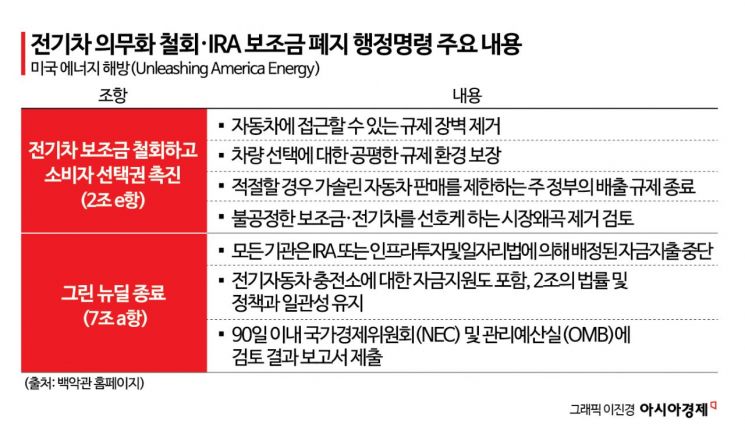
The "Unleashing American Energy" executive order also includes provisions related to the repeal of the Inflation Reduction Act (IRA), which has drawn attention from the domestic secondary battery industry.
Article 7 (Termination of the Green New Deal) directs the immediate cessation of fund expenditures allocated under the IRA or the Infrastructure Investment and Jobs Act (IIJA). This includes subsidies for infrastructure investments and electric vehicle charging stations but is not limited to these.
The EV subsidies under the IRA mainly consist of the Electric Vehicle Tax Credit (Section 30D), which provides up to $7,500 in tax credits to general consumers, and the Advanced Manufacturing Production Credit (AMPC, Sections 45X), which offers investment tax credits to companies. Although the executive order does not specify which expenditures to halt, the emphasis on consumer choice suggests it refers to Section 30D.
Junmo Park, a U.S. attorney at Yulchon LLC, stated, "Article 7 directs the termination of the Green New Deal while including a caveat in Article 2 to maintain consistency with laws and policies. Since Article 2 emphasizes consumer choice, it is reasonable to interpret this as referring to Section 30D."
While the executive order instructs the cessation of fund expenditures under the IRA, amending or repealing the IRA requires congressional approval, so significant time and challenges are expected.
Domestic secondary battery companies have anticipated that even if IRA subsidies are reduced, the AMPC provisions are likely to be maintained, as many of the regions in the U.S. where these companies have invested are represented by Republican lawmakers.
In fact, in August last year, 18 Republican members of the U.S. House of Representatives expressed opposition to the full repeal of the Inflation Reduction Act, stating that it would be the worst outcome after pouring billions of taxpayers' dollars with no returns. Among them, 15 were re-elected in the congressional elections held alongside the presidential election in November last year.
Among the electoral districts where Korean battery companies have production facilities, Indiana, Ohio, Kentucky, and Tennessee are all represented by Republicans holding both Senate seats. Michigan and Georgia are represented by Democrats holding both Senate seats, while Arizona has one Democratic and one independent senator.
© The Asia Business Daily(www.asiae.co.kr). All rights reserved.
![Clutching a Stolen Dior Bag, Saying "I Hate Being Poor but Real"... The Grotesque Con of a "Human Knockoff" [Slate]](https://cwcontent.asiae.co.kr/asiaresize/183/2026021902243444107_1771435474.jpg)

















