The Korea Forest Service will nurture and utilize forests as key assets to address social issues such as the climate crisis and regional extinction.
The Korea Forest Service announced its ‘2025 Major Work Promotion Plan’ on the 21st. The plan includes carrying out 10 detailed tasks centered on five major strategies: public safety, climate crisis response, support for forestry workers, regional development, and new industrialization.
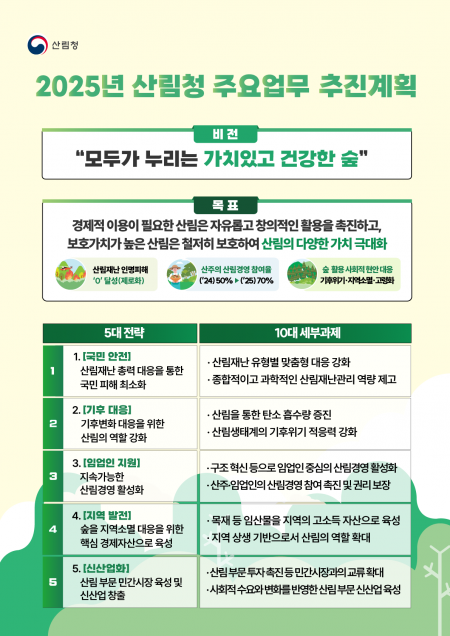
◆ Strengthening the Role of Forests in Responding to Climate Change = To increase the carbon absorption capacity of forests, sustainable forest management is essential, which involves harvesting trees for use as wood resources and replanting trees in the harvested areas.
To this end, the Korea Forest Service plans to promote the enactment of the ‘Wooden Architecture Activation Act’ and the ‘Forest Road Installation Act’ this year to establish an institutional foundation that can activate wood utilization. Additionally, 196 urban forests will be newly created nationwide, and green spaces will be expanded on idle lands such as reclaimed land to increase carbon sinks.
Efforts to secure overseas carbon sinks will also accelerate. The ‘Reducing Emissions from Deforestation and Forest Degradation in Developing Countries (REED+)’ project in Southeast Asia will be fully implemented, and the target countries will be expanded to Central and South America and Africa. The Korea Forest Service aims to secure 5 million tons of overseas carbon reduction in the forestry sector by 2030.
To strengthen the climate crisis adaptability of forest ecosystems, the ‘Forest Protection Act’ will be amended, and this year, the legal basis for managing ‘Other Effective Area-based Conservation Measures (OECMs),’ a biodiversity conservation tool recognized by the European Union, will also be established.
◆ Activating Sustainable Forest Management = This year, the Korea Forest Service will newly construct 1,000 km of forest roads, essential facilities for forest management, and will gradually purchase small-scale and fragmented private forests (3,573 hectares) to strengthen a scaled forest management structure.
Furthermore, the ‘Forest Land Pension-type’ private forest purchase program, which pays the purchase cost over 5 to 10 years in installments, will be continuously expanded to stabilize the elderly livelihood of forest owners. At the same time, a ‘Forest Land Trading Platform’ connecting forest owners (suppliers) and forestry workers (demanders) who want to use the forest land will be established and operated to improve efficiency in forest land use and forest management.
In particular, an ecosystem will be built where timber produced locally is utilized as a high value-added industry within the region, allowing forest resources to establish themselves as key economic assets in responding to regional extinction. The forest will be developed as a regional tourism resource by introducing ‘Mountain Village Stay-type Rest Areas’ where lodging is possible within the forest, and expanding forest welfare service infrastructure such as natural recreation forests and forest camping sites as measures to respond to regional extinction.
◆ Responding to Forest Disasters to Minimize Public Damage = Measures to minimize public damage from year-round and large-scale forest disasters caused by climate change will also be strengthened. Based on the ‘Forest Disaster Prevention Act’ enacted at the end of last year, a foundation for integrated management of various forest disasters will be established from this year, enabling rapid and effective response through cooperation among related organizations when forest disasters occur.
Specifically, in the wildfire response sector, 16 new ‘multipurpose wildfire suppression vehicles’ optimized for domestic mountainous environments will be introduced and deployed on-site from this year to strengthen wildfire suppression capabilities. Additionally, support for the collection and shredding of agricultural by-products in farming villages will be enhanced to prevent illegal burning, which is identified as a major cause of wildfires.
To prevent landslide damage during the summer, 1,000 additional check dams will be installed nationwide, and a rapid resident evacuation system will be established through cooperation among fire departments, police, village chiefs, and neighborhood association councils to minimize casualties in the event of landslides.
Lim Sang-seop, Administrator of the Korea Forest Service, said, “We will ensure that forests can be utilized as key assets to solve social issues such as the climate crisis and regional extinction. To this end, the Korea Forest Service will actively utilize forests that require economic use and thoroughly protect forests with high conservation value to ensure harmonious forest management.”
© The Asia Business Daily(www.asiae.co.kr). All rights reserved.
![User Who Sold Erroneously Deposited Bitcoins to Repay Debt and Fund Entertainment... What Did the Supreme Court Decide in 2021? [Legal Issue Check]](https://cwcontent.asiae.co.kr/asiaresize/183/2026020910431234020_1770601391.png)
















