Four-Year Renewable Term, Decentralized Presidential System, and Parliamentary System Discussed
"Political Engineering Constitutional Amendment"
Concerns Raised Over Side Effects of Presidential System Reform
As the presidential impeachment motion passed the National Assembly for the third time in history, the political sphere is evaluating that the five-year single-term presidential system has reached its limits. The five-year single-term system, introduced alongside direct elections under the 9th constitutional amendment in 1987, was the people's choice to prevent long-term rule and dictatorship. However, among the eight presidents elected since then (Roh Tae-woo, Kim Young-sam, Kim Dae-jung, Roh Moo-hyun, Lee Myung-bak, Park Geun-hye, Moon Jae-in, Yoon Seok-youl), three (Roh Moo-hyun, Park Geun-hye, Yoon Seok-youl) have faced impeachment trials, raising questions about whether the current presidential system is desirable. This is because, looking at past cases where presidential authority and abuse of power were grounds for impeachment, the so-called 'imperial presidency' was facilitated by the five-year single-term system.
Limits of the Five-Year Single-Term Presidential System
Political conflicts surrounding presidential power have repeatedly occurred. Under the Yoon Seok-youl administration, which began in a situation where the ruling party is in the minority, conflicts have become even more pronounced. The opposition, centered on the Democratic Party of Korea, has proposed impeachment motions a total of 29 times. Historically, only 16 impeachment motions have been proposed. In response, the president exercised the right to request reconsideration (veto) against the large opposition party. President Yoon exercised his veto power 30 times during his 2 years and 7 months in office, which is much more frequent compared to the 45 times over 12 years during the Rhee Syngman administration, when vetoes were most frequent. Eventually, President Yoon declared martial law on December 3 last year.

Such extreme political confrontation is seen as revealing the limits of the five-year single-term presidential system. This is why constitutional amendment discussions have recently ignited in the political arena. Seoul Mayor Oh Se-hoon recently stated on his social media (SNS), "The country's governance system must be completely overhauled to minimize the possibility of confusion caused by leader risks."
Gyeongbuk Governor Lee Cheol-woo also argued, "During the impeachment of President Park Geun-hye, I strongly advocated for constitutional amendment, and this time, we must change the presidential system to a parliamentary or dual executive system and amend the constitution to a bicameral system to prevent the harms of one-party dominance in the National Assembly." Former National Assembly Speaker Kim Jin-pyo recently pointed out at a meeting, "The five-year single-term presidential system hinders policy continuity," adding, "It fails to solve long-term national tasks." Former National Assembly Speaker Chung Sye-kyun also said, "I have long believed that there is no future for South Korea without constitutional amendment," and stated, "Our country's president is either a figurehead president or an imperial president. Neither is the president we want nor one who contributes to national development."
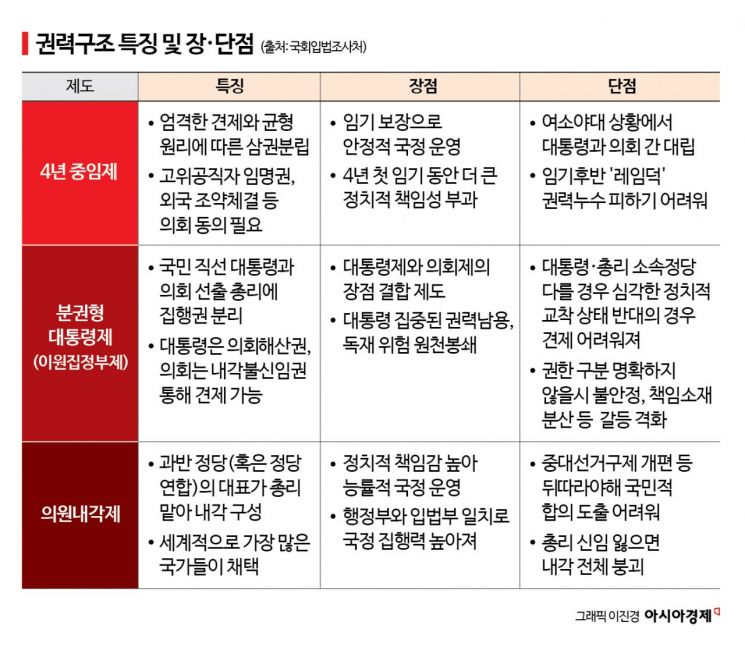
The power restructuring plan being discussed mainly within the ruling party as an alternative to the five-year single-term system is a four-year renewable term system. The biggest advantage of the four-year renewable term is that it allows for a mid-term evaluation of the administration, enabling stable governance in the first half of the term. The United States is a representative country currently implementing this system.
The United States has operated a four-year renewable term system for over 200 years. It is also the system most preferred by South Korean voters today. Park Sang-chul, director of the American Constitutional Law Association and a constitutional scholar and political scientist, emphasized, "Under strict separation of powers, the four-year renewable term is the minimum consensus discussed by the political sphere, the public, and academia." However, there are considerable concerns that without reducing the current presidential powers, the same structure would result in an 'eight-year emperor.' There are worries that populist policies aimed at re-election will be rampant, and the phenomenon of lame-duck presidency after re-election cannot be prevented.
Decentralized Presidential System, Parliamentary System, and Other Alternatives Proposed
There are also claims that the presidential system should be completely changed to a decentralized presidential system (dual executive system) or a parliamentary system. The decentralized presidential system is a form of government where executive power is divided between a president elected by direct popular vote and a prime minister elected by the legislature. It is a compromise between the presidential and parliamentary systems.
The president exercises the right to appoint the prime minister considering the majority party's opinion in the legislature and holds the roles of head of state, including supreme command of the military, dispatch and reception of diplomats, and treaty ratification. The powers concentrated in the president are distributed to the prime minister, fundamentally blocking the risk of power abuse or dictatorship. However, if the president and prime minister belong to the same party, the president's power becomes overwhelming, making it very difficult to check, and it is generally difficult to clearly distinguish the separation of executive powers where the president handles external affairs and the prime minister handles internal affairs.
In the long term, there is growing persuasion for moving toward a parliamentary system. Globally, it is a more common form of power structure than the presidential system. In a parliamentary system, the leader of the majority party or coalition in the legislature becomes the prime minister and forms the cabinet. Since the executive and legislative powers are unified, the overall execution of government affairs can be more effective. The parliamentary system also allows for the dissolution of the legislature, making it more suitable for responsible governance.
Some express concerns that if the presidential system is restructured, excessively strengthening the National Assembly's powers could cause side effects. Professor Jang Yong-geun of Hongik University's Department of Political Science and Diplomacy said in an interview, "Current constitutional amendment discussions are being conducted too much from a political engineering perspective," adding, "There is a politically technical approach where figures who have long been around political power, who would have difficulty winning in a public vote, are trying to lead the decentralized presidential or parliamentary system." Professor Jang said, "The powers of the National Assembly should also be reduced, and various measures should be sought to adjust before political conflicts become extreme."
© The Asia Business Daily(www.asiae.co.kr). All rights reserved.


















