Selected for Ministry of Environment Contest... Secured 450 Million KRW
Creation of Habitats, Ecological Trails, and Rest Areas for Flora and Fauna
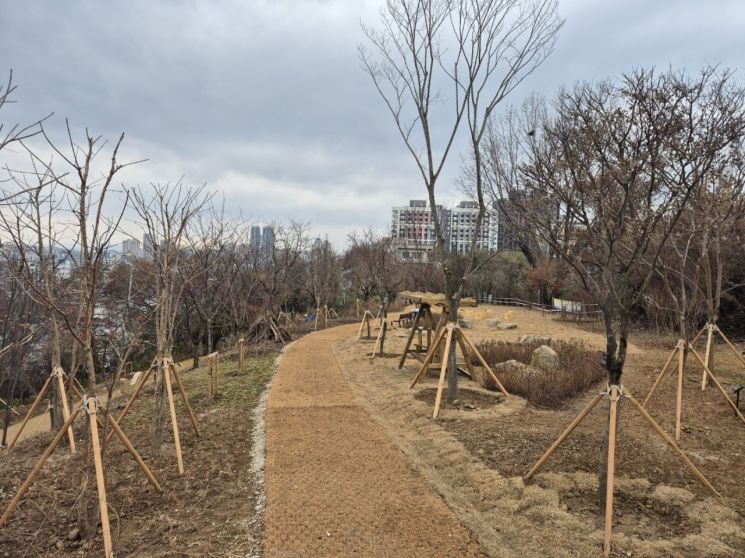 The Wolsan Neighborhood Park restoration project, selected last year for the Ministry of Environment's public contest project "Ecosystem Conservation Charge Refund Project," has been completed and transformed into an ecological park. Provided by Gwangju City
Wolsan Neighborhood Park in Nam-gu, Gwangju, which had been damaged by illegal cultivation and occupation, has been transformed into an ecological park.
According to Gwangju City on the 21st, the city recently completed the restoration of wildlife habitats, the creation of an ecological trail, and an ecological rest area in Wolsan Neighborhood Park in Wolsan-dong, Nam-gu.
This project was selected last year for the Ministry of Environment’s public contest project, the ‘Ecosystem Conservation Contribution Refund Project,’ under the title ‘Urban Small-scale Ecosystem Restoration Project for Connecting Wildlife Habitats in Wolsan Neighborhood Park.’ The city secured 450 million KRW in national funding, began construction in August last year, and completed it after five months of work.
The Ecosystem Conservation Contribution Refund Project is a public contest project by the Ministry of Environment that uses fees paid by developers whose projects significantly impact the natural environment and biodiversity to restore damaged ecosystems. The Ministry of Environment supports up to 50% of the ecosystem conservation contribution.
Wolsan Neighborhood Park is located in a densely populated residential area and had suffered severe vegetation damage and disruption of wildlife corridors due to prolonged illegal cultivation and unauthorized facilities.
The city restored 8,800 square meters of damaged land within Wolsan Neighborhood Park, secured habitats and food sources for flora and fauna, and improved the ecological environment, including the terrain. Additionally, the creation of an ecological trail and rest area now provides local residents with spaces for experience and relaxation.
Meanwhile, from 2013 to 2024, the city has invested 9.8 billion KRW to promote ecosystem restoration projects in 12 locations (276,161 square meters) including Balsan Neighborhood Park. This year, the city plans to invest 430 million KRW to carry out restoration work on 8,200 square meters of Bangnim Neighborhood Park in Nam-gu.
Kim Osuk, Head of the Nature Conservation Division, said, “We will continue to promote restoration projects for areas damaged or neglected in the city, striving to create an urban ecological environment where people and nature coexist and to build a ‘Daejabo City.’”
© The Asia Business Daily(www.asiae.co.kr). All rights reserved.
![Clutching a Stolen Dior Bag, Saying "I Hate Being Poor but Real"... The Grotesque Con of a "Human Knockoff" [Slate]](https://cwcontent.asiae.co.kr/asiaresize/183/2026021902243444107_1771435474.jpg)
















