Outlook for No New Tariffs on Trump's First Day in Office
Won-Dollar Exchange Rate Drops to 1,440 Level, Lowest in a Month
Concerns Over Further Surge Ease Amid Vigilance by Foreign Exchange Authorities
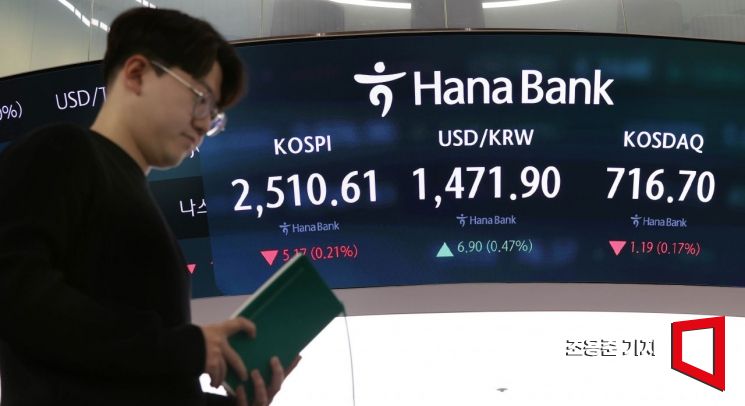 On the 13th, employees at the Hana Bank dealing room in Jung-gu, Seoul are working. Photo by Jo Yong-jun
In the foreign exchange market, the possibility of a delay in the additional tariffs imposed by U.S. President Donald Trump has emerged, causing the won-dollar exchange rate to fall to its lowest level in a month.
On the 21st, in the Seoul foreign exchange market, the won-dollar exchange rate closed at 1,444.0 won, down 14.3 won from the previous trading day’s closing price at 2 a.m. This is the lowest level in about a month since the 1,435.5 won recorded on the 18th of last month. Compared to the previous day’s closing price at 3:30 p.m. of 1,451.7 won, it dropped by 7.7 won.
As the Wall Street Journal (WSJ) reported that President Trump would not announce additional tariffs on his first day in office, contrary to his previous declarations, the exchange rate briefly fell to 1,439.0 won during the trading session. The won-dollar exchange rate had exceeded the 1,470 won level earlier this year due to concerns over tariff increases by President Trump and domestic political instability.
The WSJ reported that President Trump is expected to sign a memo on his inauguration day directing an investigation into the U.S. trade deficit and unfair trade practices by trading partners. The memo is said to designate China, Canada, and Mexico as key targets for review but does not include the imposition of new tariffs itself.
Following this news, the dollar index (DXY), which shows the value of the dollar against six major currencies, also plunged more than 1%, from 109 to 107.9. Global investment bank Citi commented, "If the new administration’s tariff policy is strongly implemented, the dollar may strengthen further, but if it proceeds gradually, it may weaken."
As the won-dollar exchange rate dropped to the 1,440 won level, domestic concerns about a further sharp rise in the exchange rate also seem to be easing. The won-dollar exchange rate surged sharply this year, threatening to reach 1,500 won, raising concerns that it would cause inflation and sluggish consumption, placing a heavy burden on the domestic economy. In response, the National Pension Service strategically hedged currency risk by releasing dollars into the market to defend the exchange rate, and the Bank of Korea also froze the base interest rate, continuing policy efforts by foreign exchange authorities to stabilize the exchange rate. Along with the news of the delay in U.S. tariff imposition, the dollar’s strength has somewhat subsided.
Minhyuk Lee, an economist at KB Kookmin Bank, said, "Initially, Trump declared additional tariffs of 10% on China, 25% on Mexico and Canada, and universal tariffs of 10-20% on all imported goods worldwide. However, since radical tariff imposition would ultimately burden the overall U.S. economy, including inflation, the Trump administration will likely slow the pace of tariff increases, and as uncertainty eases, the dollar’s strength will be adjusted." Dowoon Moon, a researcher at Korea Investment & Securities, analyzed, "The reduction of political uncertainty due to the execution of an arrest warrant against President Yoon Seok-yeol and the Bank of Korea’s decision to freeze the base interest rate amid concerns over a high exchange rate are also factors lowering the exchange rate."
© The Asia Business Daily(www.asiae.co.kr). All rights reserved.
![Clutching a Stolen Dior Bag, Saying "I Hate Being Poor but Real"... The Grotesque Con of a "Human Knockoff" [Slate]](https://cwcontent.asiae.co.kr/asiaresize/183/2026021902243444107_1771435474.jpg)











