Real Gross Domestic Product (GDP) and Private Consumption
December Industrial Activity Trends
Retail Sales Must Be Checked
Although consumer sentiment significantly deteriorated following last year's December 3 martial law incident and the December 29 Jeju Air passenger plane disaster, the objective impact on the economy has yet to be confirmed. The government is focusing on the Bank of Korea's preliminary real Gross Domestic Product (GDP) figures and December industrial activity trends in retail sales, which will be released this week. These two indicators are expected to help gauge the specific impact and scale of the psychological contraction on consumption and the economy.
According to the Ministry of Economy and Finance and related departments on the 20th, the government is paying close attention to the preliminary real GDP for the fourth quarter and the entire year of 2024, scheduled for release on the 23rd. Kim Gwi-beom, head of the Economic Analysis Division at the Ministry of Economy and Finance, stated during the 'Recent Economic Trends (Greenbook)' briefing on the 17th, “The GDP to be announced next week includes December, so we are carefully monitoring it,” adding, “It is still somewhat early to evaluate the situation up to January.”
The only tangible data related to private consumption available so far is credit card approval amounts. Interestingly, December's card approval amount is understood to have increased. According to the Ministry of Economy and Finance, last month's credit card approval amount rose by 5.4% compared to the same month last year. This increase is larger than that of October (1.2%) and November (2.9%) of last year. Although the detailed data is not publicly disclosed, the ministry believes that while sales in face-to-face sectors such as travel and accommodation declined, online consumption increased, so the overall card approval amount did not experience a significant drop.
The GDP to be released this week will show private consumption for the fourth quarter. It is objective data that allows confirmation of the overall domestic consumption situation from October to December. Of course, it is difficult to definitively assess the scale of psychological contraction caused by the martial law and Jeju Air disaster based on this indicator alone. Jeong Gyu-cheol, head of the Economic Forecasting Office at the Korea Development Institute (KDI), said, “Since the December data will be released together with October and November, it is hard to clearly distinguish whether the deterioration occurred in November or December,” adding, “However, since an objective figure is available, we can observe the trend through this indicator, and monthly data afterward will provide a clearer understanding of the psychological contraction's aftermath.”
The December monthly figures can be confirmed through the monthly retail sales statistics from the Industrial Activity Trends published by Statistics Korea. Jeong explained, “There has been a sluggish trend up to November, but we need to see if a more severe slump appeared in December,” adding, “If the slump is similar to November, it can be assessed that there is no concern about psychological contraction yet.” He further explained, “It is difficult to evaluate based on December alone; the trends in October and November must also be considered.”
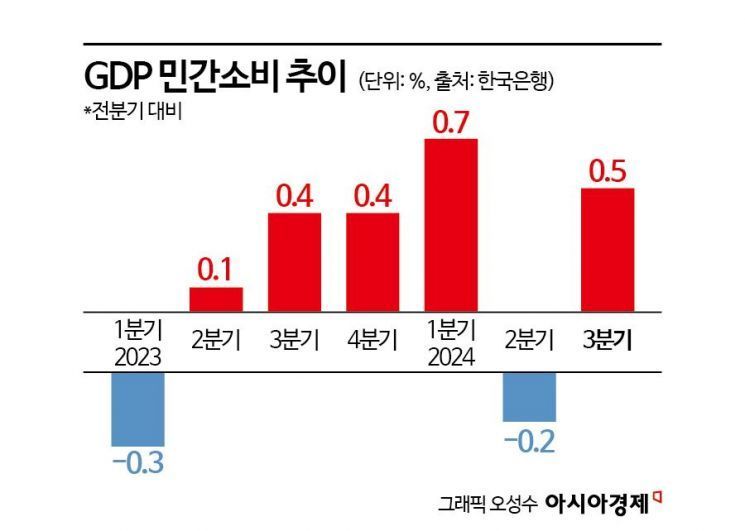
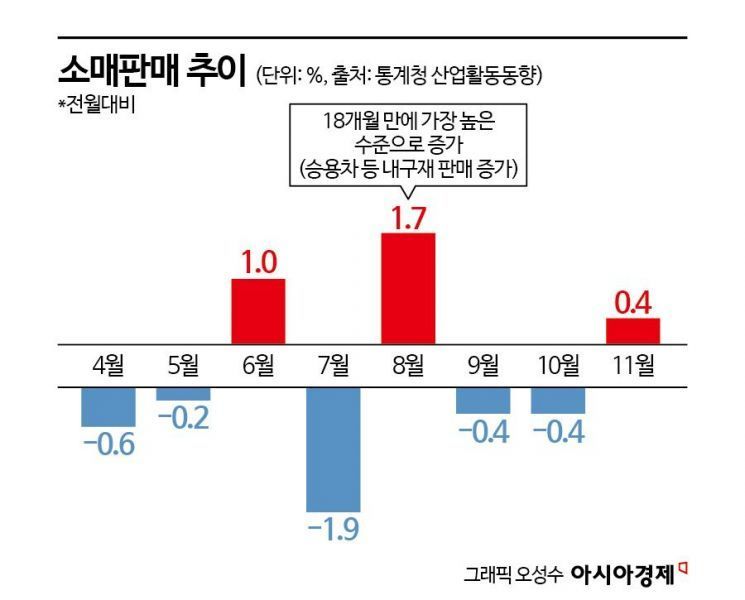
Retail sales, which represent consumption of goods, continue to face a poor situation due to sluggish domestic demand. Last year, retail sales declined for two consecutive months in September (-0.4%) and October (-0.4%), then rebounded in November (0.4%) due to large-scale consumption promotion events such as the Korea Sale Festa. However, compared to a year earlier, November retail sales decreased by 1.9%, continuing the downward trend. In GDP statistics, private consumption remains at a low growth rate of less than 1%. The private consumption growth rates were 0.7% in the first quarter, -0.2% in the second quarter, and 0.5% in the third quarter. This is a structural effect caused by an aging population combined with prolonged high interest rates and high inflation.
The deterioration of consumer sentiment is more severe than ever. According to KDI's January economic trends, the Consumer Sentiment Index fell by 9.4 points over three months during the political instability related to former President Park Geun-hye's impeachment in 2016. In contrast, after the December 3 martial law incident, the Consumer Sentiment Index dropped by 12.3 points in just one month. The Consumer Sentiment Index plunged from 100.7 in November last year to 88.4 in December, while the Business Survey Index (BSI) for manufacturing business outlook fell from 71.0 to 66.0, respectively.
© The Asia Business Daily(www.asiae.co.kr). All rights reserved.
![Clutching a Stolen Dior Bag, Saying "I Hate Being Poor but Real"... The Grotesque Con of a "Human Knockoff" [Slate]](https://cwcontent.asiae.co.kr/asiaresize/183/2026021902243444107_1771435474.jpg)

















