Comprehensive Support for Both Caregivers and Prospective Caregivers
Monthly Housing Support of 300,000 Won for Homeless Households with Newborns
Childbirth and Childcare Assistance Extended to the Self-Employed and Small Business Owners
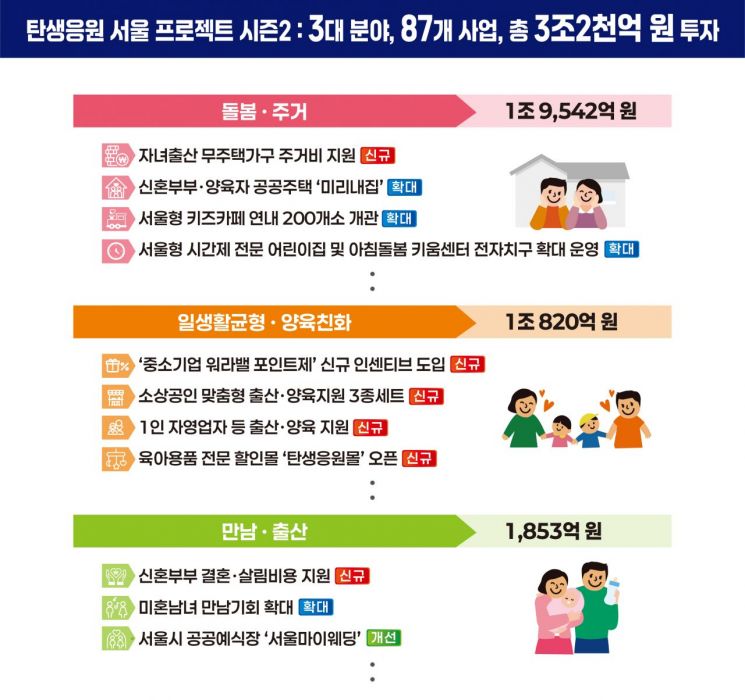
Seoul City will invest a budget of 3.2 trillion won this year to promote policies to overcome low birth rates. It will provide 300,000 won per month in housing support to housing-vulnerable households with newborns and expand the 'Seoul-type hourly professional daycare centers' to all autonomous districts. Seoul City's plan is to provide meticulous support in various fields such as childcare, housing, and work-life balance.
On the 20th, Seoul City announced that to enhance the effectiveness of the 'Birth Support Seoul Project' announced in August 2022, it will push forward with '3 sectors and 87 detailed projects' centered on these additional support measures this year.

Seoul City has recognized the low birth rate crisis as a top policy priority and, judging that individual policies alone are insufficient, has steadily expanded the support targets and projects, launching the 'Birth Support Seoul Project Season 2' last year. The project covers not only caregivers but also 'prospective caregivers' such as youth, newlyweds, and couples facing infertility, supporting practical daily changes needed before and after childbirth, including work-life balance. It also laid the foundation for a rebound in birth rates. With Seoul City's efforts, from April 2024 onward, the birth rate in Seoul showed a sharp upward trend, increasing by 1,901 (8.4%) over the same period last year for seven months until October, and the number of marriages also rose by 4,799 (24.1%) during the same period.
This year, Seoul City is accelerating the implementation of specific projects to create a birth-friendly environment encountered in daily life. First, in the housing sector, the scope of housing policies, which previously focused on newlyweds, will be expanded to include families raising children. To enable housing-vulnerable households residing in Seoul to continue living in Seoul after childbirth, a monthly housing cost difference of 300,000 won between Seoul and metropolitan area apartments will be supported for two years (a total of 7.2 million won). The target is housing-vulnerable households who give birth after January 1, 2025, with an income below 180% of the median income. The newlywed long-term lease housing II 'Mirinae Jip,' which attracted popularity with a maximum competition rate exceeding 200 to 1 in last year's tenant recruitment, will supply 3,500 households this year and 4,000 households annually from 2026.
The 'Seoul-type Kids Cafe,' which opened in May 2022 and has recorded 470,000 users in about two and a half years, gaining great popularity among children and caregivers, will expand to 200 locations within the year. This year, kids cafes will be established at Seoul's representative attractions such as Seoul Botanic Park, Seoul Baekje Children's Museum, and Mokdong Baseball Stadium.
The 'Seoul-type hourly professional daycare centers,' where children can be entrusted on an hourly basis, will expand from 9 autonomous districts last year to all 25 autonomous districts this year. The 'Seoul-type Morning Care Kiwoom Center,' where caregivers take care of elementary school children on their way to work by providing snacks, helping with homework, and accompanying them to school, also received great response with over 6,000 users in just eight months of last year's pilot project (10 autonomous districts) and will expand to all 25 autonomous districts this year.
The 'Small and Medium Enterprise Work-Life Balance Point System,' targeting SMEs friendly to childbirth and childcare, has also been improved. This year, the number of participating companies will expand to 1,500, and three new incentives that provide practical help to workers will be introduced: support for workers replacing those on parental leave, colleague encouragement allowances, and Seoul-type childbirth leave wage compensation.
From March, those not covered by employment insurance, such as self-employed individuals and freelancers, will also be guaranteed 'maternity childbirth benefits' at the level of employment insurance beneficiaries. Seoul City will add 900,000 won of its own support to the existing 1.5 million won support from the Ministry of Employment and Labor, ensuring a total of 2.4 million won in benefits.
The 'Seoul Mom and Dad Taxi,' which supports taxi vouchers worth 100,000 won per infant, will expand from one operator to two companies to improve dispatch speed and convenience. The 'Seoul Kids OK Zone,' which accommodates children, will increase participating stores from the current 701 to 800 by expanding and strengthening incentives. In addition, support for newlyweds will be expanded. Starting in October, newlyweds who registered their marriage within one year after January 1 of this year (with income below 150% of the median income) will receive up to 1 million won to cover wedding preparation and household expenses. The number of wedding cooperation companies operating public wedding halls will also increase from 5 to 10.
Kim Seon-soon, Director of the Seoul City Women and Family Office, said, "Thanks to Seoul City's advanced comprehensive measures against low birth rates, the number of births and marriages in Seoul have risen together, marking a turning point out of the long and dark low birth rate phase. We will faithfully carry out the Birth Support Seoul Project to maintain this momentum of birth rate rebound."
© The Asia Business Daily(www.asiae.co.kr). All rights reserved.
![User Who Sold Erroneously Deposited Bitcoins to Repay Debt and Fund Entertainment... What Did the Supreme Court Decide in 2021? [Legal Issue Check]](https://cwcontent.asiae.co.kr/asiaresize/183/2026020910431234020_1770601391.png)

















