Refusal to Respond to Second CIO Summons
No Way to Restrict Right to Remain Silent
Legal Experts Say "Further Investigation Seems Difficult"
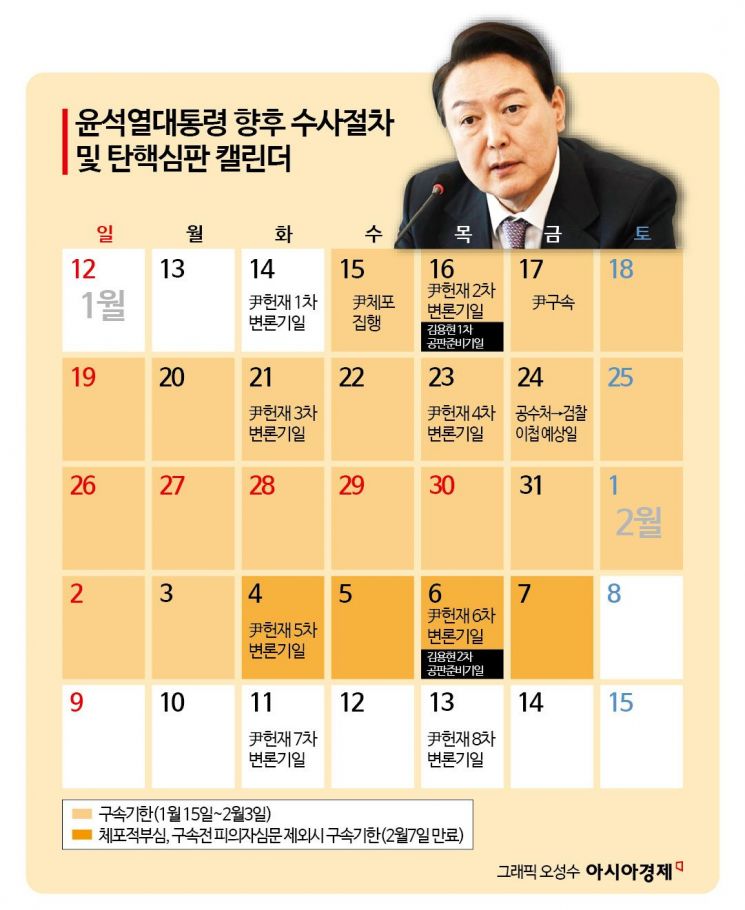
President Yoon Seok-yeol, who was detained on the 19th, did not respond to the second summons notice from the Corruption Investigation Office for High-ranking Officials (CIO) on the 20th. The president's side stated, "There is nothing more to say to the CIO." This indicates that he does not intend to undergo further investigation. Accordingly, the options the CIO can consider are limited to 'forcible detention' and 'on-site investigation.' While it is generally customary for a detained suspect to comply with the investigative agency's summons, if refused, they can be forcibly brought in.
This is a measure that restricts the suspect's freedom but is supported by Supreme Court precedents. However, if the suspect, like President Yoon, exercises the right to remain silent, there is no way to limit this. The right not to be compelled to give self-incriminating testimony is guaranteed by the Constitution. Ultimately, whether through forcible detention or CIO prosecutors visiting Seoul Detention Center for investigation, the legal community views that additional investigation of President Yoon under the current circumstances is practically difficult.
Regarding the CIO investigation, President Yoon's side has expressed refusal to cooperate since the pre-arrest stage, urging for a swift handover to the prosecution. Although the CIO detained President Yoon, the prosecution holds the authority to indict. Therefore, the CIO must concede a significant portion of the detention period (20 days) to the prosecution and hand over the investigation records before indictment. If the current situation persists, the possibility that the CIO will expedite transferring case records to the prosecution cannot be ruled out.
After the arrest warrant was issued, President Yoon became a pretrial detainee and is subject to the same regulations as other inmates. It is reported that he received an inmate number and underwent procedures including a 'mugshot' and a thorough physical examination. President Yoon changed out of the suit he was wearing at the time of arrest and now lives wearing khaki prison clothes marked with his inmate number.
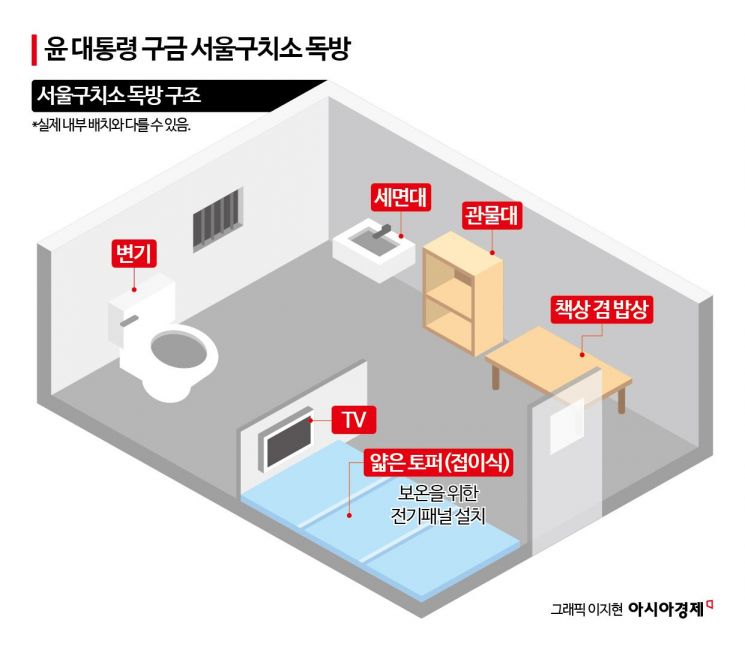
President Yoon is known to be using a single cell with a total area of 3.63 pyeong (12.01㎡), including the bathroom. Inside the room where he stays, there is a desk that doubles as a dining table, a locker, a TV, a toilet, and a washbasin, and he can sleep on a thin topper. An electric panel for heating is installed on the floor. It is presumed that the single cell includes basic living facilities along with a TV, but TV viewing is limited mainly to terrestrial broadcasts from 5 p.m. to 9 p.m.
The cell where President Yoon is detained is similar in size to those where previous presidents were held. Former Presidents Park Geun-hye and Lee Myung-bak, who stayed at Seoul Detention Center and Seoul Eastern Detention Center respectively, also lived in single cells of about 3 pyeong. Typically, single cells range from 1 to 3 pyeong in size. When using external facilities such as communal baths for showering, contact with other inmates is expected to be prevented by adjusting usage times. Exercise is allowed for less than an hour, but considering his status as the sitting president, schedules and routes will likely be coordinated to avoid overlap with other inmates. Additionally, under the Presidential Security Service Act, President Yoon can receive indirect protection from the Presidential Security Service even within the detention center. When moving outside for investigations or impeachment hearings, he will use the Ministry of Justice escort vehicle, as was the case during the warrant review.
The meal menu at Seoul Detention Center is the same as that for detainees in the suspect living quarters, with the diet repeating weekly throughout the month. According to the 'January Detainee Food Menu' at Seoul Detention Center, on the morning of the 20th, President Yoon's second day in detention, the menu included seaweed soup, chili pepper pickles, and napa cabbage kimchi, while lunch consisted of bread, ketchup, sausage, salad, and processed milk. Visits are generally allowed once a day, but meetings with lawyers can occur at any time during working hours. However, on the 19th, the CIO announced that it had sent a 'Decision to Prohibit Suspect Meetings' to Seoul Detention Center, banning President Yoon from meeting anyone except his lawyers. Visits from First Lady Kim Keon-hee are also not permitted.
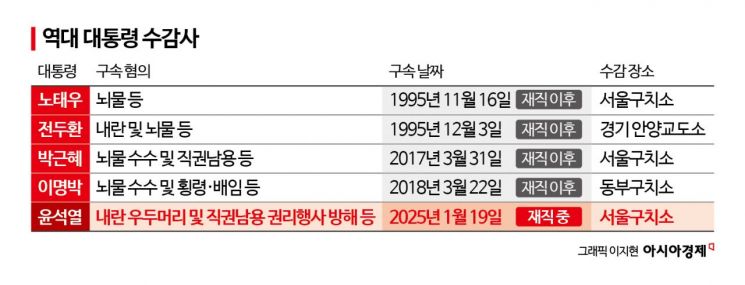
President Yoon's detention marks the fifth time a president has been detained in history, but unlike the others, he is currently the sitting president. All previous detained presidents were former presidents at the time of their detention and investigation. Starting with former President Roh Tae-woo, the first former president detained in constitutional history, followed by former Presidents Chun Doo-hwan, Park Geun-hye, and Lee Myung-bak, all were sent to detention centers. They were investigated while detained and subsequently imprisoned after being convicted in court.
© The Asia Business Daily(www.asiae.co.kr). All rights reserved.



















