Performance Upgrades for Ship-Based CIWS to Enable Ground Deployment
Ground Installation Possible by 2030... Defense Against North Korea's Long-Range Artillery
LIG Nex1 is developing the Close-In Weapons System (CIWS)-II for ground use. CIWS is a weapon system that acts as the last line of defense when enemy missiles penetrate the defense shields of ship-mounted anti-ship guided missiles (SAAM) and naval guns. It is called the "last bastion of the ship." The plan is to upgrade its performance to create a system capable of intercepting not only North Korea's ultra-large multiple rocket launchers at low altitudes but also suicide drones and cruise missiles.
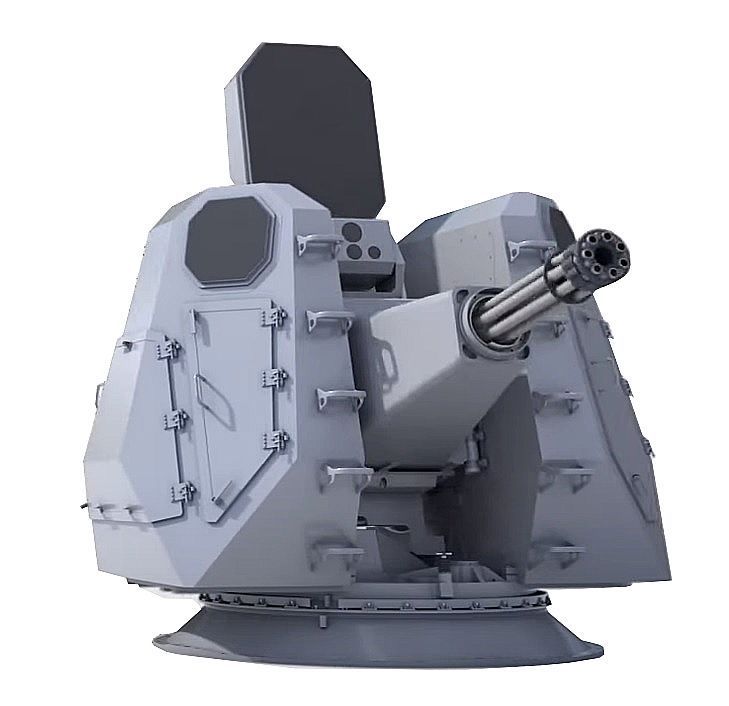
On the 20th, the Defense Acquisition Program Administration (DAPA) stated, "The CIWS-II project is a company-led development project with an investment of about 350 billion KRW, scheduled for development by 2027 and operational deployment by 2030."
So far, the Navy has operated three types of CIWS: △ the short-range rotary guided missile RAM from the U.S. Raytheon, △ the 20mm Gatling gun Phalanx, and △ the 30mm Goalkeeper from the Netherlands' Thales. However, as North Korea's cruise missiles have become faster, exceeding Mach 2, performance upgrades have become necessary.
Directly importing CIWS from overseas resulted in considerable maintenance costs such as repairs. This raised the need for domestic production. Last year, the military submitted a request for integrated requirements review to the Joint Chiefs of Staff for 2026 and promoted an expanded development project for a ground-based air defense system based on the CIWS-II weapon system. The U.S. military also operates the C-RAM (Counter Rocket, Artillery, and Mortar), an air defense system converted from ship-based CIWS for ground use.
LIG Nex1 was selected as the final preferred negotiation partner for the CIWS-II project in August 2021. They had already formed a partnership with the Netherlands' Thales, which had ceased additional production of the Goalkeeper, continuing maintenance and upgrade work for the Goalkeeper systems sold to the South Korean Navy and other navies.
The CIWS-II development project plans to apply active electronically scanned array (AESA) radar technology secured through the Korean Fighter (KF-21) project and develop the system through technological cooperation with domestic and international companies to neutralize enemy supersonic or sea-skimming missiles and high-speed boat infiltrations.
Installing CIWS-II on the ground will enable defense of key points such as air force runways and military command facilities. This means responding to North Korea's long-range artillery, evolving from existing 170mm howitzers and 240mm multiple rocket launchers to guided 240mm, 300mm, and 600mm ultra-large multiple rocket launchers. It will also provide close defense capabilities for the Korean next-generation destroyer (KDDX) and the Ulsan-class Batch-III.
Meanwhile, it is reported that DAPA named the next-generation Korean close-in weapons system development project "CIWS-II" because there is an opinion that the 40mm caliber twin-barrel naval gun named "Nobong," meaning "Jangsu Hornet," developed from 1988 and completed in 1996, can be regarded as a CIWS in a broad sense.
© The Asia Business Daily(www.asiae.co.kr). All rights reserved.

















