TikTok's Short-Form Video Service Temporarily Suspended in the U.S.
'TikTok Ban Act' Impact... Service Restored Following Trump's Remarks
NYT: "Chinese Companies Nervously Awaiting If They Will Be the Next Target"
As TikTok's short-form video platform service in the United States was temporarily suspended, reports emerged that other Chinese companies operating in the U.S. are nervously anticipating whether they might be the next targets. On the 18th (local time), The New York Times (NYT) reported, "Startups associated with China are increasingly facing numerous regulations and political investigations from U.S. authorities, making it progressively more difficult to do business or list on U.S. stock exchanges."
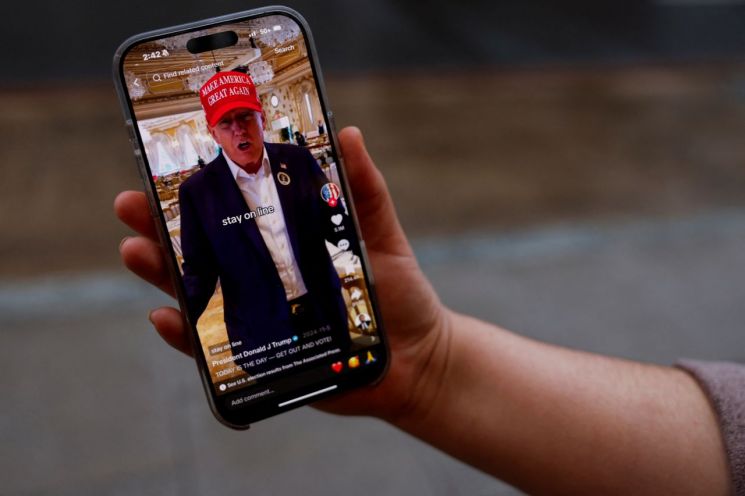 On the morning of the 19th (local time), when TikTok usage resumed, an American TikTok user is showing the page of Donald Trump, the President-elect of the United States. Photo by Reuters Yonhap News
At 10:50 PM that day, TikTok was removed from the U.S. App Stores operated by Google and Apple, and when users tried to open the previously installed app, a message stating "A law banning TikTok has been enacted in the United States" reportedly appeared. Other apps operated by TikTok's parent company ByteDance, such as the video editing app 'CapCut' and the social networking service (SNS) app 'Lemon8,' also became unavailable.
This action follows the 'TikTok Ban Act' enacted by the U.S. Congress in April last year. The bill cites concerns that ByteDance collects large amounts of personal information from Americans, posing a national security threat, and stipulates that unless ByteDance sells its U.S. business rights to a U.S. company, new downloads of TikTok will be banned starting from the 19th of this month. TikTok filed a lawsuit claiming the bill is unfair but lost in both the first and second trials, and its injunction request to the Supreme Court to halt the bill's enforcement was also dismissed.
However, then-President-elect Donald Trump stated on the morning of the 19th, "I will delay the enforcement of the law through an executive order immediately after taking office," adding, "I want the U.S. to have 50% ownership in the joint venture with TikTok," and "Without U.S. approval, there will be no TikTok, and with our approval, it will have tremendous value." Subsequently, some users were able to use TikTok again.
Nevertheless, the anxiety among Chinese companies has not subsided. In the past, ByteDance entered the U.S. market with investments from U.S. corporations such as GE (General Atlantic) and American institutions, gaining enthusiastic support from teenagers. Chinese startups have long regarded listing on U.S. stock exchanges as a symbol of success. According to the NYT, the number of Chinese companies listed on U.S. stock exchanges last year exceeded the total number listed in the previous two years combined.
However, as U.S.-China relations deteriorate, the entry of companies related to China into the U.S. market is slowing down. Chinese fast-fashion company Shein faced difficulties listing on the U.S. stock market last year due to the fallout from U.S.-China tensions and is currently preparing for a listing in the United Kingdom. Marco Rubio, a U.S. Senator and nominee for Secretary of State in the second Trump administration, argued at the time that "unless Shein discloses detailed information about its relationship with China and its corporate structure, the U.S. Securities and Exchange Commission (SEC) should not approve its initial public offering (IPO)."
The Committee on Foreign Investment in the United States (CFIUS), under the U.S. Department of the Treasury, is conducting regulations and investigations targeting Chinese companies within the U.S. In 2019, CFIUS ordered the Chinese company Kunlun, which owns the world's largest gay dating app 'Grindr,' to sell the app, and in 2020, it blocked a Chinese company from establishing a joint venture with a U.S. medical robotics firm.
Chase Karniecki, a CFIUS expert at the law firm Clearly Gottlieb, told the NYT, "CFIUS is intensely focused on reviewing transactions involving any companies that have any connection to Chinese companies, no matter how small or distant."
© The Asia Business Daily(www.asiae.co.kr). All rights reserved.

















