The Australian War Memorial in Canberra, the capital of Australia, is facing demands from the Korean Australian community to remove or relocate a children's outfit resembling traditional Chinese clothing that is displayed right in front of the South Korean flag in the Korean War section.
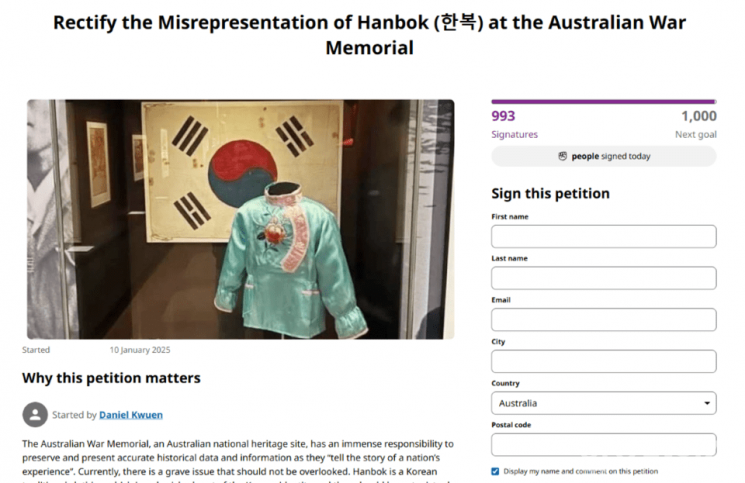 An online petition requesting the Australian War Memorial to remove Chinese-style clothing displayed in front of the Taegeukgi flag (Photo by online petition site change.org)
According to the Australian public broadcaster ABC on the 18th, more than 900 people signed an online petition claiming that the Australian War Memorial's decision to display Chinese-style clothing directly in front of the South Korean flag misleads Korean cultural identity. The Korean Association in Canberra has also demanded that this be corrected, and opposition to the display is spreading.
Daniel Kwon, a second-generation Korean Australian, stated in an online petition about this issue, "The current exhibit may convey incorrect information to Australian students and visitors," and demanded that "the outfit must be completely separated from the South Korean flag."
Kwon is the great-grandson of Kang Sa-chae, an independence activist who led the Gwangju Student Anti-Japanese Movement during the Japanese colonial period. He is double majoring in Business Administration and Actuarial Studies at the University of New South Wales (UNSW) in Sydney.
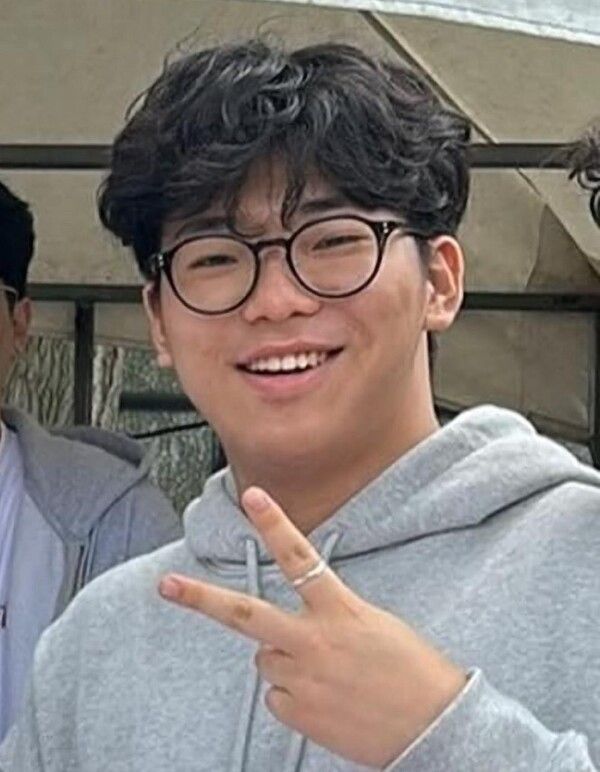 Daniel Kwon, a Korean-Australian university student in Sydney, started an online petition demanding the removal of Chinese-style clothing displayed in front of the Taegukgi at the Australian War Memorial.
A spokesperson for the Australian War Memorial said, "The outfit was initially mislabeled as traditional Korean clothing but was later corrected," adding, "It was purchased and donated to the memorial by Corporal R.N. Man, who served during 1954-55. It is an example of items sold by impoverished South Korean residents struggling to survive due to the war."
The outfit is still displayed in front of the South Korean flag, but the description has been revised to read, "This was abandoned by retreating communist forces and appears to have been sold by impoverished South Korean residents due to the war."
In response, Myo-sun Kwon, president of the Korean Association in Canberra, said, "There is still a possibility that visitors may mistakenly believe the outfit is traditional Korean clothing," and demanded its removal or relocation. He expressed dissatisfaction, saying, "The memorial does not listen to our voices," and that the outfit is still displayed in front of the South Korean flag.
Dr. Su-kyung Hwang, a Korean Studies scholar at the University of Sydney, criticized the exhibit as "historically and culturally misleading," stating, "It shows a lack of cultural awareness on the part of the curator."
He compared it to "displaying German traditional clothing as French attire from World War II," emphasizing, "The memorial should request the Korean Cultural Center in Sydney to properly exhibit authentic Hanbok."
Dr. Hwang added, "The War Memorial is a publicly funded institution responsible for providing historically accurate information," and stated, "The outfit should be removed from the exhibit."
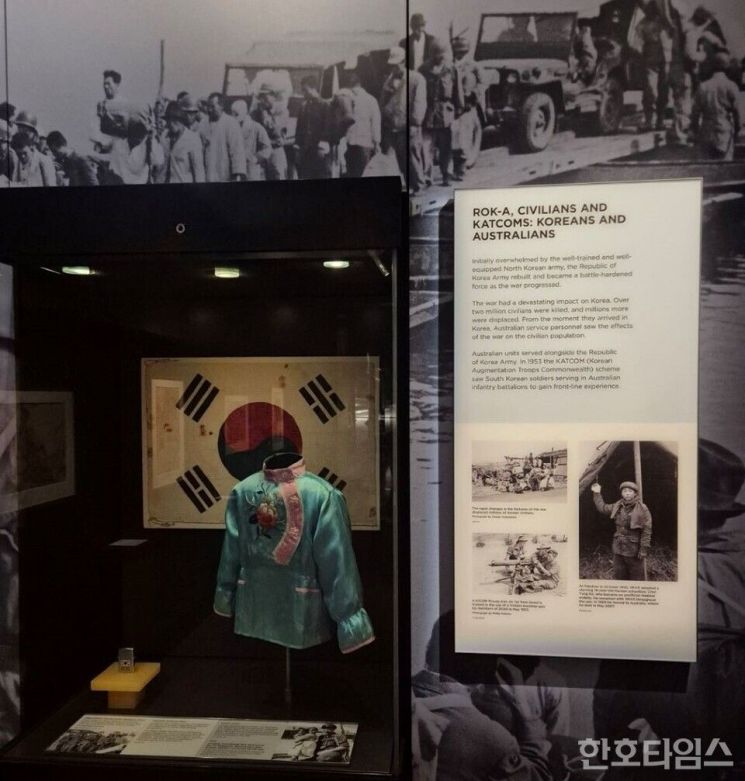 Chinese-style clothing displayed right in front of the Taegeukgi at the Australian War Memorial Cold War Exhibition in Canberra, the capital of Australia (Photo by Kwon Myo-sun)
Second Secretary Ji-soo Yoon of the Korean Embassy in Australia said in an interview with ABC, "We sincerely appreciate the interest in this issue," but added, "As discussions are currently ongoing, it is difficult to share additional information."
The memorial's spokesperson said they are positively cooperating with the Korean Embassy and are discussing concerns related to the exhibit.
During the Korean War, more than 17,000 Australian soldiers participated, with 340 killed and over 1,200 wounded.
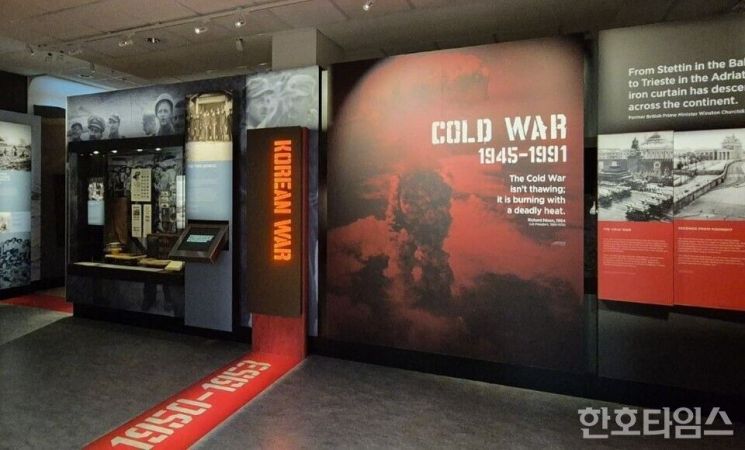 Australian War Memorial Cold War Exhibition Hall in Canberra, the capital of Australia (Photo by Kwon Myo-sun)
The Cold War exhibition hall, which opened in June last year at the War Memorial, records that approximately 4 million people, including 2 million civilians, were casualties of the Korean War.
At the time of the Cold War exhibition's opening, the Korean Embassy in Australia stated in a press release, "Korea never forgets the support of Australia and its allies during the Korean War," and added, "We hope the new exhibition will deepen the friendship between the two countries."
Jung Dong-chul, Hanho Times Reporter
※This article was written using content provided by Hanho Times (www.hanhotimes.com).
© The Asia Business Daily(www.asiae.co.kr). All rights reserved.



















