"It May Be the Largest Private Bathhouse Ever Excavated"
Featuring Hot, Warm, and Cold Baths... Accommodates Up to 30 People
A massive private bathhouse dating back 2,000 years has been unearthed at the ancient Italian city of Pompeii.
The ANSA news agency reported on the 17th (local time) that the Pompeii Archaeological Park discovered this bathhouse during the excavation of a house in Regio IX, the ninth archaeological district, which was the wealthiest area in Pompeii.
Gabriel Zugtriegel, director of the Pompeii Archaeological Park, said, "This is probably the largest private bathhouse ever excavated in Pompeii," adding, "It is a once-in-a-lifetime discovery."
Anna Onesti, the lead archaeologist, explained, "The excavation of the bathhouse, especially the peristyle, was made possible thanks to advanced techniques," and added, "Thanks to this, we were able to reach the floor without dismantling unstable architectural elements."
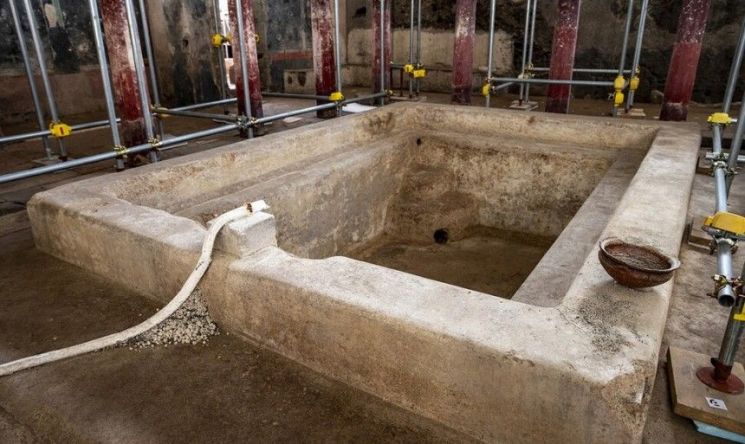
This bathhouse, adorned with intricate mosaic decorations, featured various sauna systems including hot baths, warm baths, and cold baths. The cold bath, measuring 10 meters in both width and length, stands out for its structure. It is well-preserved in an elaborate form surrounded by ancient Roman-style round columns (peristyle). Considering the size of the changing room, it is estimated to have accommodated up to 30 people.
The bathhouse and banquet hall were spaces where the upper class entertained guests for purposes such as election campaigns, status display, and contract signings. The park officials believe that after enjoying the baths, guests moved to the banquet hall decorated with murals themed on Greek mythology and held grand dinners under candlelight.
Pompeii, one of the most prosperous cities of the ancient Roman Empire, was destroyed by the natural disaster of the Mount Vesuvius eruption in AD 79.
The first excavation of Pompeii began in 1748, triggered by the discovery of ruins during 16th-century waterway construction. Today, the site has reached a level where the layout of the ancient city can be roughly inferred.
Due to its excellent state of preservation and significant archaeological value that offers insights into the lives of people at the time, Pompeii was designated a UNESCO World Heritage Site in 1997. It is also the second most visited archaeological site in the world.
© The Asia Business Daily(www.asiae.co.kr). All rights reserved.
![Clutching a Stolen Dior Bag, Saying "I Hate Being Poor but Real"... The Grotesque Con of a "Human Knockoff" [Slate]](https://cwcontent.asiae.co.kr/asiaresize/183/2026021902243444107_1771435474.jpg)
















