Lee Bok-hyun Points Out Insufficient Protection for Minority Shareholders
Increasing Trend of Tender Offers for Delisting Purposes
Lee Bok-hyun, Governor of the Financial Supervisory Service (FSS), pointed out that the protection of minority shareholders is insufficient during the tender offer process aimed at delisting. In this context, a research institute emphasized the need for an external agency’s evaluation of the appropriateness of the tender offer price and the submission of the board of directors’ opinion. They argued that while voluntary delisting should proceed if necessary, institutional measures must be in place to ensure that the rights of minority shareholders are properly protected throughout the process. The FSS, as the competent authority, shares the consensus that regulatory adjustments are needed regarding tender offers for delisting purposes by private equity funds (PEFs), which have been increasing recently, and plans to explore improvement measures.
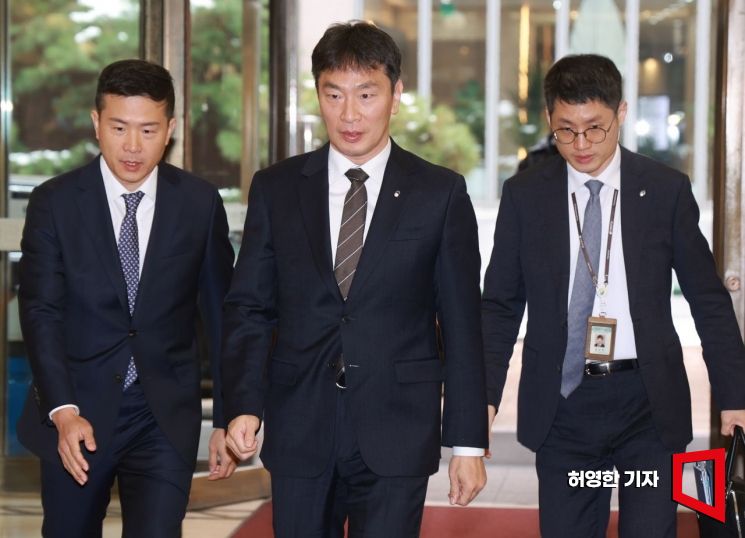 Lee Bok-hyun, Governor of the Financial Supervisory Service, is entering the Bankers' Hall in Myeongdong, Seoul, on the 28th to attend a meeting between the FSS Governor and the chairpersons of bank holding companies. Photo by Heo Young-han
On the 14th, Governor Lee stated at an executive meeting, “There are shortcomings in protecting minority shareholders amid the recent increase in tender offers aimed at delisting, mainly by private equity funds.” Based on his remarks, it appears that regulatory improvements will be made to establish safeguards for shareholders during voluntary delisting.
An FSS official said, “The governor’s request at the executive meeting reflects that, after analyzing the current status of delisting through tender offers, some areas need improvement, so we will review them. Although it is difficult to specify the direction immediately, we will examine the content and consider possible improvements.”
Tender offers are mainly conducted by major shareholders who are private equity funds in companies that prefer delisting to reduce operational burdens such as disclosure obligations rather than maintaining their listing.
According to data from the Korea Capital Market Institute, voluntary delisting cases using tender offers or comprehensive stock exchanges (squeeze-outs) in the domestic stock market have been increasing annually. From 2009 to September 2024, there were 51 tender offers and 131 comprehensive stock exchanges, with 20 (39.2%) and 33 (25.2%) cases respectively occurring since 2022.
Although tender offers by PEFs with delisting in mind are increasing, concerns about the appropriateness of tender offer prices persist. According to FSS data, there have been 36 tender offers for delisting purposes since 2014. The FSS analysis showed that 36% of tender offer prices were below the net asset value per share, and 42% of cases conducted large dividends after the tender offer (an average of 24.5 times compared to before).
Meanwhile, the Korea Capital Market Institute published a report titled “The Necessity and Challenges of Investor Protection in Voluntary Delisting Using M&A” on the 15th, the day after Governor Lee’s remarks. Researcher Hwang Hyun-young, who authored the report, stated that tender offers for voluntary delisting should be approached differently from general tender offers. For example, general tender offers occur amid active management disputes, where parties offer better terms to shareholders. A representative case is the “ping-pong game” of raising tender offer prices between Korea Zinc and MBK during their management dispute.
However, tender offers premised on voluntary delisting are different. In most cases, the largest shareholder already holds a significant portion of shares before the tender offer, allowing the offer to proceed without concerns about management threats. This structure makes it easy for the largest shareholder to set the tender offer price at their desired level. Some argue that if the tender offer price is deemed inappropriate, minority shareholders can simply reject it, but in reality, such a choice is difficult. If delisting occurs, the shares held become worthless, causing investors to lose their entire investment. Thus, minority shareholders often have no choice but to accept the tender offer proposed by the company reluctantly.
Researcher Hwang said, “This is not to say that tender offers for delisting should be prohibited, but that institutional measures are needed to ensure the tender offer price is appropriate and sufficiently explained, allowing minority shareholders to make informed judgments.”
As necessary institutional measures, he pointed to the evaluation of tender offers by external agencies and the submission of the board of directors’ opinion. Hwang explained, “In Korea, it is necessary to disclose detailed explanations related to delisting and specific formulas for price calculation in tender offers for delisting. Additionally, similar to the recently revised merger regulations, mandatory submission of the board’s opinion and appointment of external evaluation agencies should be considered.”
The report also introduced that major foreign countries such as the United States, the United Kingdom, Germany, and Japan have separate regulations on price and procedures to protect minority shareholders during tender offers for delisting. According to Researcher Hwang, these countries not only do not recognize cash consideration in comprehensive stock exchanges but also have measures to protect minority shareholders in cash mergers and compulsory acquisition systems.
© The Asia Business Daily(www.asiae.co.kr). All rights reserved.

![Clutching a Stolen Dior Bag, Saying "I Hate Being Poor but Real"... The Grotesque Con of a "Human Knockoff" [Slate]](https://cwcontent.asiae.co.kr/asiaresize/183/2026021902243444107_1771435474.jpg)















