Announcement of the "2025 Transportation Policy Direction" on the 16th
Establishing a Diverse Range of Transportation Options and a Citizen-Centered Transportation Environment
Ulsan City is establishing and promoting the 2025 policy direction for the transportation sector to enhance convenience in citizens' daily lives through improvements in the transportation environment.
The 2025 transportation policy direction aims to “Make citizens' daily lives comfortable and create the future of intelligent (smart) Ulsan transportation” by focusing on securing various transportation means that broaden citizens' daily lives and creating a transportation environment that citizens can feel.
To this end, the city plans to focus on four key strategies and 15 tasks, including ▲construction of urban rail and metropolitan railway networks ▲airport revitalization ▲support for transportation costs and expansion of mobility rights for transportation-vulnerable groups ▲and establishment of systems to improve transportation convenience.
The detailed contents are as follows.
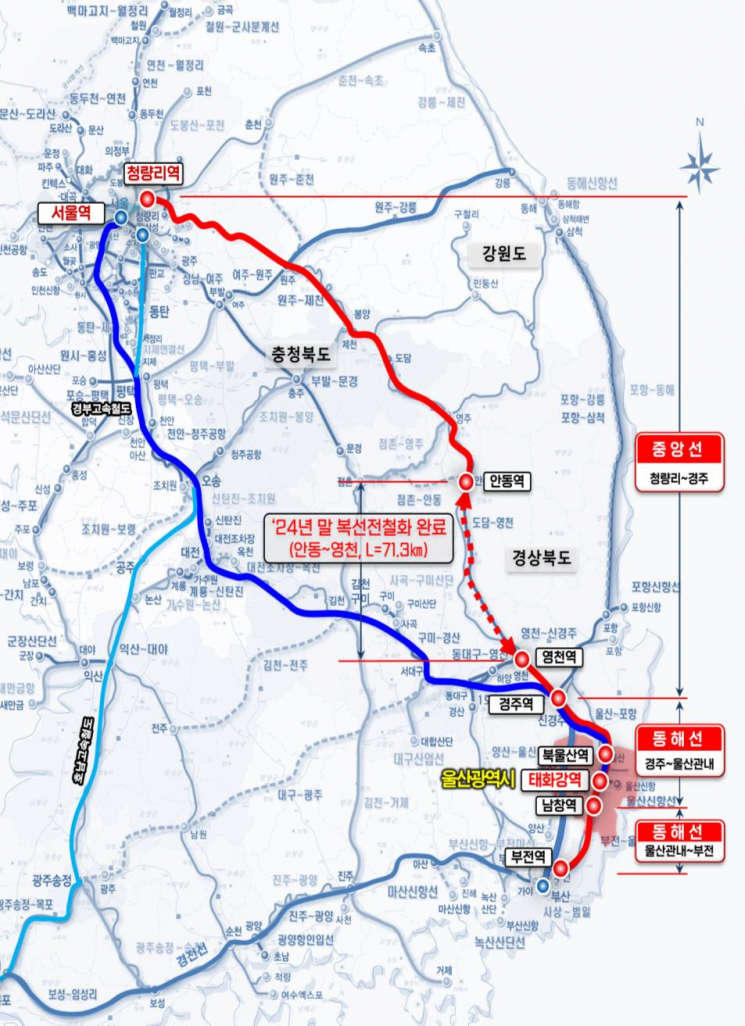
First, to build urban rail and metropolitan railway networks, the city will promote ▲the world’s first hydrogen tram Line 1 and Line 2 construction ▲Ulsan metropolitan railway (Ulsan?Yangsan?Busan, Southeast region loop) construction ▲increasing KTX-Eum services and promoting new stops for KTX-Sancheon ▲and improvement projects for transfer systems at Buk-Ulsan Station.
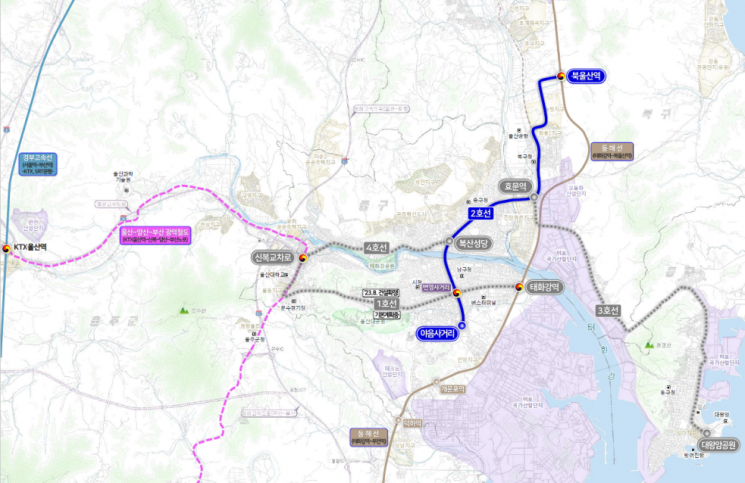
Tram Line 1 (Taehwagang Station?Sinbok Intersection, 11 km) aims to open in January 2029, with basic and detailed designs completed, and Line 2 (Buk-Ulsan Station?Yaeum Intersection, 13 km) is being promoted to be selected as a project subject to the Ministry of Economy and Finance’s preliminary feasibility study.
Additionally, the Ulsan?Yangsan?Busan metropolitan railway will complete its preliminary feasibility study in the first half of the year, and the Southeast region loop metropolitan railway will actively respond to pass the preliminary feasibility study.
Along with this, efforts to open a new transportation era will continue, such as increasing the frequency of the KTX-Eum service at Taehwagang Station (opened in December last year) from 3 round trips to 9, conducting a feasibility study for KTX-Sancheon stops, and completing the Buk-Ulsan Station transfer system improvement project (installation of pedestrian overpasses and other transfer facilities) by March.
Second, to revitalize the airport, the city will promote ▲the role of the airport supporting the Asia-Pacific Economic Cooperation (APEC) summit and increasing domestic flights ▲launching international irregular routes during the Ulsan Industrial Festival ▲and attracting the Ulsan city airport terminal.
For the convenience of participants attending the APEC summit held in Gyeongju at the end of October this year, a new Incheon↔Ulsan route will be launched, and irregular direct flights will be established for overseas sister and friendly cities invited to the Ulsan Industrial Festival.
To improve accessibility to the Gadukdo New Airport, scheduled to open in December 2029, the city plans to promote feasibility studies for attracting the Ulsan city airport terminal (boarding procedures, baggage check-in, etc.) to further solidify its status as a global industrial capital.
Third, to support transportation costs and expand mobility rights for transportation-vulnerable groups, the city will implement ▲the U-Pass tailored to Ulsan’s public transportation cost support project ▲free city bus fares for seniors ▲and taxi mobility support using vouchers for pregnant women, infants, and the elderly.
In the second half of this year, the Ulsan-type U-Pass, linked and expanded with the K-Pass, will be implemented, offering unlimited transportation cost support, full refunds for low-income groups, and expanding youth age eligibility to 39 years old. Free city bus fares for seniors aged 75 and older will also be implemented to provide customized transportation services by class and age.
Additionally, from February, the voucher taxi service will expand its target users to include pregnant women, infants, and seniors aged 85 and older, increasing the number of vehicles in operation to strengthen mobility rights and support for transportation-vulnerable groups.
Finally, to improve transportation convenience, the city will promote ▲stabilization of bus route reorganization ▲expansion of intelligent (smart) shelter-type bus stops ▲expansion of the next-generation intelligent transportation system (C-ITS) ▲construction of large-scale public parking lots (Pyeongchang, Dongpyeong, etc.) and expansion of ‘wallet-free parking’ ▲and establishment of family-friendly exclusive parking spaces.
To minimize inconvenience caused by the full-scale reorganization of city bus routes, a route reorganization monitoring project will be conducted by May, and adjustments will be made based on the results after June.
Forty additional ‘intelligent (smart) shelter-type bus stops’ equipped with various convenience facilities will be installed by next year to provide waiting and transfer convenience for passengers.
The next-generation intelligent transportation system (C-ITS) will be expanded to provide real-time traffic information via navigation systems, a large-scale public parking lot will be constructed in the Nam-gu area, a commercial district, and the ‘wallet-free parking’ system, an automatic parking fee payment system, will be expanded.
Moreover, family-friendly exclusive parking spaces will be newly established and operated for vehicles carrying three generations of a family or pregnant women and infants, building and expanding a system to improve parking environments and enhance transportation convenience.
An official from Ulsan City said, “We will solidly promote major transportation projects for 2025 to minimize citizen inconvenience and enhance convenience, thereby creating a transportation environment that adds convenience to citizens’ daily lives.”
© The Asia Business Daily(www.asiae.co.kr). All rights reserved.
![Clutching a Stolen Dior Bag, Saying "I Hate Being Poor but Real"... The Grotesque Con of a "Human Knockoff" [Slate]](https://cwcontent.asiae.co.kr/asiaresize/183/2026021902243444107_1771435474.jpg)

















