Local Government Targets Lay Foundation for Central Government Goals
5 Percent Growth Target Likely to Be Announced at National Sessions in March
However, IMF Forecasts 4.5 Percent Growth... Significant Gap Remains
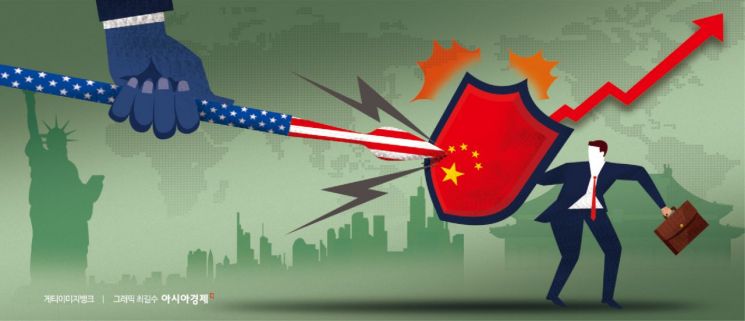
Local governments in China have set economic growth targets of over 5% for this year. This contrasts with the International Monetary Fund (IMF) and President Donald Trump's re-election prospects, which have projected China's growth rate at 4.5% for this year.
According to Shanghai You Newspaper on the 15th, Shanghai announced a target of approximately 5% GDP growth for this year during the work report at the 3rd session of the 16th People's Congress held that day. Shanghai is China's economic capital. The Shanghai Legoland, expected to open around this summer, is a key project for this year. Shanghai stated that last year's GDP likely increased by about 5%, marking a new stage where the city's total economic scale exceeded 5 trillion yuan (approximately 994 trillion won).
Guangdong Province also set a target expecting about a 5% increase compared to the previous year. Guangdong cited the economy's basic stability and the complete clearance of existing hidden debts as pillars for economic stability and long-term development. Beijing also set its economic growth target at about 5% the day before.
Southeastern Fujian Province forecasted a growth rate of 5 to 5.5% this year. Nanjing, the capital of Jiangsu Province, announced last weekend that it expects this year's growth rate to reach about 5%, higher than last year's estimated growth rate of 4.5%. Zhejiang Province set a target of 5.5%, the same as last year's predicted growth rate. Tianjin, one of the four centrally administered municipalities, which conservatively estimated last year's growth rate at 4.7%, set a 5% growth target, and Wuxi and Changzhou also announced targets exceeding 5% respectively.
Local governments announce their annual economic growth targets during their own annual sessions (People's Congress and Chinese People's Political Consultative Conference) held in January and February, which serve as the foundation for the central government's economic growth target announcement. For this reason, major Chinese media including the Hong Kong South China Morning Post analyze that China is likely to present a growth target around 5%, similar to last year, at the upcoming national annual sessions in March.
However, China's growth targets differ from the expectations of international organizations. The IMF predicted a 4.5% growth this year, citing reasons such as the real estate slump, weak consumption, and the prospect of a hardline policy under Trump's re-election.
China will announce last year's GDP growth rate on the 17th.
© The Asia Business Daily(www.asiae.co.kr). All rights reserved.
![Clutching a Stolen Dior Bag, Saying "I Hate Being Poor but Real"... The Grotesque Con of a "Human Knockoff" [Slate]](https://cwcontent.asiae.co.kr/asiaresize/183/2026021902243444107_1771435474.jpg)
















